

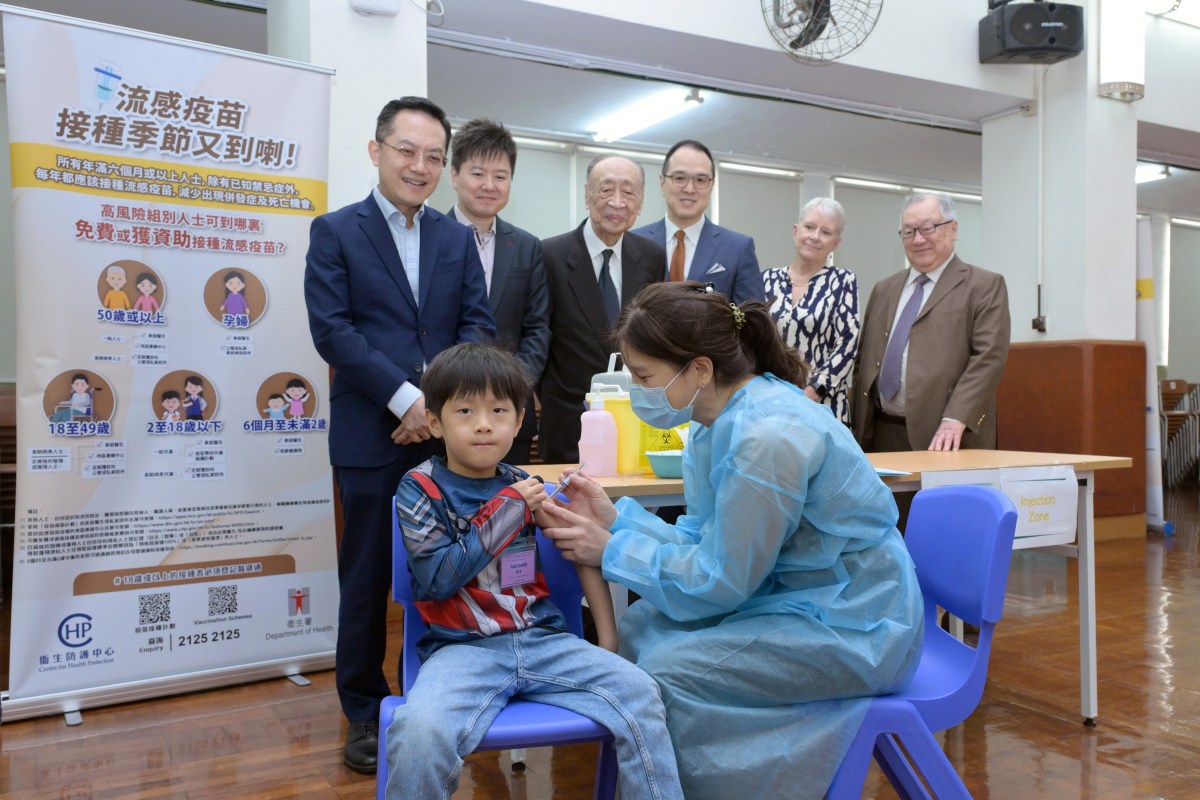
Hong Kong’s health authorities have cautioned against altering children's vaccination schedules arbitrarily without reliable scientific data or medical research support, warning that doing so poses severe and irreversible health risks to children.
Emphasizing that all public health policies and medical recommendations must be based on scientific evidence, the Department of Health’s Centre for Health Protection (CHP) reminded parents on Tuesday to ensure their children receive timely vaccinations under the Hong Kong Childhood Immunisation Programme (HKCIP).
Responding to media enquiries regarding the HKCIP, the CHP said in a statement that delaying vaccinations reduces protection against relevant infectious diseases.
Hong Kong implemented the HKCIP in the 1960s, providing immunization services to children through the DH's Maternal and Child Health Centres and School Immunisation Teams.
Currently, infants from birth to students of Primary Six should receive multiple vaccines and booster doses under the HKCIP to prevent tuberculosis, poliomyelitis, hepatitis B, diphtheria, pertussis, tetanus, pneumococcal infection, chickenpox, measles, mumps and rubella.
The HKCIP also provides the human papillomavirus vaccinations to eligible Primary schoolgirls to prevent cervical cancer. The special administrative region government also provides vaccination services to high-risk groups against seasonal influenza, pneumococcal infection and COVID-19 infection.
RELATED ARTICLES
- CHP: 7-year-old boy dies after severe flu infection
- HK expands flu jab coverage after record uptake
- HK urges flu shots for kids after 14-year-old develops severe infection
- How healthy are Hong Kong people?
Highlighting that Hong Kong’s high vaccination coverage has successfully kept childhood infectious diseases at extremely low levels, CHP Controller Edwin Tsui Lok-kin said recommendations for the program are made from a public health perspective by the CHP’s Scientific Committee on Vaccine Preventable Diseases.
“With the help of vaccines, smallpox was eradicated globally in 1980, and poliomyelitis was eliminated in Hong Kong in 2000. Measles and rubella were successfully eliminated in Hong Kong in 2016 and 2021, respectively,” he said.
Under the HKCIP, children receive the combined measles, mumps and rubella (MMR) vaccine at 12 months, followed by the measles, mumps, rubella and varicella (MMRV) vaccine at 18 months.
Due to consistently high vaccine uptake, imported measles cases over the past two years have not caused significant local transmission, allowing Hong Kong to maintain its measles-eliminated status, the CHP said.
The city’s hepatitis B vaccination coverage among pre-school children stands at 99 percent, while the prevalence of the disease among individuals born after the introduction of the universal childhood hepatitis B immunization program in 1988 has dropped below 1 percent, it added.
The CHP call came the same day as the World Health Organization defended the science-based process used to determine childhood immunization schedules after US President Donald Trump signed an executive order aimed at reducing the number of recommended childhood vaccinations and splitting the MMR shots in the country.
The order advances a long-standing objective of US Health Secretary Robert F Kennedy Jr., who has questioned vaccine safety and promoted claims linking vaccines to autism even though scientific studies and public health authorities have found no evidence of a link.
WHO spokesperson Tarik Jašarević told a press briefing in Geneva that vaccination recommendations were based on more than 60 years of research by WHO, national authorities and independent expert groups. The timing of individual vaccines was determined through extensive scientific review of when people were most vulnerable to particular diseases and the development of the immune system, Jašarević added.
E-consent for school jabs
The CHP also announced on Tuesday that the 2026-27 Seasonal Influenza Vaccination School Outreach Programme will introduce a new electronic consent form feature. Beginning on Monday, parents can use the eHealth mobile application to submit an e-consent form for their children to receive seasonal influenza vaccinations (SIV) under the program.
The introduction of the new e-consent form will reduce the time parents need to fill out the form, the center said in a separate statement.
The e-consent form has four main benefits – simplifying the form-filling process for parents, reducing schools' administrative work, reducing healthcare providers' administrative work and advancing vaccination activities.
Starting Wednesday, participating schools will receive school-specific QR codes for distribution to parents. The QR codes will take effect on Monday. By then, parents can start filling out the e-consent forms for their children, the CHP said, adding that details of the 2026-27 SIV program arrangements, such as eligible groups and vaccination venues, will be announced in due course.
With Reuters input
