

For almost four decades, the Zheng He has served as an operational classroom and floating instrument of China's maritime diplomacy
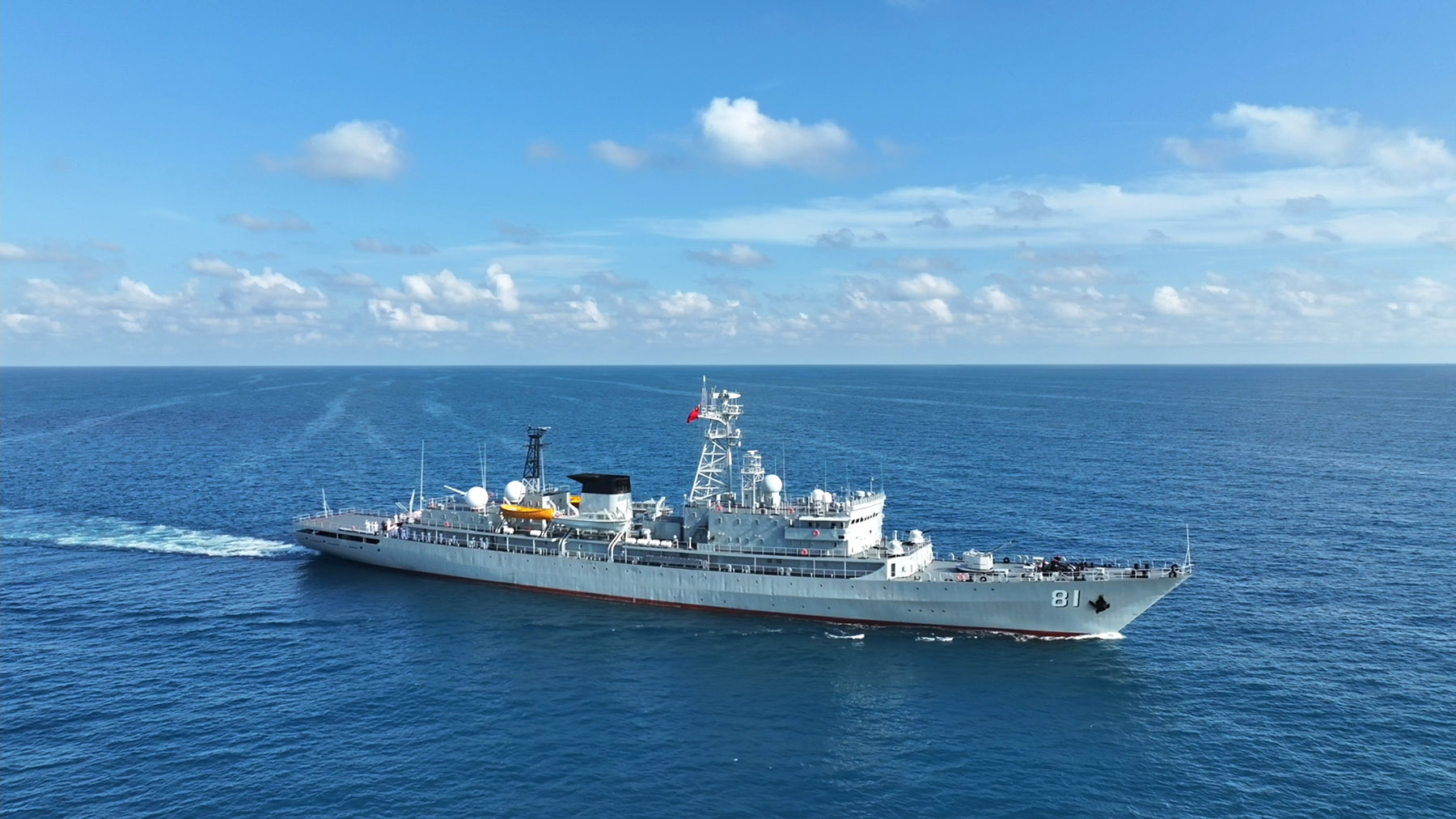
As the sun sets at a naval port in Dalian, Northeast China's Liaoning province, the massive hull number "81" gleams along the side of the Zheng He, an oceangoing vessel operated by the People's Liberation Army Dalian Naval Academy.
The number "81" is no ordinary designation. It serves as a direct tribute to Aug 1, 1927 — the date of the Nanchang Uprising that marked the founding of the PLA. Commissioned in 1987 as China's first purpose-built, indigenously designed Type 679 training ship, the 132-meter-long, 5,000-metric-ton vessel serves as the operational crucible for China's modernizing surface fleet.
The ship belongs to the Dalian Naval Academy — established in 1949 as the PLA's first formal naval school and widely regarded as the nation's premier training ground for surface warship commanders. While the Zheng He is primarily dedicated to the at-sea practice of officer midshipmen, its mission extends well beyond officer candidates. With 18 living quarters and four activity areas, the ship accommodates up to about 200 cadets at a time, providing hands-on operational experience for enlisted technicians, non-commissioned officers and junior midshipmen alike.
READ MORE: PLA Navy flotilla departs on far-seas training mission
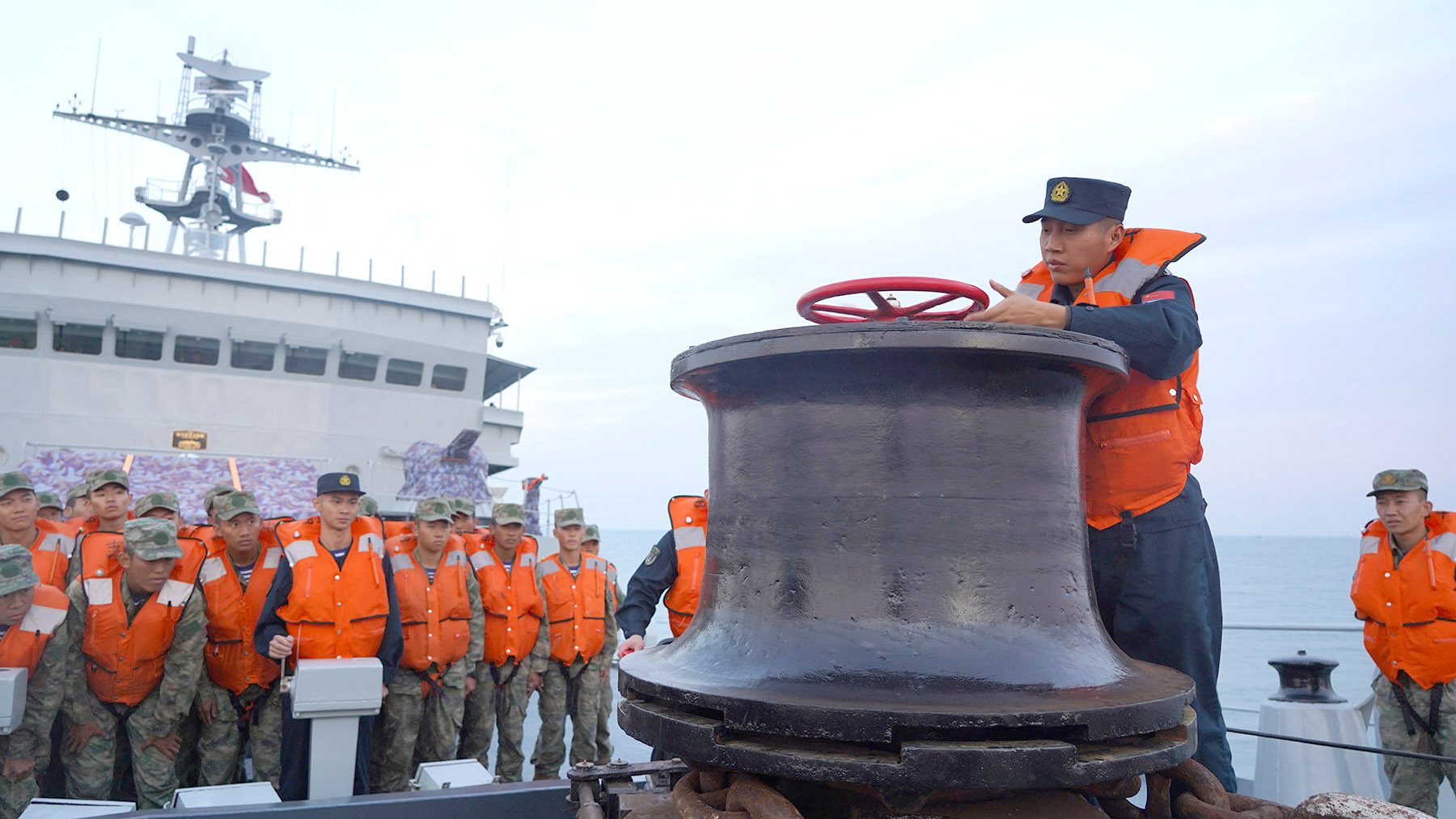
In recent days, Zheng He deck officer Zhang Zecong was tasked with organizing teaching models and equipment in preparation for the arrival of a new cohort of cadets. Now in his sixth year aboard the Zheng He, Zhang carries out his duties with precision.
"I heard plenty about the Zheng He's illustrious history when I was a cadet at Dalian Naval Academy," Zhang said. "It fills me with pride to carry on this ship's fine traditions and contribute to nurturing talent for the PLA Navy."
Named after the legendary Ming Dynasty (1368-1644) imperial envoy who commanded China's 15th-century treasure fleets, the Zheng He has earned the moniker "talent carrier" for the PLA Navy. Over nearly four decades of service, it has delivered more than 50,000 military professionals. Two out of every three active-duty surface warship commanding officers in the PLA Navy have completed at-sea training aboard its decks, as have more than half of all flag officers and senior fleet commanders.
In addition to its domestic training role, the vessel functions as an instrument of naval diplomacy. The ship has sailed beyond national waters 16 times, traversing all three major oceans and visiting 29 countries and regions across six continents. Its cumulative log exceeds 600,000 nautical miles — equivalent to 27 complete circumnavigations of the globe. Cited as an "Advanced Unit of the PLA" in 2012 and awarded the title "Meritorious Training Ship" in 2015, it holds a unique position in China's maritime development.
From cadet to instructor
For Zhang, the bond with the vessel began in the summer of 2018 during his sophomore year at the academy, when he embarked on a monthlong navigation exercise.
"We encountered a succession of typhoons, and for over 10 days we couldn't make port. Giant waves battered the ship, and my stomach churned," he recalled. "But after that experience, I never got seasick again, and I no longer fear rough seas."
What proved even more transformative was watching the crew maintain composure under pressure. Upon graduation in 2020, Zhang requested and received an assignment back to the Zheng He. The transition from trainee to trainer brought a sharp learning curve.
When his first group of cadets came aboard, he tried to pour everything he knew into them, repeating explanations and demonstrations endlessly. But he soon realized that the deluge of information overwhelmed them.
"Over time, I came to understand that teaching isn't about cramming — it's about guiding. You have to progress step by step and tailor your approach to each cadet's ability," he said.
Today, Zhang has evolved into what the PLA Navy terms a "four-in-one" professional: capable of serving simultaneously as a crew member, instructor, combatant and tactical commander.
Passing the torch
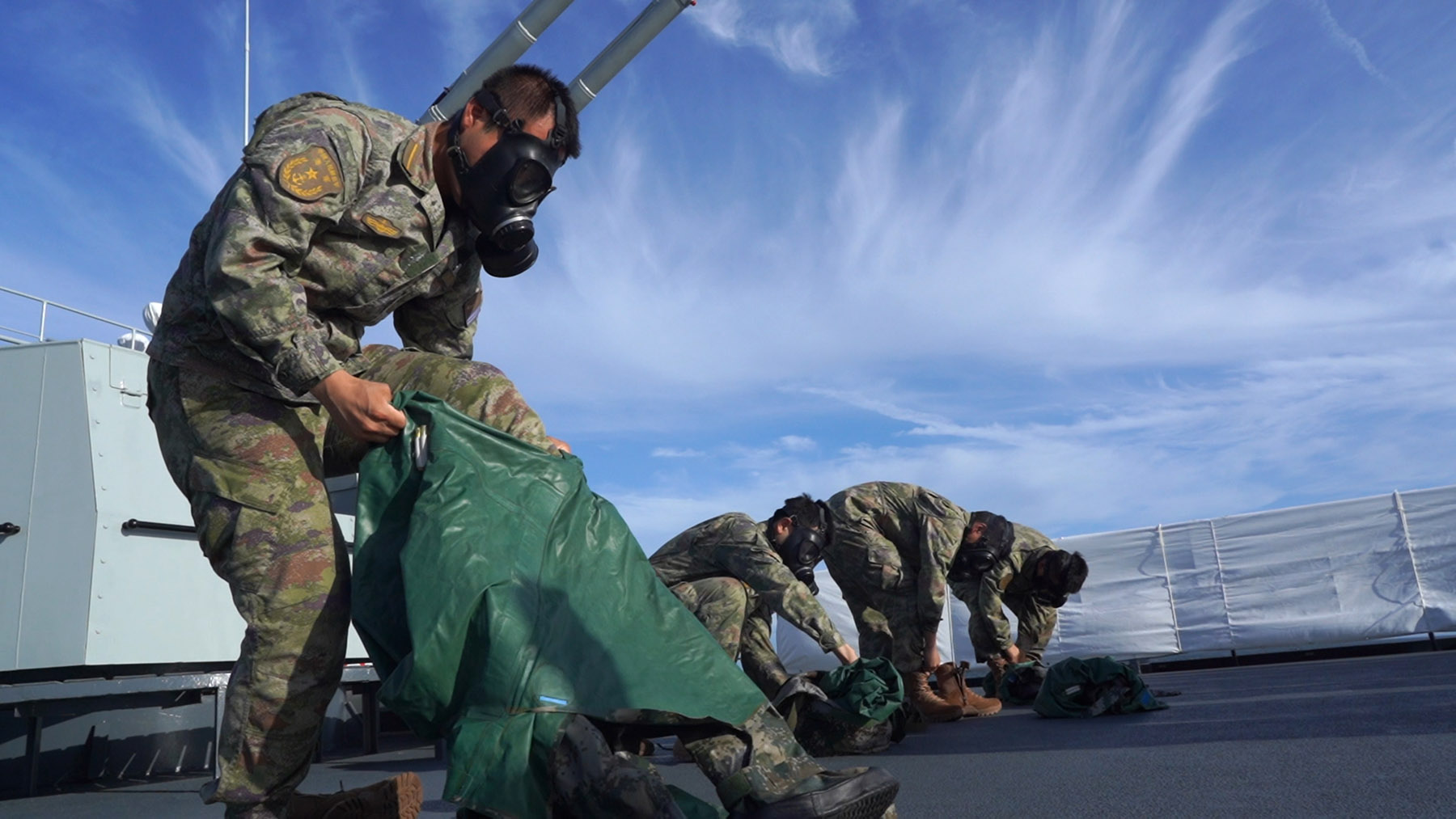
Every member of the Zheng He's crew doubles as an educator. Navigation officer Wu Jiahui maintains 17 distinct lesson plans on her workstation, tailoring instructional modules for specific specialties and mission profiles. Rather than drilling formulaic exercises, she forces cadets to evaluate dynamic operational hazards.
"You have to actively engage and guide cadets to think," she said. "They will become combatants and commanders one day, and they must rely on their own exploration and creativity."
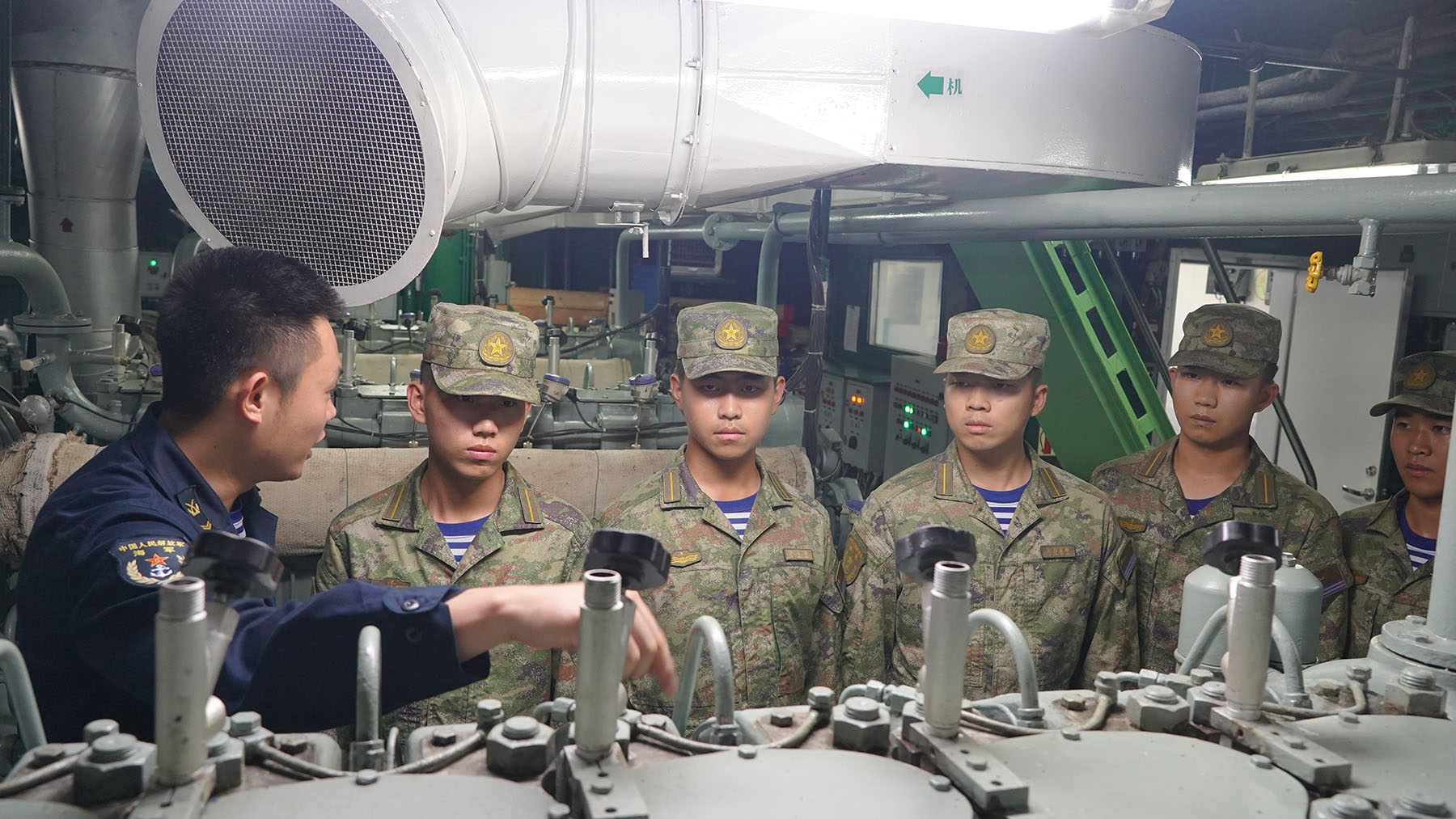
Elsewhere on the ship, navigation officer Gao Siyu leads cadets through every compartment to help them memorize equipment layouts, having them draw dozens of detailed piping diagrams by hand. Down in the heat and engine noise, engineering officer Li Hui provides hands-on instruction in machinery diagnostics and emergency repairs.
In the ship's honor room, new arrivals gather to memorize the dying words of the ship's first commanding officer, Feng Zuanshu: "The ship obeys my commands; I obey the Party's commands — guard the seas and defend the motherland!"
Cadet Deng Yuyang said: "The Zheng He is a warship with tradition and heritage. I must carry forward and build on that proud legacy."
Technology forward
While the vessel's hull has aged, its internal training infrastructure has undergone constant modernization. Responding to past criticisms that an aging auxiliary ship could not replicate modern combat systems, electrical engineering officer Cheng Bo spent three months fabricating a custom electrical control system model out of discarded components.
Thanks to this new teaching aid, cadets can quickly grasp abstract electrical principles.
"By leveraging technology to break through teaching bottlenecks and moving beyond the limitations of traditional practical training, we ensure that every extra effort we put into instructional support translates into fewer difficulties for our cadets in the future," Cheng said.
In recent years, the ship's classrooms have been upgraded with digital modeling, virtual war-gaming and high-fidelity ship-handling simulators. Trainees now run command drills and situational briefings in replicated sea conditions, learning operational plotting and real-time threat analysis before ever taking command of a front-line destroyer or frigate.
Lin Qiuming, an officer from a unit in Zhoushan, Zhejiang province, who trained aboard the Zheng He three years ago, was impressed during a recent return visit by the new ship-handling simulator, a system that replicates control equipment and complex sea environments.
Free from the constraints of weather or range, it allows trainees to conduct command drills and post-training reviews at any time.
"Back then, I could only watch without hands-on practice, so I never felt fully confident. Now, with intelligent equipment for repeated drills, training efficiency and quality have improved dramatically," Lin said.
To hone targeted skills, navigation officer Li Yiming and his team have meticulously designed training "menus" organized by specialty, offering flexible observation and training stops to help cadets quickly familiarize themselves with navigation operations.
Working with other vessels in a flotilla, Li compiled a video database of 119 model training positions across eight categories, including navigation, gunnery, communications and engineering.
During a recent main-engine failure simulation, engineering officer Gu Bin demonstrated why technical mastery alone is insufficient for future commanders. When a cadet asked why engine technicians needed to study fleet tactics while fixing a drive shaft, Gu offered a broader perspective.
"Repair work is not purely technical. It requires contextual decision-making. Sometimes, abandoning a compartment may be the best choice for the overall mission," Gu said. "In the future, you will be responsible for a warship, a formation, a fleet. If your perspective is too narrow, you cannot be a qualified commander."
Floating national territory
In the ship's honor room, a display wall features naval crests from 14 foreign nations, highlighting its role as an ambassador for China's maritime posture. During overseas visits — from Australia to New Zealand and Indonesia — the ship acts as a sovereign outpost, often welcoming overseas Chinese communities and conducting military diplomacy.
Navigation officer Wu often uses this space as the main venue for her ship history lectures, broadcasting live to three classrooms of cadets. The Zheng He's "diplomatic resume" — 16 overseas voyages visiting 29 countries and regions — remains an indispensable topic.
Wu recounted the ship's visit to Australia, saying going abroad teaches self-reflection, not mere admiration of others.
During that visit, she and other representatives from the Zheng He toured an Australian amphibious assault ship, which opened its joint operations center to Chinese visitors.
ALSO READ: China successfully tests nuclear-capable missile
Zhang Zhiyou, an instructor from the academy in Dalian, said: "Overseas visits expand our horizons and also showcase the PLA's image to the world. Our Navy personnel are diplomats in uniform, and we have a duty to tell China's story and amplify China's voice."
During a visit to Indonesia amid local unrest, the ship's interim Party committee decided not only to keep the ship open to visitors as planned but to extend visiting hours and expand reception capacity. One overseas Chinese resident from Jakarta said that seeing the ship from the motherland greatly relieved his anxiety.
In New Zealand, an 80-year-old Chinese expatriate handed out homemade pastries daily to the ship's crew, clasping their hands and saying that seeing them made him see the hope of the motherland.
"Truly, Chinese expatriates living far from home travel great distances to attend our ship's open days, just to set foot on this 'floating national territory', to see their own military personnel and to hear the familiar accent of home," said Wu.
The veteran training ship is preparing once again to slip its moorings, carrying a new class of midshipmen out into open waters.
Wang Zhao contributed to this story.
Contact the writers at zhangxiaomin@chinadaily.com.cn
