

Xi's long-term view for Ningxia partnership plan helped turn area into land of prosperity
Even today, Hai Guobao still vividly remembers the moment his family first stepped into their new home in Minning township more than a decade ago.
The family moved into a house in the new settlement near the Helan Mountains in the Ningxia Hui autonomous region, where rows of brick homes and broad, paved roads stood in sharp contrast to the rugged mountain villages they had left behind.
After the long journey from Xihaigu, long known as one of China's harshest environments for human settlement, his family paused at the doorway before doing anything else.
Inside, they tested the most basic features first: a switch on the wall, then a tap in the kitchen. A light came on. Water flowed immediately. "We could never have imagined it even in our dreams," Hai recalled. "It was the first time we were leaving our home in Xihaigu for good. Many of us shed tears — both out of sadness and hope."
For his family, that moment marked the end of a way of life defined by scarcity. In Xihaigu, drinking water seeped through cracks in the rocks and had to be carried long distances back to villages scattered across steep hillsides. Droughts frequently brought crop failures, trapping generations of families in a cycle of hardship.
READ MORE: Xi calls for more coordination of regional growth
Hai's journey to Minning was part of a vision first set in motion nearly three decades earlier. In 1996, Fujian province and Ningxia were paired under a national poverty-reduction initiative designed to channel resources, investment and expertise from China's more developed eastern coast to its less developed western interior.
Xi Jinping, then deputy secretary of the Communist Party of China Fujian Provincial Committee, played a leading role in advancing the cooperation mechanism.
During a research trip to Ningxia in April 1997, Xi visited a relocation site in Xiji county, where he proposed building what would become Minning township. He called for pooling resources and investment to create a model of Fujian-Ningxia cooperation, whereby relocated residents could move out of the mountains, settle down and build prosperous lives.
At a Fujian-Ningxia poverty alleviation coordination meeting in 1998, Xi stressed that the partnership should focus on meeting the basic needs of poor residents.
In the years that followed, he continued to advocate expanding cooperation, innovating assistance mechanisms and broadening participation, laying the groundwork for a partnership that evolved from poverty relief to long-term regional development.
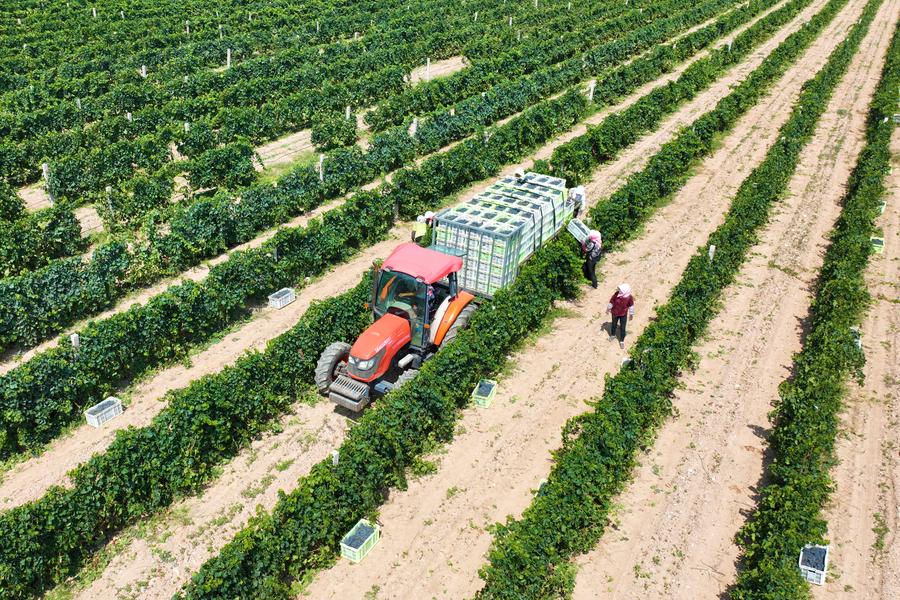
The idea gradually took shape at the foot of the Helan Mountains. Successive waves of migrants left Xihaigu for Minning, where irrigation from the Yellow River turned arid land into farmland and where new roads, schools, clinics and homes replaced the barren landscape.
Over the past three decades, Fujian has provided 7.68 billion yuan ($1.14 billion) in assistance funding for infrastructure projects in Ningxia's formerly impoverished areas and encouraged more than 1,600 enterprises to invest in the region, bringing over 100 billion yuan in actual investment.
The impact has been profound. According to Wang Jian, head of Ningxia's regional department of agriculture and rural affairs, all 803,000 rural residents who once lived below the poverty line in the region have been lifted out of poverty. Xihaigu has shed its long-standing reputation for extreme hardship, while 1.13 million people have gained access to safe drinking water.
Annual per capita disposable income for rural residents in Ningxia has risen from about 1,400 yuan in 1996 to more than 20,000 yuan in 2025.
Minning's evolution continues to influence China's broader development agenda.
In an instruction published on June 17, President Xi Jinping, who is also general secretary of the Communist Party of China Central Committee, called for further improving the country's east-west collaboration mechanism and urged officials to draw on the experience of Fujian-Ningxia cooperation.
He said the model had played an important role in poverty alleviation and coordinated regional development over the past three decades, calling for deeper industrial cooperation, personnel exchanges and technological collaboration while advancing rural vitalization and common prosperity.
For a younger generation, Minning represents something very different from the place their parents first encountered.
Wu Juan, a university graduate and online content creator whose family relocated from Xihaigu when she was a child, the contrast between her early memories and life today could hardly be greater.
"Before I was seven, our staple food was always potatoes," she said. "I'm not exaggerating when I say there are many kinds of fruit that I had never even seen."
Water was so scarce that bathing was a luxury, she recalled.
Today, she sees a different future.
"If we hadn't moved out of the mountains, we would still be scraping out a living from the land. But here, I feel there are infinite possibilities ahead," Wu said.
She said Xi's vision has over the past three decades been turned into reality, step by step, through China's ability to mobilize resources for major undertakings and the joint efforts of the people.
For Zhao Chao, head of Minning township, those opportunities are the result of decades of planning and sustained commitment.
"Over the past 30 years, we have witnessed General Secretary Xi's vision of turning a 'sandy land' into a 'land of prosperity' gradually becoming a reality," he said.
According to Zhao, the relocation strategy fundamentally addressed the dilemma that had defined Xihaigu for generations — local conditions could no longer sustain the population.
"The development of Minning did not emerge out of thin air," he said. "It reflects a deep understanding of poverty alleviation, ecological restoration and industrial development."
Today, every village in the township has developed its own industries. Residents can find jobs close to home. Children attend nearby schools, while elderly residents have access to medical services without traveling long distances.
"What stands out most," Zhao said, "is the people's sense of security and confidence in the future."
That confidence is increasingly being reinforced by a new chapter in Fujian-Ningxia cooperation.
Having helped transform Minning from a poverty-relief resettlement site into a thriving community, the partnership is now turning its focus toward high-quality development, with green energy and the digital economy emerging as new engines of growth.
Ningxia has become one of China's fastest-growing renewable energy bases, thanks to its abundant wind and solar resources, competitive electricity prices and favorable natural conditions.
According to regional government statistics, renewable energy capacity expanded 17 percent on average annually between 2021 and 2025, reaching 57.32 million kilowatts and accounting for 63 percent of the region's total installed power capacity.
By 2030, the region's renewable energy capacity is expected to exceed 100 million kilowatts, representing about 70 percent of its installed power capacity.
ALSO READ: China to expand East-West program
Against that backdrop, a growing number of sci-tech companies from Fujian and elsewhere are expanding their presence in Ningxia to boost their computing power resources.
Li Yuanyuan, vice-president of Xiamen Kehua Digital Energy Tech Co, said the company chose to invest in Minning because of both national development priorities and Ningxia's long-term market potential.
The region's transportation network also allows companies operating in Ningxia to serve markets across Shaanxi, Gansu and Qinghai provinces and the Xinjiang Uygur and Inner Mongolia autonomous regions.
"We hope to take root here for the long term and help Minning develop green industries, create stable employment and build a sustainable industrial base that will benefit generations to come," Li said.
"Our goal is to help transform what was once a sandy land into a digital golden land."
Contact the writers at xuwei@chinadaily.com.cn
