

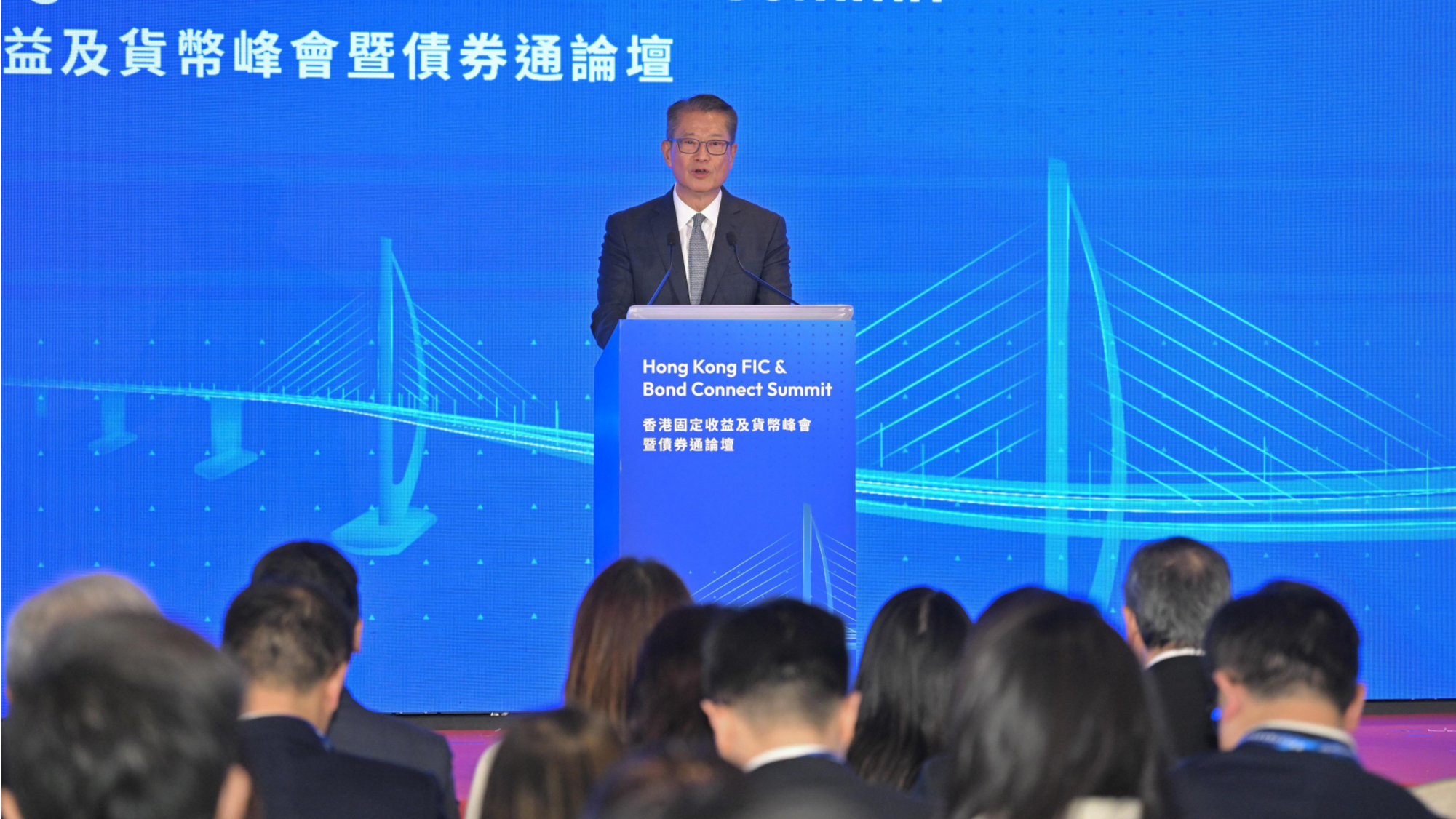
Hong Kong’s launch of the Bond Connect, the Swap Connect and treasury bond futures has created a closed-loop risk management system between the spot and futures markets, enabling overseas investors to trade in renminbi treasury bonds in the offshore market more efficiently and conveniently, with the city playing a key role in the process, the city’s Financial Secretary Paul Chan Mo-po said in his Sunday blog.
Hong Kong Exchanges and Clearing, which runs the city’s bourse, rolled out five-year China Government Bond Futures on Monday — the only futures product in the offshore market allowing international investors to hedge renminbi interest-rate risks.
Global investors can use their existing trading accounts and processes in the special administrative region to complete the trading and settlement of relevant contracts in the offshore market.
“This marks a new milestone in Hong Kong’s development as an offshore renminbi business hub. It enriches the renminbi risk management tools available in the local market, signifying the deeper growth of government bonds in the offshore market and the orderly advancement of renminbi internationalization,” Chan said.
ALSO READ: Chan: HK to broaden investor access channels
The Bond Connect, launched in 2017, enables overseas investors to participate in the mainland bond market through the program’s northbound trading. Southbound trading was subsequently introduced, allowing two-way trading.
The Swap Connect kicked off in 2023, with investors conducting interest-rate hedging for their Chinese mainland government bond holdings. The listing of government bond futures offers a standardized, exchange-traded and liquid offshore hedging tool for investors holding government bonds.
“The offshore renminbi market’s development is based on the country’s continued strengthening of its economic power and sound economic and monetary policies. Deepening world economic and trade cooperation will inevitably give rise to more renminbi usage scenarios — from trade settlement to investment pricing, and from asset allocation to central bank reserves,” Chan said.
“The deepening development of renminbi internationalization requires the support of a comprehensive and efficient offshore market,” he added.
The Bond Connect has long been the main channel for overseas investors to access the mainland bond market, accounting for about two-thirds of the total trading volume. According to the finance chief, the scale of Chinese bonds held by overseas investors through this channel exceeded 3 trillion yuan ($444.3 billion) by end-June — having almost tripled from 800 billion yuan by the end of 2017.
The issuance volume of dim sum bonds has surpassed 1 trillion yuan in the past two years, with outstanding bonds eclipsing 1.6 trillion yuan, while the monthly settlement volume of the interbank settlement system is nearing the 48-trillion-yuan mark.
Chan said the SAR is accelerating the development of an international gold trading center and a commodity trading ecosystem to support the launch of more renminbi-denominated products.
He called Hong Kong a hub for “two-way allocation and two-way risk management”, providing northbound bond allocation and interest-rate hedging, to offshore financing and clearing, as well as renminbi-denominated trade settlement.
“We will continue to leverage our role as a link between the mainland and global markets, actively promote the smooth, stable and in-depth development of the offshore renminbi market, and consolidate and optimize Hong Kong’s function and status as the world’s largest offshore renminbi business hub,” he said.
READ MORE: Hong Kong seeks to strengthen bond market
On Hong Kong’s economic performance, Chan said the government has revised upward its economic growth forecast for 2026, to be released in mid-August.
“Hong Kong’s economy grew 5.1 percent in the first half of this year — stronger than expected. Merchandise exports in the second half are expected to continue benefitting from strong global demand for artificial intelligence products. Overseas demand for Hong Kong’s financial and business services and an increase in visitor numbers will drive service exports, boosting local consumption and investment,” he said.
However, Hong Kong must not be complacent. “Future trends will still be affected by geopolitical developments, interest rates in the United States, and other uncertainties. We will continue to remain highly vigilant, vigorously accelerating economic development while safeguarding economic and financial security,” Chan added.
In the capital market, the Hang Seng Index had risen 13 percent, or about 3,000 points, by July this year, marking its largest monthly gain in nearly two years. Average daily turnover remained above HK$300 billion ($38.4 billion) for the second consecutive month.
In the first seven months of this year, funds raised in Hong Kong’s initial public offering market exceeded the total amount raised in the whole of 2015 by 13 percent, while post-listing refinancing rose more than 20 percent year-on-year.
Contact the writers at oswald@chinadailyhk.com
