

Early kickoffs lead fans in Jiangsu to turn their backs on beer and barbecue, instead choosing to watch games accompanied by traditional morning tea
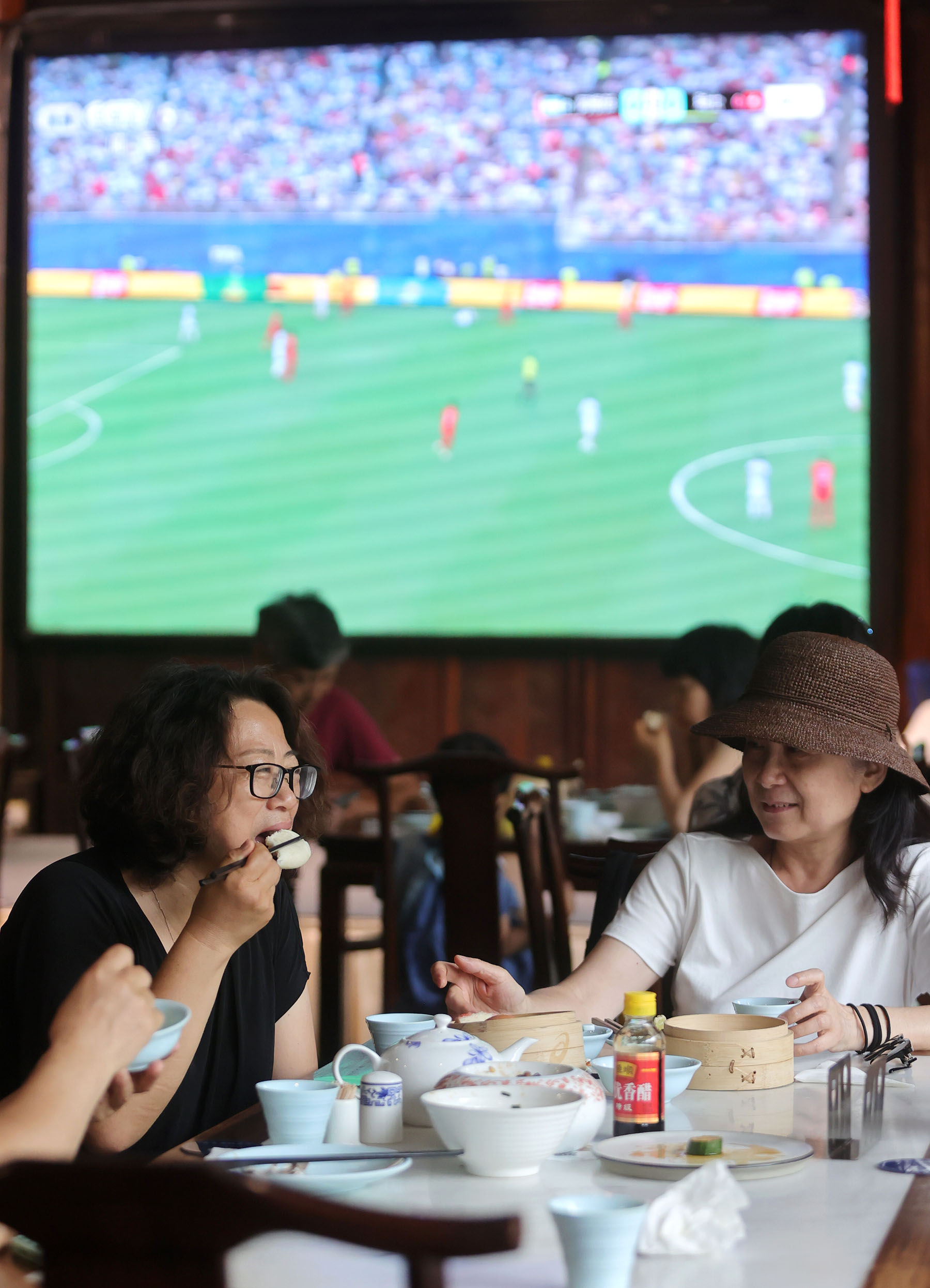
A unique scene has unfolded in Yangzhou in East China's Jiangsu province over the past month during the World Cup, which is heading toward its thrilling finale. Normally serene teahouses, filled with the aroma of freshly steamed delicacies, are now abuzz with the cheers — and occasional tears — of soccer fans watching the early-morning matches.
Unlike previous tournaments, when late-night games often came with barbecue and beer, the time difference for this year's tournament has resulted in a different type of hydration break — one that's going down well with the city's soccer fans.
Fans have chosen to enjoy the early kickoffs over a traditional morning tea — sipping on the ancient infusion, munching on local delicacies and celebrating the tournament's spectacular goals.
READ MORE: Lively atmosphere gives prominence to beer in Qingdao
"Watching the World Cup while having morning tea is a very different experience," said soccer fan Han Xiao. "It allows us to appreciate Yangzhou's tea culture while still getting to watch the games. It is a refreshing way to enjoy the tournament."
A fan of the Scotland team, Han was excited when Scotland scored against Haiti in its group stage opener. "I was pleased with the result," he said following the 1-0 win.
At Yechun, one of Yangzhou's most renowned teahouses, staff members have adjusted their schedules during the tournament, switching on large screens for customers whenever there are morning matches. For some popular games, the teahouse even opens earlier to accommodate fans.
"Most World Cup matches in the past were held at night, so fewer people would get up early to watch them," said Hong Jing, deputy general manager of Yechun Catering Co. "This year, many matches take place in the morning, which gave us the idea of combining soccer with Yangzhou morning tea."
The teahouse has launched special World Cup breakfast packages, allowing groups of fans to watch games while enjoying traditional dishes.
Inside the teahouse, soccer-themed decorations adorn the traditional interior, and while the world's top players battle it out on the big screens, servers skip between tables carrying steaming baskets of dim sum.
For Yangzhou residents, morning tea is far more than a meal. It is a long-established ritual that reflects the city's relaxed pace and social traditions.
The saying "having water wrapped in the morning and being wrapped in water at night" describes a local way of life — enjoying soup-filled dumplings in the morning at the teahouse and bathing in the evening.
Yangzhou's morning tea culture developed alongside the city's historical prosperity, particularly during the Qing Dynasty (1644-1911), when the Beijing-Hangzhou Grand Canal brought economic and cultural exchanges from far and wide.
Teahouses became places not only for dining, but also for conversations, friendships and business discussions.
Yechun, with a history spanning 300 years of cultural heritage and nearly 150 years as a formal establishment, remains one of the best-known representatives of Yangzhou morning tea.
Today, the brand operates 37 stores, including 22 in Yangzhou.
"Traditional Yangzhou morning tea emphasizes freshly made delicacies — freshly ordered, freshly wrapped, freshly steamed and freshly served," said Hong.
Among the must-try dishes are steamed dumplings, five-diced buns, jade-colored shaomai and thousand-layer oil cake.
The famous "salt merchant five-diced bun" combines five ingredients — diced chicken, pork, bamboo shoots, shrimp and sea cucumber — reflecting the refined techniques of Huaiyang cuisine, one of the four great traditions in Chinese cuisine from Huai'an and Yangzhou in Jiangsu.
Another signature dish, hot dried tofu strips, is a showcase of knife skills. A large piece of dried tofu is sliced into fine threads and dressed with soy sauce, sesame oil, ginger and shrimp, creating a simple yet delicate flavor.
ALSO READ: Police crack down on FIFA World Cup betting rings
The city's morning tea culture has also attracted international visitors. Hong said foreign guests are often fascinated by Yangzhou's soup dumplings, asking how the soup can be enclosed inside the dough. The answer lies in a traditional technique:Chefs prepare aspic in advance, wrap it into the dough, and allow it to melt into soup during steaming.
The World Cup has provided a new setting for this centuries-old tradition. As soccer fans gather around tea tables, Yangzhou morning tea demonstrates how heritage can adapt to contemporary lifestyles.
Contact the writers at liyingxue@chinadaily.com.cn
