

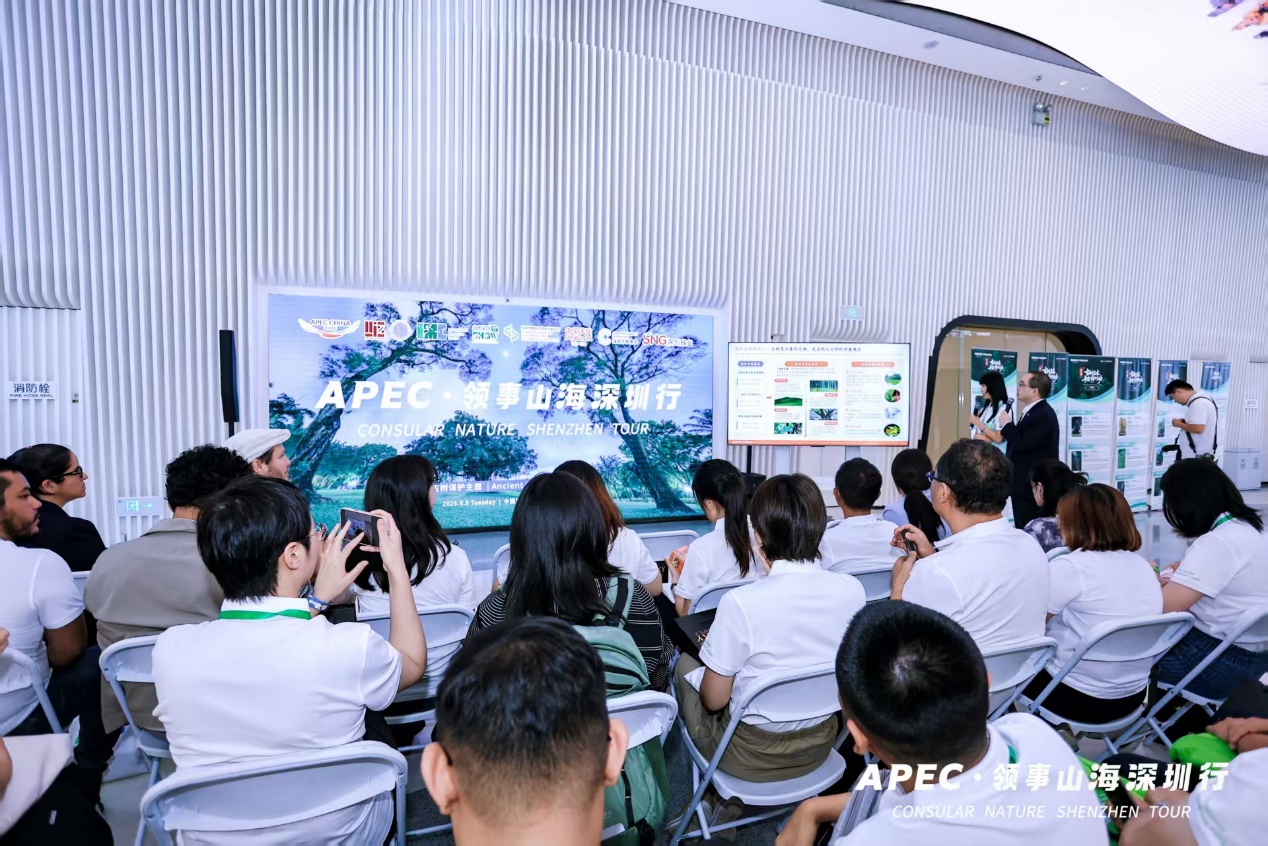
Global ecological experts called for deeper exchanges and cooperation on mangrove and ancient tree conservation in the Asia-Pacific region, while highlighting that China’s efforts in the field can offer useful experience to other countries.
They made the remarks in Shenzhen on Tuesday as the city held the Opening Ceremony of the Workshop on Mangrove Conservation and Restoration in the Asia-Pacific Region of the International Mangrove Center and the learning tour of ancient trees conservation.
Twenty-four representatives from economies of the Asia Pacific region, such as Brunei, Chile, China, Papua New Guinea, Mexico, and Thailand, as well as international organizations, took part in the workshop, co-hosted by the International Mangrove Center and the Urban Planning and Natural Resources Bureau of Shenzhen Municipality. for Asia-Pacific Economic Cooperation economies.
Mangroves are not only “coastal guardians”, but also the “lungs of the ocean”, said Bao Daming, director general of the Interim Secretariat of the International Mangrove Center.
The Asia-Pacific region holds nearly half of the world’s mangrove resources, bearing a significant responsibility for their protection, he pointed out.
According to the International Union for Conservation of Nature’s Red List of Ecosystems, published in 2024, over half of the world’s mangrove ecosystems are at risk of collapse. Nearly 20 percent of the assessed mangroves were deemed to be at high risk, classed as either endangered or critically endangered, which reflected that these areas were facing a severe risk of collapse.
The assessment, which based its results on the study of mangrove ecosystems of 36 different regions across the globe, warned that without additional conservation measures, around 7,065 square kilometers of mangroves could disappear and some 23,672 sq km could be submerged by 2050, resulting in the loss of 1.8 billion tons of carbon stored, protection for 2.1 million lives exposed to coastal flooding, $36 billion worth of properties, and 17 million days of fishing effort per year.
Wang Chunfeng, executive director of the Asia-Pacific Network for Sustainable Forest Management and Rehabilitation, noted that while mangrove protection in the Asia-Pacific region still faces challenges, the global rate of mangrove loss has been significantly curbed, demonstrating that collective action can yield tangible results.
He said he hoped to see increased international cooperation in areas such as capacity building, knowledge sharing, and demonstration projects.
Diego Montesclaros, assistant protected area superintendent at Las Pinas Paranaque Wetland Park in the Philippines, said China’s solutions to mangrove conservation challenges can offer a practical template for his country’s environmental protection efforts.
“I have noticed many innovative environmental practices in China, and I believe adopting similar approaches will deliver great benefits to ecological conservation in our country,” he said.
The international delegation also learned how to protect ancient trees during the learning tour of ancient trees conservation, where Ping An Insurance (Group) Company of China shared its initiatives in the field.
“We have launched an innovative ‘insurance plus technology plus service’ model by leveraging our core insurance strengths. While providing financial indemnity for damaged ancient trees, we also offer pre-loss risk mitigation services to reduce disaster probability and loss severity, enabling sustainable tree preservation,” Henry Wang, deputy general manager of rural insurance department of Ping An’s property and casualty insurance unit, said.
As of the end of 2025, the company had provided special treatment and restoration coverage for more than 50,000 ancient trees, with total risk protection hitting 1 billion yuan ($147 million).
Chen Ziyu contributed to this story.
