

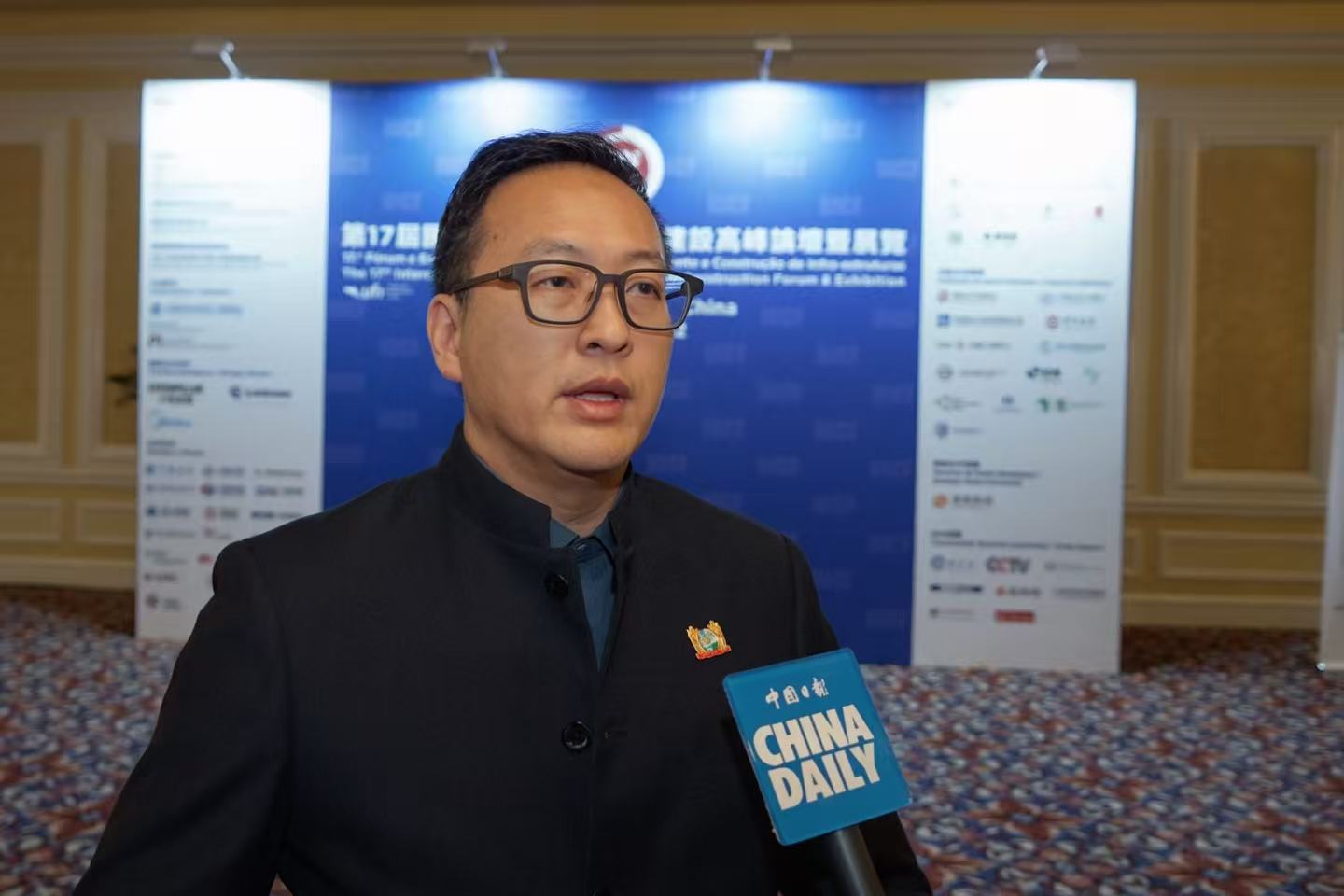
China’s infrastructure advantage makes the country a key partner for Caribbean nations seeking cost-efficient building solutions, said Stephen Tsang Kam-wing, Suriname’s minister of public works and spatial planning.
“China is among the leaders in innovation and infrastructure, so anything the Caribbean needs, China has,” he said. “That’s why we’re looking to China as one of our biggest partners.”
Tsang spoke to China Daily on the sidelines of the 17th International Infrastructure Investment and Construction Forum and Exhibition in the Macao Special Administrative Region.
Organized by the Macao Commerce and Investment Promotion Institute and the China International Contractors Association, the event, held from Wednesday to Friday, attracted more than 3,500 participants from over 70 countries and regions, including nearly 60 officials at vice-ministerial level or above, as well as political and business leaders from the global infrastructure industry.
This year marks the 50th anniversary of the establishment of diplomatic ties between China and Suriname.
Noting that Suriname is one of the first Caribbean nations to join the Belt and Road Initiative, Tsang said the BRI ideology shares with Suriname its common interests as the country also wants to enhance connectivity with other nations.
He said the country wants to build bridges linking their neighbors Guyana and French Guiana, and that the BRI has the idea of connecting all regions.
ALSO READ: Infrastructure forum in Macao closes with 21 deals worth $9.9 billion
With growing geopolitical tensions worldwide, the minister said unilateralism shouldn’t be the way forward. “We need to do business with anybody we want. We have to build our own bridges and our ties with other countries.”
Located along the northern Atlantic margin of South America, Suriname is part of the Guiana-Suriname Basin — one of the world’s most closely watched offshore petroleum provinces.
Tsang said his country is transitioning to a global energy frontier with the first offshore deep-water oil production due to start in 2028, posing a unique challenge for the carbon negative nation to navigate an oil boom through sustainable, digitally-integrated infrastructure.
This will create enormous opportunities across various sectors of Suriname’s economy, including transport and logistics, oil and gas, renewable energy, and housing, he said, adding the nation is planning a deep seaport and welcomes international investors.
“Between now and 2028, it’s the moment to invest.”
ALSO READ: Macao forum boosts ties between Portuguese-speaking nations, China
Suriname, despite being a carbon negative country, is also one of the most vulnerable countries to climate change with the majority of its population living in the coastal areas.
With rising sea levels and more flooding, the threat of climate change is real, and the Surname government is placing this high on its agenda for more sustainable and resilient infrastructure, Tsang said.
As Chinese companies are actively involved in Suriname’s infrastructure projects, he hopes future cooperation can focus more on innovative and cost-effective technologies.
