


JERUSALEM/BEIRUT/BRUSSELS – Israeli Defense Minister Israel Katz on Thursday said that the current reality in Lebanon could lead to a peace agreement between the two countries, according to a statement issued by his office.
Katz said that the declaration of principles reached in Washington between Israel and the Lebanese government reflects the situation on the ground in Lebanon, including efforts to disarm Hezbollah, push its forces north of the Litani River, and establish a demilitarized zone.
He also said Israel "will not rely on any other party for its security", adding that the emerging situation could, depending on developments and Israel's security needs, create conditions for a possible peace agreement and achieving real and permanent security for northern Israel residents for the first time in 50 years.
On Wednesday night, Israel and Lebanon agreed to implement a ceasefire following US-mediated trilateral talks in Washington.
The ceasefire depends on a complete halt to Hezbollah fire and the withdrawal of all Hezbollah operatives from south of the Litani River.
The agreement also includes steps to create "pilot zones" in Lebanon where Hezbollah would be excluded, with the Lebanese military taking full control of those areas.
Further high-level talks are planned later this month to reach a comprehensive agreement.
Lebanese leader hopes talks to lead to end of enmity
During a meeting at Baabda Palace with French presidential envoy Jean-Yves Le Drian and French Ambassador to Lebanon Herve Magro, Lebanese President Joseph Aoun expressed hope that ongoing negotiations in Washington between Lebanese, US, and Israeli delegations would yield positive results, leading to a lasting ceasefire and eventually ending the state of enmity between Lebanon and Israel.
Aoun said the process should lead to "the withdrawal of Israeli forces from Lebanese territories occupied in the south, the deployment of the Lebanese Army up to the internationally recognized border, ultimately leading to an end to the state of enmity between Lebanon and Israel", according to a statement released by Lebanon Presidency.
ALSO READ: Lebanese officials: Hezbollah accepted US proposal on ‘mutual cessation of attacks’
Aoun stressed the need not to provide Israel with pretexts to delay its withdrawal, adding that efforts in this direction would have positive implications for the negotiations.
Israeli army withdrawal in eastern Lebanon
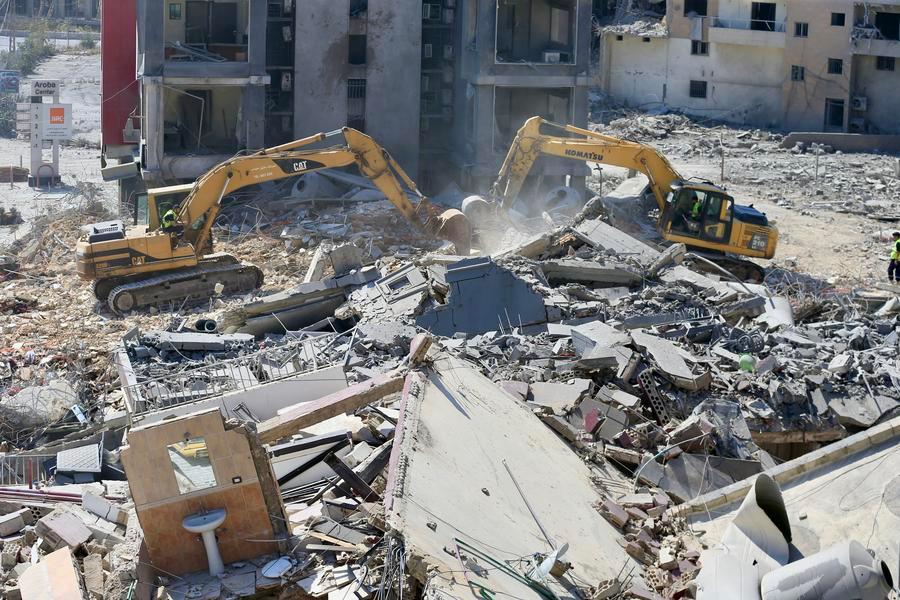
Also on Thursday, Lebanese security sources and eyewitnesses said the Israeli army has begun a gradual withdrawal from the town of Dibbine in eastern South Lebanon.
The sources told Xinhua that several Merkava tanks and armored personnel carriers were seen moving from the eastern outskirts of Dibbine toward the neighboring town of Khiam, while a number of drones continued to fly overhead.
Israeli forces entered Dibbine about a week ago and, during their presence, carried out demolitions and bulldozing operations that destroyed dozens of homes, according to the sources.
No official statement has yet been issued by the Israeli military regarding the reported withdrawal.
Lebanese troops deployment in southern areas
At a Cabinet session, Lebanese Prime Minister Nawaf Salam announced the Lebanese army will begin a gradual deployment in selected areas of southern Lebanon, describing the move as a practical step toward achieving a full Israeli withdrawal from Lebanese territory.
"The next step is practical and tangible: the deployment of the Lebanese Army in pilot areas as a first phase. This does not undermine our right to a full withdrawal, but rather brings us closer to it," Salam said, according to Lebanon's National News Agency.
Salam defended the government's negotiation approach as the fastest and least costly option for Lebanon, despite acknowledging the challenges posed by Israeli intransigence.
He called on all parties to prioritize national interest over external or factional considerations.
In another development, the European Union has agreed to provide an additional 100 million euros ($116 million) to Lebanon's Armed Forces, EU foreign policy chief Kaja Kallas said on social media platform X.
ALSO READ: 1 UN peacekeeper killed, 2 injured in southeastern Lebanon
Kallas said the latest ceasefire between Israel and Lebanon offers a chance to prevent a return to full-scale hostilities. However, she cautioned that the death of a United Nations Interim Force in Lebanon (UNIFIL) peacekeeper and continued skirmishes "underscore the tenuous nature of what was agreed".
'Resistance till Israeli occupation persists'
In a televised speech, Hezbollah leader Naim Qassem said resistance against Israel will continue and Israeli settlements will remain unsafe as long as the occupation and attacks on Lebanese territory persist.
"We are concerned only with a comprehensive end to the aggression, a ceasefire, and Israel's withdrawal. As long as the occupation exists, the resistance will continue," Qassem said.
He warned that any agreement making disarmament of the resistance its primary objective would "eliminate Lebanon's strength, threaten its existence, and allow Israel to achieve through politics what it failed to achieve through war".
The Hezbollah leader said the group had not committed to refraining from responding to Israeli actions, and warned that Israeli settlements would not be safe while Lebanese villages remained under attack.
