

Project helps locals learn new skills, raising incomes and productivity
For the first time in her life, Khanpovan Phanthadasomchith from Laos got to taste Chinese meat floss balls, or rousongxiaobei, during a study trip to South China's Guangdong province in early May.
The fluffy sponge cake filled with creamy custard and coated in savory meat floss left such a deep impression on her that she began dreaming of opening her own bakery in Vientiane one day.
Khanpovan, 37, is a cooking instructor at the Lao Women's Union Training Center. In March last year, she joined a one-week Cantonese cuisine training course under a joint project between the center and Dongguan Technician College. Another bakery course was offered last month.
"I had seen online before that China has a lot of delicious food, but Guangdong cuisine alone already amazed us," she said. "I didn't expect Chinese food to have so many different flavors and cooking styles, and everything was really tasty. I especially like roujiamo, the Chinese meat sandwich."
READ MORE: Advancing cooperation with Laos envisioned
"The training courses really opened our eyes," Khanpovan said. "China's creative bakery industry has its own unique style, and I think many people in Laos would love it. I want to continue improving my skills and open my own shop in Vientiane in the future."
The bakery course that Khanpovan joined is part of the ILO/China Partnership Programme on Strengthening Skills Development in Laos through South-South and Triangular Cooperation. ILO stands for the International Labour Organization. The initiative aims to provide technical support to improve local employment services, skills development and institutional capacity building, while boosting enterprise productivity.
It is also the program's only project specifically focused on improving skills for local women.
"In Laos, many women earn only between 3 million and 3.5 million kip ($137 to $160) per month," said Chansamone Senghalath, deputy director of the Lao Women's Union Training Center. "Low incomes have resulted in many Lao workers seeking jobs abroad."
"Many of them are mothers and wives. If they can earn a better income through skill improvement while staying with their families, that would be the best option," Chansamone said.
In November 2021, with the support of the ILO/China Partnership Programme, Dongguan Technician College established a formal partnership with the Lao Women's Union Training Center. Over the past three years, the college has delivered three rounds of skills training for Lao women, covering areas such as tailoring, Chinese cuisine and baking.
So far, the program has trained 17 instructors from the Lao training center.
According to Chansamone, 52 women from the center have benefited from the project. "After improving their professional skills, their average monthly income can increase by 1 million to 2 million kip, representing a rise of about 50 to 70 percent compared with previous levels," she said.
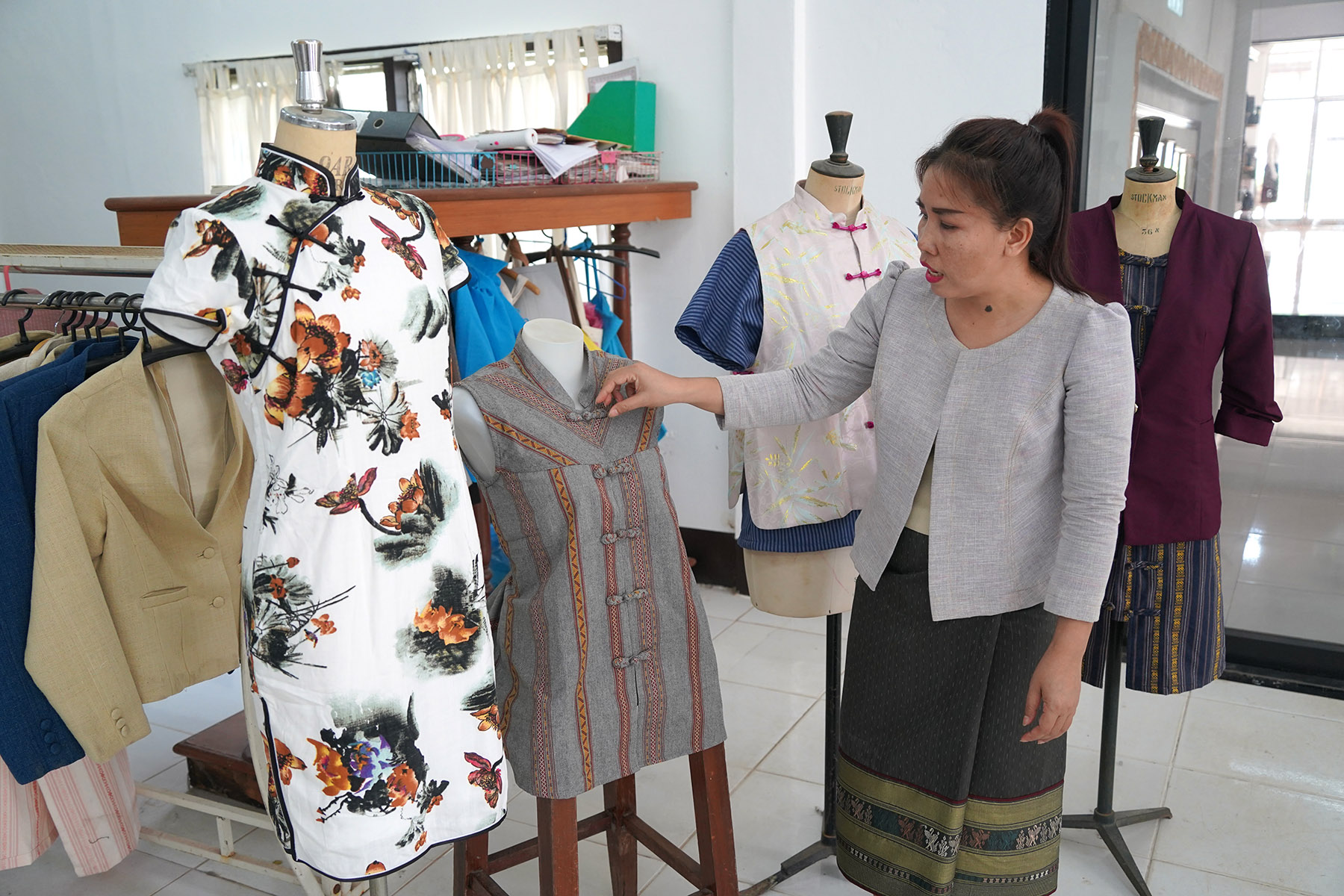
Thippavong Vongmano, 40, a tailoring instructor at the Lao center, visited Dongguan Technician College twice to study garment-making techniques. She can now independently make the iconic Chinese qipao as well as Chinese-style waistcoats.
"Thanks to the training, we not only gained modern tailoring skills from China, but were also deeply impressed by Chinese culture reflected in its clothing styles," Thippavong said. "The exquisite designs of traditional Chinese garments incorporate rich cultural elements."
Cultural integration
Inspired by Chinese tailoring techniques, Thippavong has blended traditional Lao clothing styles with Chinese features, such as frog buttons, creating designs that reflect cross-cultural integration.
"Dongguan has one of Asia's largest textile markets, and the city's tailoring industry is well known across China for its efficiency, flexibility and premium manufacturing capabilities for global brands and fashion startups," said Guo Chunlei, Party secretary of Dongguan Technician College.
Tian Feng, project manager of the ILO/China Partnership Programme, revealed that the project is funded by the Chinese government through the Ministry of Human Resources and Social Security and implemented by the ILO.
He said the project not only contributes to poverty reduction in Laos by strengthening skills development and promoting labor market participation, but also advances gender equality and social inclusion.
"Through South-South cooperation, we aim to deepen collaboration through cross-border learning mechanisms, strengthen skills development in countries involved in the Belt and Road Initiative, promote the exchange of expertise and best practices, and advance full and productive employment and decent work, while fostering investment, innovation and workplace training initiatives," Tian said.
For the Lao side, however, expanding the reach of the program remains a challenge.
"So far, our trainer-to-practitioner model mainly benefits members of the center, but many women in other provinces still do not have access to on-site training," Chansamone said.
ALSO READ: Hit travel reality show ventures abroad to Laos
According to Guo, Dongguan Technician College plans to further strengthen its partnership with the Lao center through regular online courses in the near future, while instructors from the college will also travel to Laos to provide on-site teaching.
"Moreover, we are planning to expand our training programs into more in-demand fields, such as artificial intelligence and e-commerce livestreaming," Guo said. "China has extensive experience in these sectors. We hope our expertise can benefit more developing countries like Laos and help improve local livelihoods."
Contact the writers at yangwanli@chinadaily.com.cn
