

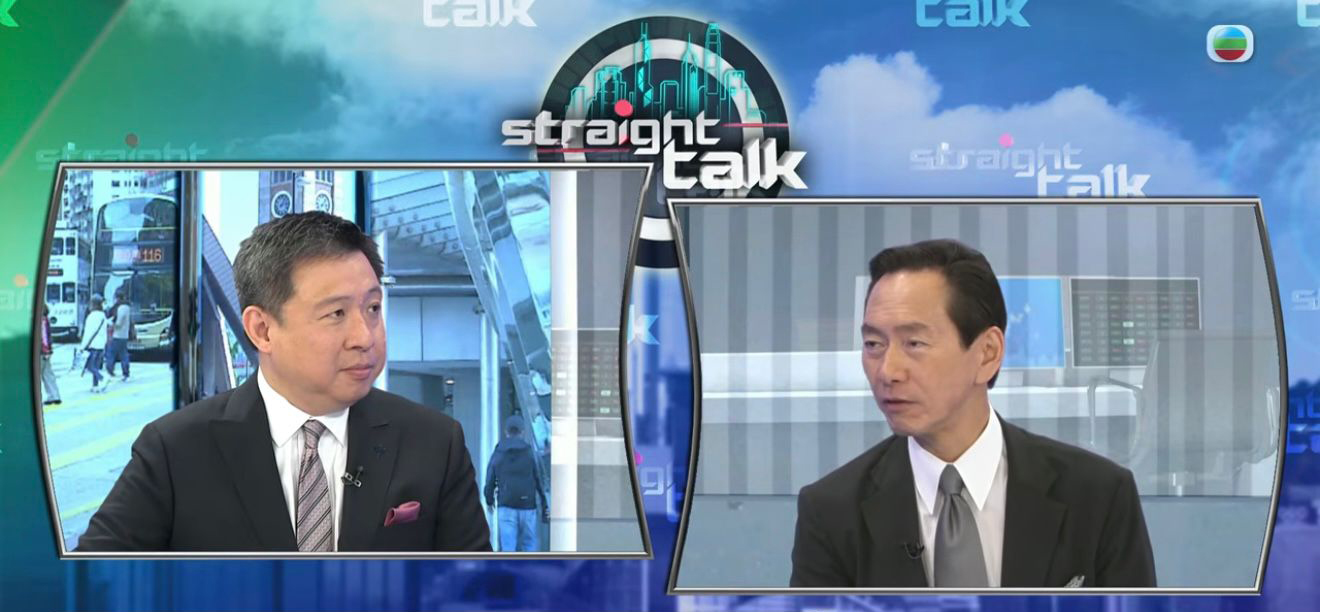
Bernard Charnwut Chan, chairman of Our Hong Kong Foundation, is on Straight Talk this week to reflect on our host's 5th year anniversary on the show, and what happened to Hong Kong the past 5 years and what's next.
Check out the full transcript of TVB’s Straight Talk host Eugene Chan Kin-keung’s interview with Bernard Chan:
Eugene: Good evening, I'm Eugene Chan. Five years ago tonight, I sat in this chair for the first time as host of Straight Talk. My very first guest was Bernard Chan, a man who has long been a barometer of Hong Kong's confidence, candor and conscience. He is the chairman of Our Hong Kong Foundation, former Executive Council (ExCo) convener, former Hong Kong deputy to the National People's Congress and recipient of the Grand Bauhinia Medal. Bernard, welcome back to Straight Talk and for this very special 5th year edition.
Bernard: Hi Eugene. How are you doing? Five years.
Eugene: Time flies.
Bernard: Wow! How do you manage all those five years?
Eugene: As a healthcare professional, it's not easy, but I must say it's because of yourself and the viewers. Because when I meet people on the street, in the clinics or community events, they come and talk to me and I feel that they have watched; they care and they have encouraged me. And I must thank them, for all of them are so incredibly forgiving to all the mistakes I've made! And to that, I thank you again.
Bernard: You know, this is something I don't understand now. How you managed to convince all these, you've done this must be 200 sometimes now. Why would these people agree to come to your show to be grilled on?
Eugene: Oh, today is the 261st episode. I mean, we have 245 guests, meaning nearly 90 percent of the guests that you guys watch are being here the first time. The simple answers are the viewers, because quite often they text me, they give me all the questions, so I'm game enough to approach all the interviewees to say someone wants to listen to you. And after all, the show is a reflection of what Hong Kong is, and I truly want people to understand and treasure our city, so that we all contribute and enjoy what we have in Hong Kong.
Bernard: Wow! Indeed, this is my third time coming to your show.
Eugene: Yes, and I really want to take the opportunity to thank the TVB crew from the leaders and management of the News and Information Services, our producer, our director, and the crew. I mean, they have a trust in an amateur like me. And not to mention my fellow anchors, the chairman of the Board of TVB, they give me trust that I haven't earned yet. I'm very grateful. Okay, so, maybe let's get back to the show.
Bernard: Okay.
Taking stock
Eugene: Bernard, you've been here three times, and I actually did look at what we've said the last two times, and I'm sure people want to see how we move on for the next five years. And a quick recap, when we talked in 2021, the NSL (National Security Law) was just enacted, and Hong Kong electoral system has been improved.
In 2021, actually, let's listen to what you said:
“Eugene: The title of tonight's show is Does the Improvement of the Electoral System the Answer to Hong Kong's Future? So do you think this improvement is going to solve the problems we had?
Bernard: Well, I think the electoral reform is somewhat a must.”
Bernard, you said that the electoral system must somewhat be … I mean the change must be a must. And you think, doing it alone will not be able to solve Hong Kong's deep-seated problem. Three years on, in 2024, you said governance has become more focused. So, as of now, it's like five years. Do you think the electoral system has actually helped Hong Kong to move on better? What do you think?
Bernard: No, honestly, I think during the time, during my time when I was in both LegCo (Legislative Council) and ExCo, we had to deal with both issues that are affecting the economy. But at the same time, we did, back then, have the oppositions. And unfortunately, some of those members of the opposition, they tend to disagree for the sake of disagreeing and slowing Hong Kong down a lot of the reform that it badly needed. So, with the political reform, the electoral reform, I think now somewhat addressed. Because now I think every member of the LegCo are focused in helping Hong Kong to recover and also to help the administration find a new path for Hong Kong going forward.
So, I think to date, by far, I think you can arguably say there's less of a resistance from within the system. Now, does that mean that we're now able to address every issue? Obviously not. There are still very, these top, these issues that are involving a lot of vested interests, they still remain and they still need to be addressed. And on top of that, five years, the world has changed so much.
Eugene: Indeed.
Bernard: Has changed so much. I think we can no longer hang on to whatever made Hong Kong successful in the last 20, 30 years. I think this is something we all now agree.
And the big challenge actually for Hong Kong today is, you know, let's think about the five-year plan. People say, why did Hong Kong need a five-year plan? No, the Hong Kong Special Administrative Region doesn't need a five-year plan. But China, with its Five-Year Plan, is making a huge impact, not just to China, for the whole world.
Shouldn't Hong Kong also, you know, at least know what is going on and Hong Kong play a role on that. So, all these changes require not just how we, you know, not just about the people, but also about the administration.
Eugene: Right.
Bernard: Because we're so used to the one system, the one model that we worked on. So, now all these changes are happening. So, the big issue is as we integrate, so-called integrate, right, we are integrating with the mainland, both economically, socially, not politically. Politically, we still have the “two systems”, but both economically and socially.
We are fast integrating with the Chinese mainland. And that requires a lot of mindset changes, both from the administration to the general public. I think that we're still a long way to go. It's natural. I mean, it's all new to us, new to you, new to me as well.
Eugene: Exactly. Right, Bernard, Before we go on to the “two systems” thing, which I'd like to ask you, I'm sure viewers would like to know your insights, is one comment, you also made in 2021 was very, you were very direct. You're saying that the LegCo members, even with the new system, however they're being elected, they would not be yes man, because they are answerable to their own constituencies. Looking at the Legislature today, would you say your projection has held up?
Bernard: Well, as I said, we are all going through these changes. I think, you know, we've gone from, perhaps, in the past where people opposed for the sake of opposing to now, I think, people are perhaps maybe sometime too second guessing, second guessing what would be in Hong Kong’s interest or perhaps in the national interest. So, I think, you know, maybe perhaps we're still going through that whole period of time where we try to figure out what's the role of LegCo. Because the role of LegCo is somewhat different from when I was a LegCo member. When I was a LegCo member, we so-called we held the government accountable. So, what's the role for us? It's like, in fact, because we do not drive policy. In fact, in a way, we try to nitpick on the fault of the government. Now, whether you're pro-establishment or you're so-called opposition, we do the same thing because that's how people see the function of LegCo members – to hold the government accountable and by finding fault in them.
Now clearly it's not the case today. Today we're told LegCo members help the administration. Now what's the definition of helping? Is that meaning that you're going to just say yes to everything or you give constructive advice?
Now, so, I think many LegCo members still try to figure it out exactly how you would, what contribution you can offer. Now if you simply just say yes, then I think I'm pretty sure we all can agree that you're effectively not doing a good job either.
But if you're just going to play your lip service and so on, that's no good. But by opposing everything that comes, it's no good. So, I think, you know, the LegCo members themselves also need to figure it out exactly is the role.
I personally believe that there's so much LegCo members can contribute, you know, because most of them are being elected based on their professional experiences or their connections and so on. So, I think they can help the government a lot because administrator, they might not know best about how the business worlds operate or how the public opinion is.
So, I think they can be complementary, but I think they're all still going through a period where they try to figure out soul searching and try to figure out exactly how they should play their role and how are they being held accountable by those who elect them.
Eugene: When I'm sure I'm going to ask you the same question when you come next time to see whether we have all found a new way of helping Hong Kong. Since you mentioned “two systems” earlier, I would say “one country, two systems” is a phrase. But for some critics in the West, I'm sure when you go for interviews in or maybe overseas, they would say that in daily life, “one country” becomes more and more dormant. You can feel it, you can see it. And “two systems” become more symbolic rather than substantive. Do you agree?
Bernard: You know, the good thing is that I'm not an official anymore, so I don't have to use the government line to take when I go abroad to convey the message. Because I think honestly, you have to put yourself in their perspective. It's very difficult for them to understand there's “one country” and there's “two systems”. So, I will not even bother to try to explain what “one country, two systems” are because you can't expect them to really care about what these “two systems” are.
So, the way I would usually do it is explain why Hong Kong is different from the Chinese mainland is that we have two legal systems. I think that may be an easier concept for them to understand. We have two set of legal systems. We have two currency systems. And if they are interested enough, then I can explain more how that “two systems” operate while serving under “one country”. So, I think sometimes, especially when you talk to someone from overseas, it is not easy for them to understand. And I don't think we should get too technical because ...
Eugene: Right, yeah, since you're talking about foreign people that you've met, I mean our counterparts in the Western world primarily. But as we all know, Hong Kong pitched the world has always been rested on predictability, meaning the rule of law, the free flow of information, and our independent judiciary. So, when these international investors or partners get concerned about how our pillars are today, how do you tell them, as you said, and would you say enough good Hong Kong stories have been told?
Bernard: Well, obviously not, because I think we suffered from a lot of misinformation for the last many years, starting from 2019, from the protests and unrest, and with COVID. So, the very first thing I always need to highlight is the fact that China, the Chinese mainland, wants the “two system” to continue. I think that's the first thing first, because a lot of the misinformation is that the Chinese mainland is taking over and they wanted us to follow their system, which is factually wrong.
So, I think the very first thing I always need to emphasize is it is in China's best interest to keep the “two systems” going. They want the two system because it's in national interest. So, this is the one point I need to get through them.
And of course, you can't expect everyone to agree with that. But I think that first thing first, because otherwise they keep thinking that the Hong Kong people are fighting with the Chinese mainland. I say, no, Chinese may not want the “two systems” as much as the Hong Kong people want the “two systems” to continue because it's in China's interest to keep the system separate.
Eugene: All right. All right, Bernard, let's go a short break now. We'll be back with more Straight Talk.
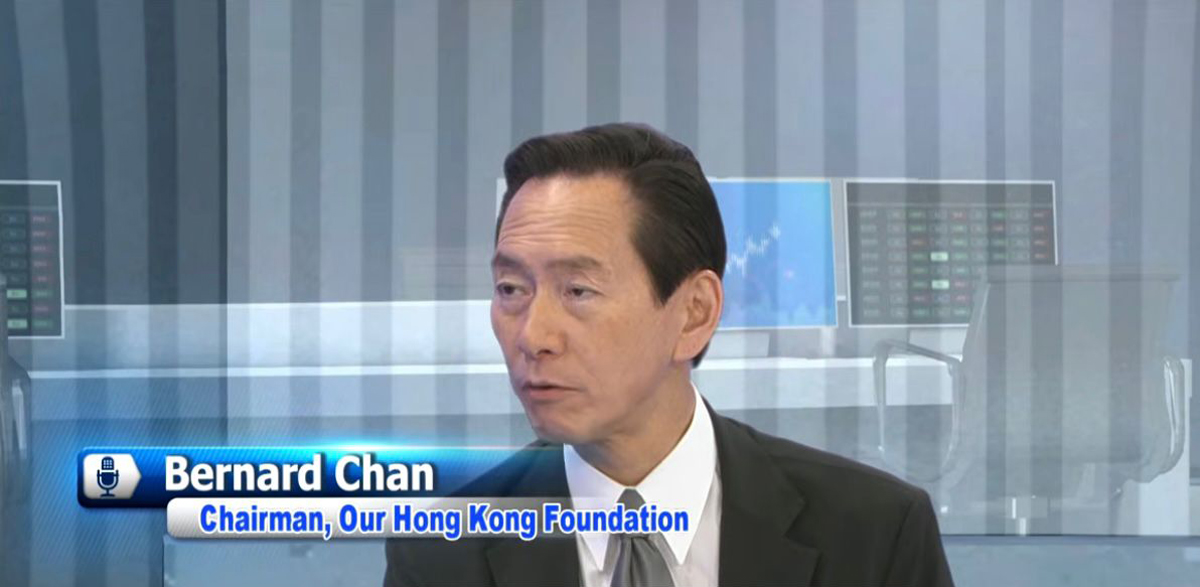
Eugene: We are back on the fifth year anniversary of Straight Talk with our inaugural guest, the Honourable Bernard Chan. We've been talking about how Hong Kong has traveled over the last five years. Let's look forward to what Hong Kong's next chapter will look like. So, Bernard, thank you very much for telling us how you communicate with the international community, especially on how they should look at Hong Kong.
Challenges
Eugene: Let's come back more locally. Hong Kong's relationship with Shenzhen has been transformed. In 2021, you actually encouraged young Hong Kong people to explore the GBA. By 2024, you were surprised that Hong Kong people were crossing the border to spend money that we didn't expect. So, would you say that, rather than them coming over to Hong Kong to spend, would you say that we're losing our own market to mainland next door?
Bernard: Well, I don't think it's just losing. We gained certain things, obviously. But this is the thing, right? I think we are complementary. Hong Kong Special Administrative Region is complementary to the Chinese mainland, of course, to GBA, our next-door neighbor. But what took me and many people in Hong Kong by surprise is the speed of that change.
Eugene: Indeed, yes.
Bernard: You know, I'm pretty sure five years ago, I would not have imagined that hundreds of thousands of people from Hong Kong would travel to Shenzhen over the weekend for a good meal. Never would I. If you were to ask the same question five years ago, I would not believe it because I think back then we still had this notion of, oh, maybe the food there wasn't up to the standard. There may be a compromise here and there. But today, I think most people would agree that they're actually pretty good, and not even better than Hong Kong. Services are better and so on. So, these are the pace of the changes. It really pushes Hong Kong to a journey of no return. We've got to work faster. And how can Hong Kong continue to command the premium, right? Because we command the premium over Shenzhen. But yet, if we cannot deliver to that premium, then we're in trouble.
But certain sector, I think any sector that ride on the benefit of the “two systems” will continue to do very well. Because only on Hong Kong side we can do it. But on trades such as F&B, food and beverages, where there is no distinction anymore between the “two systems”, then we are directly competing with them on pricing, on quality, and services.
Then we got to improve ourselves. Otherwise, Shenzhen will be taking a big share of that from us.
Eugene: Right, Bernard. I mean, it's not only F&B, look at our retail, because of the change in the mode of business, everything has been very challenging. And if you look at what our government says, we say new thinking and new methods, very much to what you said, we want to increase ourselves to be more of a premium standard. But we call this just a slogan. What exactly do we do and can we do it? That's the issue.
Bernard: You know the beauty of Hong Kong. I mean, there's no one else out there to bail you out. Hong Kong people need to survive and we need to reinvent ourselves. Now, you think about this sort of crisis, if we look back in history in the ’50s and the ’80s and the 2000s, and Hong Kong went through many different cycles of challenges and changes. Each time, somehow Hong Kong people will manage to bounce back on our own. Now, we can never expect the government to bail us out because the government will be the last people to know how to run the business. So, Hong Kong people just need to figure it out, business people need to figure it out, how to reinvent.
Certain business model will not survive, will be obsolete. But new business model will come. For example, today, obviously, we're pushing education as a major hub in Hong Kong.
Eugene: That's something we never expected.
Bernard: We never expected. Well, we sort of knew, but then there wasn't that demand at the time. Today, the huge demand. So, every time, what helps Hong Kong SAR to move forward is the changes on the mainland.
Eugene: True.
Bernard: That's the key. So, I think Hong Kong people need to stay very alert. They need to understand what's happening in the mainland because whatever happening in the mainland will have an impact us ... where Hong Kong people, Hong Kong businesses can take advantage of that changes.
So, I think every single time, in the early ’50s and ’60s, when there's an embargo on the mainland, Hong Kong’s traders took advantage of that. Into the ’80s, when there's an economic reform in China, again, Hong Kong manufacturers moved to the mainland to build factories. And then 2000 when a lot of the Chinese company … capital, Hong Kong is the IPO capital.
Today Chinese companies are going outbound, right? So, Hong Kong, again, is being used as the bridge to connect to the world. Each time when something happens on our mainland, Hong Kong is able to capture that opportunity.
But it requires us to first understand what the needs are and how we can create that.
Eugene: That's exactly what you said a bit earlier, that we need to know the five-year plan of the country. How can we integrate, isn't it? We have now come to, I would say, from a chaos to order now, from the order to prosperity stage, as national policy has said. We have the National Security Law, electoral reforms, Article 23, and now we are going through these challenges to say how to reinvent our businesses, how we retain our talent. So, would you agree that we are now on the way to prosperity, especially given all the geopolitical or all the wars are happening? Is it helping us to move faster? What do you think?
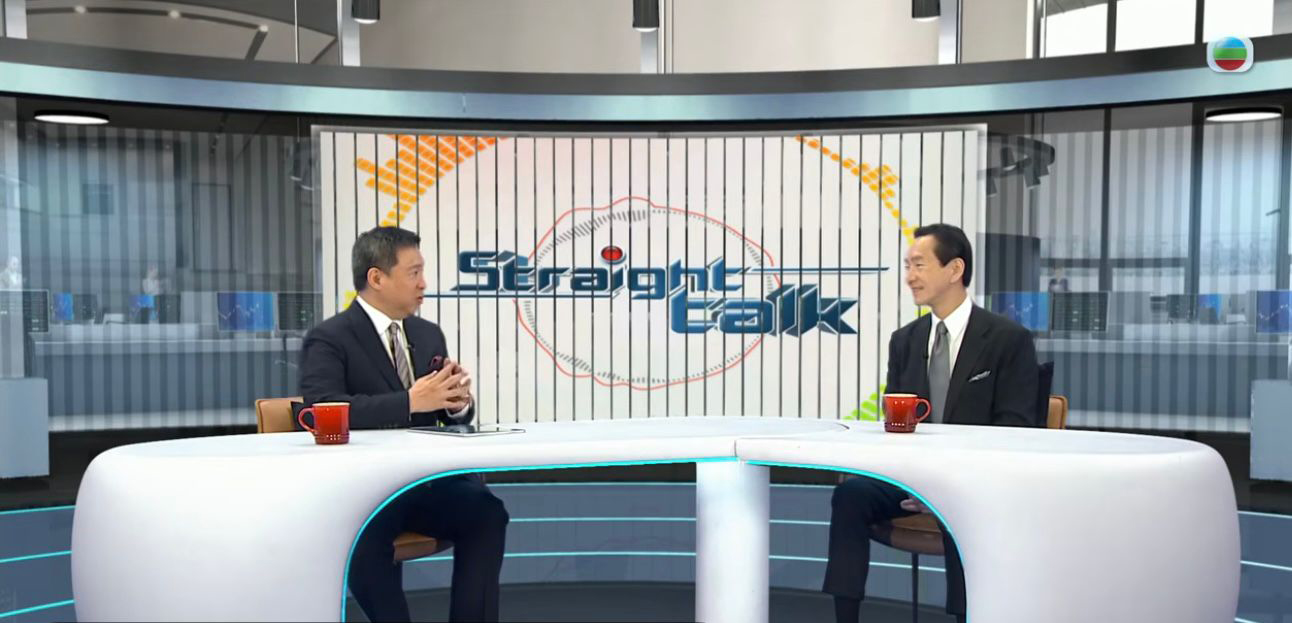
Bernard: Well, I think for sure with the enactment of this National Security Law and the electoral reform, I think stability-wise, yes. I think we are more or less now free from any potential confrontation and all this, we've been used as a means to attack the Chinese mainland. I think we're okay. But in terms of prosperity, I think we are far from that yet.
Because first of all, there is still a need for reform within the system. We're so far behind with some of the changes needed. And on top of that, the rest of the world is not slowing down for us with the AI coming around. So, are we going to be able to still keep the same job that we used to have? Where are the future jobs for our young generations? And on top of that, the geopolitics is real, given what happened now. I mean, in fact, geopolitics is crazy. Every six months, something else happens. You know, just six, seven months ago, we have a tariff war. Now we have a real war. And that is going to impact the whole economy. It's not just our economy. It's global economy.
Eugene: Yes.
Bernard: I would not do, I don't think we can assume that we are now on a safe path to prosperity.
Eugene: Right.
Bernard: But at least the good news is, riding along with mainland fortune, I think Hong Kong SAR is somewhat in a way … You look at what happened to Europe, it happened to Southeast Asia, there's a lot of problem going through them. So, I think Hong Kong by and large is somewhat okay, but we are far from …
Eugene: Prosperity, as you say.
Bernard: … prosperity, yeah.
Eugene: In 2024, I keep on quoting what you said. You call labor shortage a crisis that forced opening importing schemes. And you see, the current government, looking at Chris Sun’s bureau, it is working very hard to get people coming. Looks like we've got some success. But let's talk about our own people. I mean, I've got a good friend who asked me yesterday that they try to get their son to come back to work in Hong Kong. He’s in the (United) States right now.
So, what would you say to a 20-year-old Hong Kong-based professional now in London or Toronto? Come back and why?
Bernard: Again, I think the trouble today is what the careers are in the future? And it's happening everywhere in the world. So, they have to make a decision where they are better off. Are they better off wherever they are? Or are they coming back to Asia? And in Asia, I guess everyone is looking at China. So, it's really where they can create the extra value. It's whatever profession they're in, the skills set that they have, how that would actually be useful, the value add to, say, in China's expansion plan and how Hong Kong can play that role in helping China. Because it's very clear China is going to stay very focused. In fact, if you look at the Five-Year Plan, they're doubling down on innovation. So, anything to do with innovations and self-sufficiency, I think that's where China is going to be moving forward and how Hong Kong SAR can play that role whether it is from raising capital to services industries and so on.
Eugene: Right.
Bernard: So, I think for those people who decided to come back, the real question is: where are they better off? And of course, this is the big part now. When they have decided to come back, are they coming back as a single, as a married couple, or as a family? Now, increasingly, I think people now have to look at security, safety, and quality of life. Hong Kong is not bad at all. Hong Kong, by far, is very safe. Quality of life has significantly improved. And education offering is great. So, I think increasingly now people choose to come back because of those reasons.
Eugene: Right, I must ask you a last final question. In 2024, let's listen to your final words.
“Eugene: How do you see Hong Kong in the next 1,000 days ahead?
Bernard: You know what? I always believe in there's always a new hope from a new crisis because it forces us to change.”
You said that I've always believed there is new hope from a new crisis, but it forces us to change. In short, what is the crisis now and how are we going to change? In short.
Bernard: With the geopolitical tension between Chinese mainland and the United States, I think Hong Kong increasingly plays a very important role as that bridge, the bridge between China and the rest of the world.
Eugene: Well, Bernard, I wish we didn't have to stop. As always, we want to thank you for your candor, your insight and your time. Hong Kong has been through so much in five years, but as Bernard said, there's always new hope from a new crisis because it forces us to change. Let's keep walking this path together.
Have a good evening and see you next week.
