

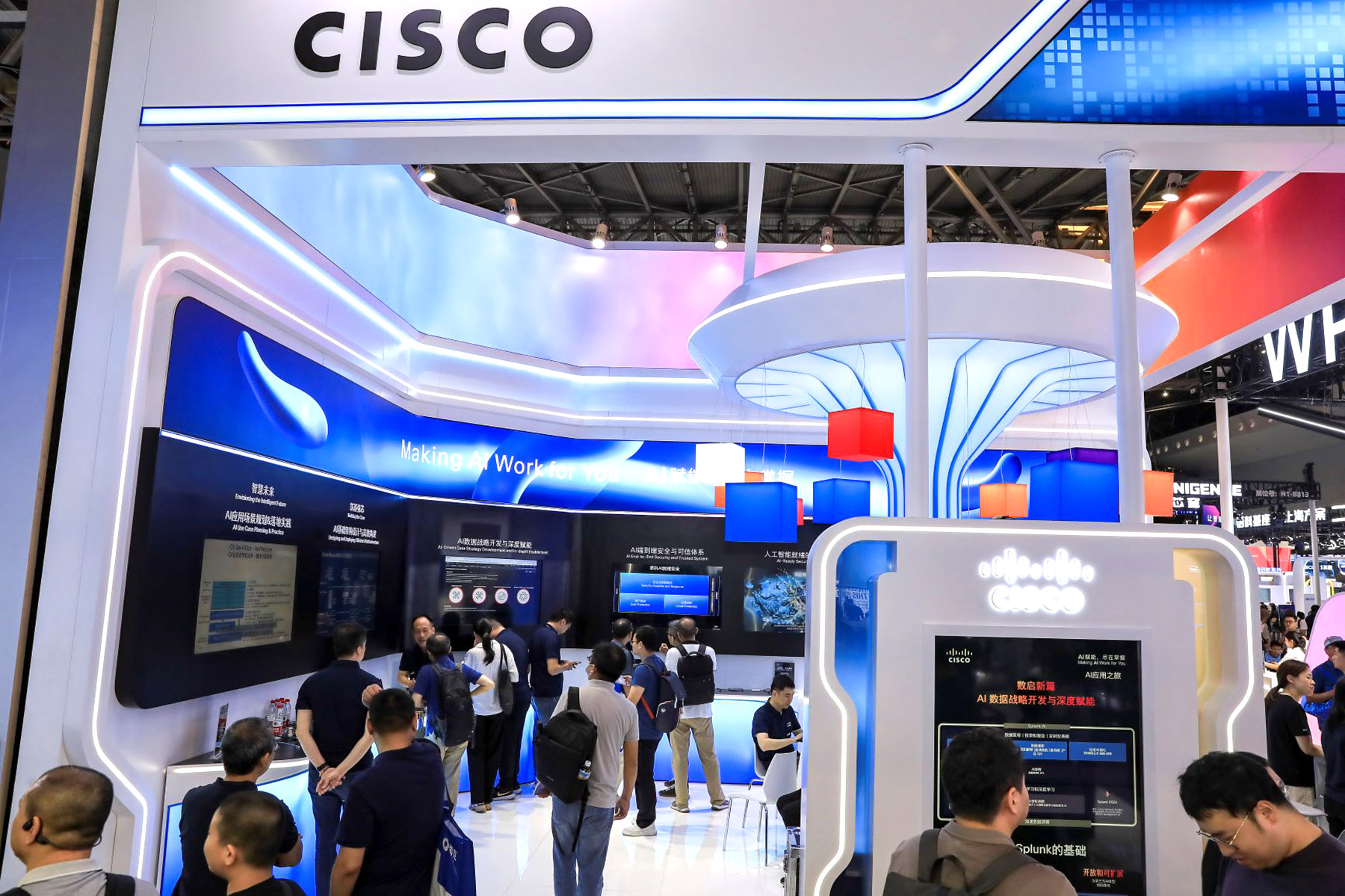
Even as the global landscape shifts, businesses from the United States are reaffirming their deep-rooted presence in China, adopting a long-term strategic vision to navigate cyclical fluctuations and geopolitical headwinds.
"Chinese enterprises are advancing technologically at a pace unmatched globally," said Ming Wong, vice-president of Cisco and CEO of Cisco Greater China. "What foreign companies once took 20 or 30 years to accomplish, China can now achieve in just two or three years — particularly in the realm of technological innovation and application," he added.
Headquartered in San Jose, California, Cisco is a multinational technology conglomerate specializing in networking hardware, software and cybersecurity solutions.
"The advantages of the Chinese market are evident. For one, policy support fosters a stable environment for foreign enterprises. Beyond that, the market abounds with opportunities. Cisco has operated in China for 32 years, witnessing its continuous expansion. Particularly amid the artificial intelligence boom over the past two years, the wealth of innovation opportunities and application scenarios here is highly compelling to us," Wong said.
The Chinese market for Cisco is undergoing a profound evolution, Wong said. "The previous phase was characterized by a market for technology, whereas the relationship is now entering a new stage of market co-innovation," he said.
This transformation is evident across three dimensions: the shift from "one-way input" to "two-way empowerment"; the transition from "product adaptation" to "joint research on standards"; and the progression from "serving the market in China" to "going global hand-in-hand".
Cisco is joining forces with several global telecom giants, pledging to build a 6G network on an open, secure, AI-native platform.
Wong said that 6G will not merely be an upgrade of communication technology, but an industrywide transformation driven by AI as the core engine. He added that this is particularly critical for the China market, as only AI-native networks can truly underpin the mass-scale deployment of applications. Whether it is smart manufacturing, autonomous driving or smart cities, all impose heightened demands for low latency, high reliability and real-time intelligent decision-making.
According to the 15th Five-Year Plan (2026-30), China will steadily expand institutional opening-up, safeguard the multilateral trading system, and extend international circulation, using openness to promote reform and development while sharing opportunities and pursuing common development with the rest of the world.
"Regarding the outline of the 15th Five-Year Plan, I see a forward-looking direction that integrates new technologies and the evolving landscape to further deepen our roots in established sectors. The AI explosion, in particular, has made Cisco's core strengths in connectivity and security even more critical," Wong said.
In recent years, China has continuously expanded its high-standard opening-up, shortened its negative list for foreign investment, and optimized its business environment, providing foreign enterprises with a fairer and more open market landscape.
According to the latest surveys by the American Chamber of Commerce in China and the European Union Chamber of Commerce in China, more than three-quarters of foreign-invested enterprises operating in China plan to continue their operations and increase their investments in the country.
Honeywell, one of the earliest foreign enterprises to enter China, has established a localized value chain in the country covering innovation, research and development, manufacturing and sales. By implementing its "East for East" strategy, the US-based diversified technology company continues to drive business growth through local innovation.
"Honeywell remains committed to its 'East for East' strategy and the philosophy of 'rooting in China, serving China'. On the one hand, it will continue to deepen cooperation with Chinese enterprises; on the other hand, it will keep increasing investment in the R&D and deployment of localized innovative technologies. Furthermore, it will continue to link upstream and downstream resources to bring more Chinese innovations to the global stage, while ensuring that global expertise better serves China's development," said Yu Feng, president of Honeywell China.
Founded in 1885, Honeywell is a multinational technology company headquartered in Charlotte, North Carolina. Its operations span four key sectors of aerospace, building automation, energy and sustainability technologies, and industrial automation.
Honeywell's presence in China dates back to 1935 with its first Shanghai sales agency. After Universal Oil Products, now a subsidiary of Honeywell, was selected as a refining expert during Richard Nixon's 1972 visit, Honeywell became an early entrant to Beijing in 1988.
The company moved toward localization in 1989 via a joint venture with Shanghai Huayi Holdings Group, later partnering with local businesses such as Sinopec.
Accelerating in the 21st century, Honeywell established all of its business groups in China in 2003, advancing the "East for East" strategy. In 2004, it built its China R&D Center in Shanghai.
"Honeywell's 'East for East' strategy differs from conventional localization, which typically involves adapting foreign products to the domestic market. Instead, it is led by local Chinese teams who design, source and manufacture products entirely within China based on specific market demands and client pain points, with all offerings strictly adhering to relevant domestic standards," said Yu.
As Chinese new energy vehicle manufacturers accelerate their global expansion, Honeywell is following suit to extend its overseas footprint. Meanwhile, products developed in China — recognized for their superior performance and cost-effectiveness — are being recommended to globally renowned automotive brands and integrated into the global supply chain, Yu added.
This year marks the 20th anniversary of the US-China Commercial Match-Making Program, or CMP. Established in 2005 by the China Council for the Promotion of International Trade and the International Trade Administration of the US Department of Commerce, the CMP has organized over 100 economic and trade events and served more than 3,000 enterprises from both countries over the past two decades, making it a landmark project for pragmatic cooperation between the business communities of the two nations.
"In recent years, there has actually been a notable increase in exchanges focusing on green and low-carbon initiatives, rail transit and financial investment. This aligns with the expanding scope of bilateral cooperation and reflects the broader trajectory of China-US collaboration," said Li Xiang, deputy director-general of the department of industry promotion at CCPIT.
Next, the CCPIT will leverage the CMP to consolidate and promote deep collaboration between enterprises in fields such as the digital economy, healthcare and new energy vehicles, striving to yield more pragmatic results, according to Li.
