

Xi praises younger generation for dedication to grassroots amid awards to mark China’s Youth Day
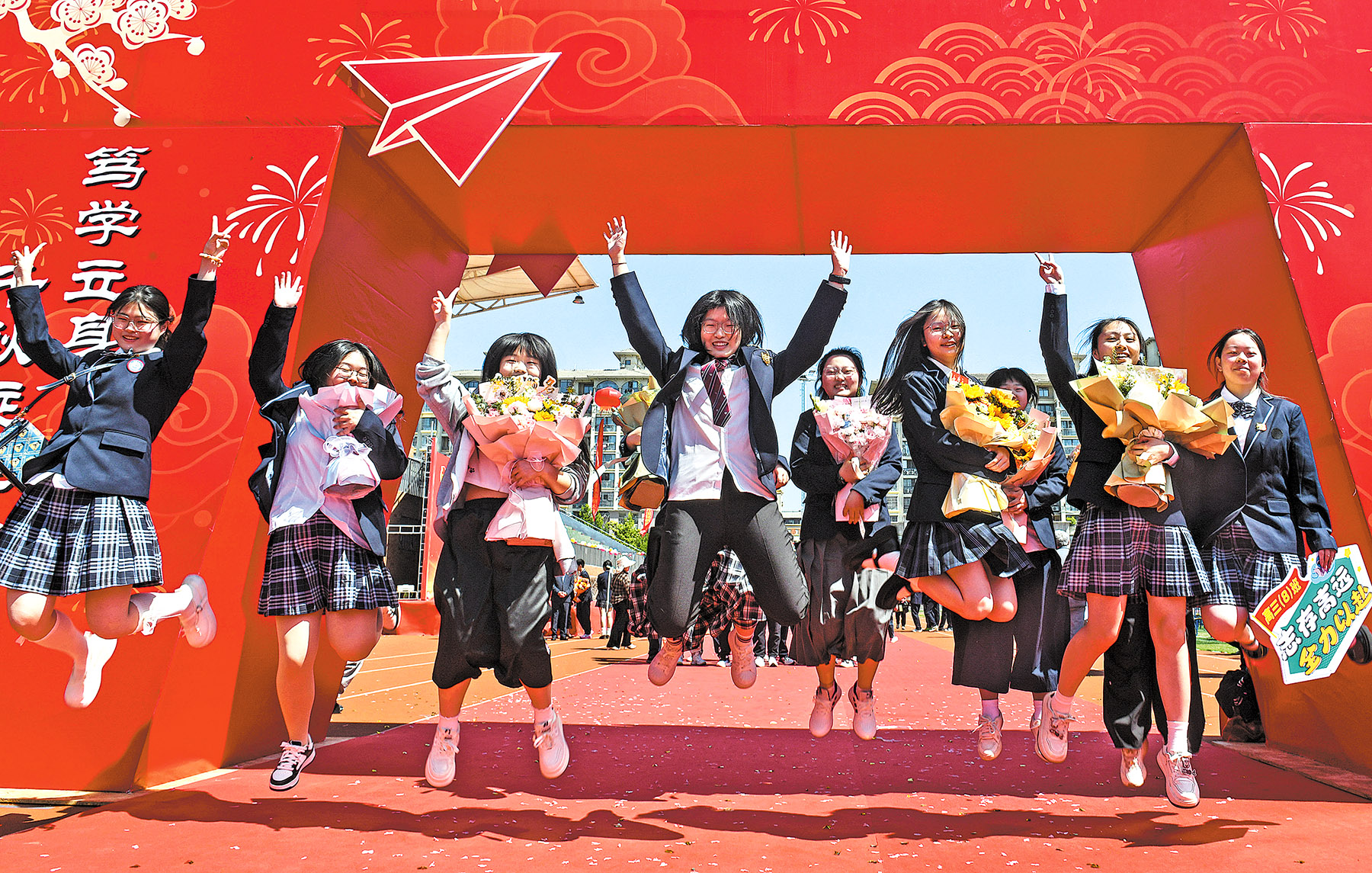
President Xi Jinping encouraged Chinese youth to integrate their personal aspirations into the bigger picture of national development, as he extended greetings to young people nationwide ahead of China’s Youth Day, which fell on May 4.
Xi, who is also general secretary of the Communist Party of China Central Committee and chairman of the Central Military Commission, made the remarks in a reply letter to representatives of recipients of the China Youth May Fourth Medal and the New Era Youth Pioneer award.
In his reply, Xi commended those exemplary young people for their dedication in grassroots and frontline positions, such as sci-tech innovation, rural vitalization, social services, and border defense, and highlighted that they have written a meaningful chapter of youth through practical work and responsibility.
This has demonstrated the confident, self-reliant, and high-spirited outlook of Chinese youth in the new era, he added.
Noting that this year marks the beginning of the 15th Five-Year Plan (2026-30) period, Xi said it is prime time for young people to contribute to the country’s development. He expressed hope that the representatives will uphold lofty ideals, remain committed to hard work, and inspire more young people to integrate their personal pursuits into the country’s overall development.
The president urged young Chinese to strive for new accomplishments in their posts and inject youthful dynamism into advancing the nation’s new journey of development.
Both prizes are designed to honor outstanding young role models who demonstrate political advancement, high moral character, and make significant contributions to society.
Recently, 16 awardees who have won the titles since 2012 wrote to the president to report on their work and insights from serving at the grassroots level, and reaffirmed their resolve to contribute to national development.
This year, 29 individuals and 30 organizations have been awarded the China Youth May Fourth Medal, the country’s highest youth honor for Chinese people aged from 14 to 40. Meanwhile, 749 young individuals received the New Era Youth Pioneer award.
Li Yao, a recipient of the 2026 China Youth May Fourth Medal and a grassroots official of Kantiangezhuang village in Tangshan, Hebei province, said he felt profoundly inspired by Xi’s reply and pledged to translate the encouragement into concrete action promoting rural vitalization.
He said that he will work with fellow villagers to develop local specialty industries, improve the living environment, and encourage more young people to engage in agriculture and rural development — all aimed at boosting the village’s economy and increasing residents’ incomes.
Qiu Kunfeng, also a 2026 China Youth May Fourth Medal recipient and dean of the Beijing-based China University of Geosciences’ School of Earth Sciences and Resources, said that Xi’s message has offered young people renewed motivation to contribute to the nation’s broader development goals.
He said he will remain dedicated to teaching and research, venture into new technological frontiers, and work to address key challenges in strategic mineral exploration.
Xi regularly engages with young people around Youth Day each year, visiting college campuses, attending youth gatherings, or writing back to young students to extend his greetings.
He has consistently highlighted the crucial role of young people, showing unwavering care and support for the younger generation. He continually offers them encouragement and inspiration, while maintaining high expectations for their growth and contributions.
Xi’s reply letter to the young role models commended their dedication in grassroots positions in areas such as sci-tech innovation, rural vitalization, social services, and border defense.
He also encouraged young Chinese to integrate their personal aspirations into the bigger picture of national development, strive for new achievements in their posts, and inject their youthful dynamism into advancing the nation’s new development journey.
This call has been answered by a vast number of young people across the country over the years. Among them is Wang Xuemeng, a young forestry technician at the Saihanba forest farm in Hebei.
After graduating from university in 2018, Wang chose to follow in the footsteps of her grandfather and father to become a forester at Saihanba. Like them, she has woven her youth and ideals into the nation’s ecological endeavors.
Over 60 years ago, 369 young pioneers, including Wang’s grandfather, with an average age below 24, arrived on the barren, windswept plateau with a critical mission: to build an artificial forest farm to halt the southward advance of the Hunshandake sandy land, which posed a persistent threat to Beijing and other northern cities.
Thanks to sustained efforts by generations of foresters, Saihanba has been transformed from a wasteland to a sea of forests — an achievement hailed by Xi as a “miracle”. Today, a third generation is carrying this legacy forward.
Wang said that while earlier generations focused on helping the trees survive and thrive, her generation’s task is to protect the forest farm while enhancing its value as an ecological resource.
“Our strength in the three-generation relay stems from the same original aspiration: to safeguard the ecological shield for our nation,” Wang said. “For over six decades, generations of foresters have all integrated their personal ideals into the broader mission of China’s ecological progress.”
Such commitment is widespread among China’s young people today. Beyond the story of Saihanba, it is reflected in various forms — from young scientists at the forefront of national research and athletes competing on the world stage, to volunteers teaching in less-developed western regions and university graduates driving rural vitalization in their hometowns.
Zhang Jun, secretary of the Shanxi Provincial Committee of the Communist Youth League of China, noted that more than 15,000 university graduates from the province have joined the national Go West volunteer service program. Zhang encouraged more young volunteers to step up and play a part in serving the western regions and working at the grassroots level.
Pledging further guidance and support, Zhang said Shanxi will create more opportunities, improve the recruitment and training process, and enhance job matching, so that more aspiring young people can gain experience, realize their potential, and contribute their youthful energy to advancing Chinese modernization.
According to an article in China Population News, people aged 14 to 35 accounted for about 26 percent of China’s total population in 2025, and their number is projected to remain at approximately 350 million by 2030 and stay above 210 million even by 2050.
The article noted that China is poised to maintain a sizable youth population for the foreseeable future, and this dynamic demographic profile will, in turn, provide favorable conditions for sustained, healthy socioeconomic development.
For President Xi, this dynamic generation is not only a vital force driving national progress, but also a bridge for international friendship and an envoy for people-to-people exchanges.
This vision is being translated into action through a series of concrete initiatives. In 2023, Xi announced a plan to invite 50,000 young people from the United States to China for exchange and study programs over the following five years.
More than 40,000 young people from the US have participated so far, opening a window for them to understand the real China and building a bridge to carry forward the friendship between the two peoples.
In 2025, China and Vietnam co-launched the Red Study Tour program, through which Vietnamese youths will visit China to trace the historical footsteps of the two countries’ revolutionary forebears and strengthen the bonds of friendship.
Furthermore, China has established Luban Workshops in numerous countries, including many in Africa, providing vocational skills training and creating sustained platforms for practical exchanges and cooperation among young people.
In January 2024, Xi replied to a letter from representatives of Kenyan students and alumni at Beijing Jiaotong University. Jamlick Mwangi Kariuki was one of the writers.
Xi places great importance on Africa’s youth, creating many opportunities for them to grow and contribute more to their nation’s development and China-Africa friendship, Kariuki told Xinhua News Agency.
After completing his undergraduate studies in China, Kariuki returned to work on the Mombasa-Nairobi Railway, a flagship project under the Belt and Road Initiative in Kenya. He later returned to China for postgraduate studies.
Kariuki also encouraged more Kenyan youths to study in China, emphasizing the critical importance of cultivating professionals with an international perspective for Kenya’s development.
Yang Dian, a researcher at the Chinese Academy of Social Sciences’ Institute of Sociology, was quoted by China Youth Daily as saying that it is crucial to expand platforms for international youth exchanges and cooperation.
He said that global public goods, such as the Belt and Road Initiative and the Global Development Initiative, have provided young Chinese people with opportunities to engage on the world stage. Through these platforms, he said, young people can enhance mutual understanding, build friendships, and grow together via mutual learning.
Yang also called for leveraging such cooperation frameworks to increase exchange programs, which he said will help foster a global perspective and strengthen the younger generation’s cross-cultural communication skills.
Zhu Xingxin in Taiyuan and Zou Shuo in Beijing contributed to this story.
Contact the writers at jihaisheng@chinadaily.com.cn
