

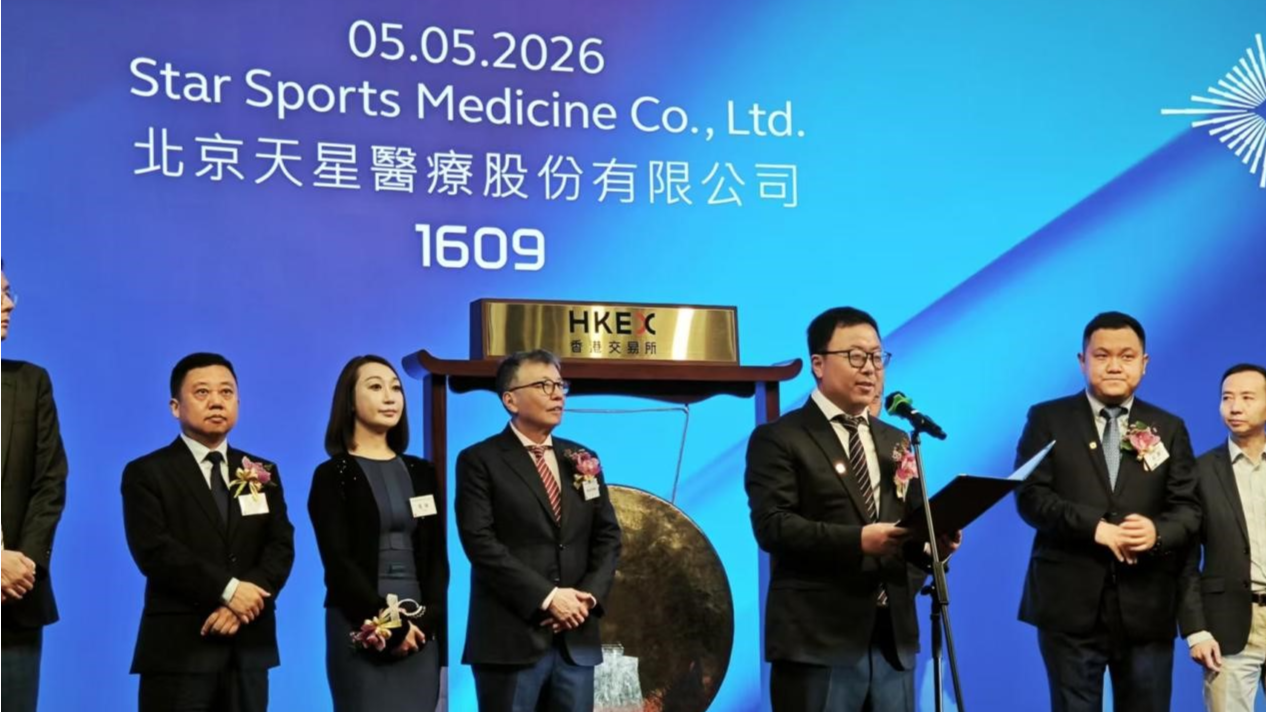
Hong Kong’s biotech sector is gaining further traction, reflected in the initial public offering of Beijing-based Star Sports Medicine on the city’s stock exchange on Tuesday and a pipeline of planned IPOs.
Experts attributed this sustained momentum to stronger full-year results, accelerated commercialization efforts, and robust policy support.
By the end of March, 113 Hong Kong-listed biotech companies had reported their full-year 2025 results, with nearly two-thirds posting positive revenue growth, according to Chinese financial data provider Wind. Ten companies more than doubled their revenue, while 13 swung back to profitability, signaling improving earnings prospects across the sector.
Chinese biotech firms are accelerating their global expansion. Cross-border outlicensing deals of Chinese biotech firms hit record highs in the first quarter of 2026, said Huang Yang, senior analyst for China Healthcare at JPMorgan. He expressed optimism about the outlook of Hong Kong-listed innovative drugmakers.
ALSO READ: InSilico at forefront of AI drug development
The sector’s investment appeal is further bolstered by a reset in valuations. Huang said in a report that some subsectors of the biotech industry have experienced valuation corrections since the fourth quarter of 2025, bringing prices down significantly from their 2025 peaks. Moreover, China’s 2026 Government Work Report recognized biopharmaceuticals as a new pillar industry for the first time, promising additional policy support for the sector, he said.
Meanwhile, Star Sports Medicine, a Beijing-based medical device company, made a stellar debut on the Hong Kong stock exchange on Tuesday.
The company’s stock staged a dramatic rally, at one point skyrocketing over 203 percent to an intraday high of HK$299 ($38.15). It closed at HK$215, marking a 118.3 percent gain from its offering price of HK$98.50. This catapulted its market capitalization to about HK$11.8 billion.
Star Sports Medicine raised net proceeds of HK$758.4 million from its Hong Kong listing. According to the company’s filing to the Hong Kong Exchanges and Clearing Ltd, the city’s stock exchange operator, about 35 percent of the funds will be allocated to research and development (R&D), including expanding the R&D team, procuring research materials and equipment, and increasing investment in design validation, registration tests and clinical trials. About 25 percent will be used for commercialization, sales and marketing initiatives.
READ MORE: Hong Kong seen as launchpad for more life sciences companies
Based on 2024 sales revenue, Star Sports Medicine ranked as the fourth-largest sports-medicine implants and instruments provider in China and the largest domestic supplier, with a market share of 6.5 percent, as data from China Insights Consultancy showed.
The listing was more than 7,800 times oversubscribed in the retail tranche.
“This strong demand deeply reflects the vibrancy and prosperity of the Hong Kong capital market,” said Dong Wenxing, the company’s founder and chairman, at the listing ceremony. He pledged to build a second growth curve centered on smart healthcare and regenerative medicine, creating a full-cycle product portfolio covering prevention, treatment and rehabilitation, while advancing the company’s development toward greater international presence.
The broader biotech sector is on track to see more listings in the near term. Medical device company Corfu Medical Technology is scheduled to list on May 6, while biotech firm Impact Therapeutics is expected to debut in the coming week.
The overall performance of the Hong Kong stock exchange was weaker on Tuesday. The benchmark Hang Seng Index edged down 0.76 percent to close at 25,898.61 points, while the Hang Seng Tech Index, which tracks the city’s 30 largest listed technology companies, dropped 0.94 percent to 4,929.68 points.
Contact the writer at akirawang@chinadailyhk.com
