

Experts: Domestic demand signals steady expansion in months ahead
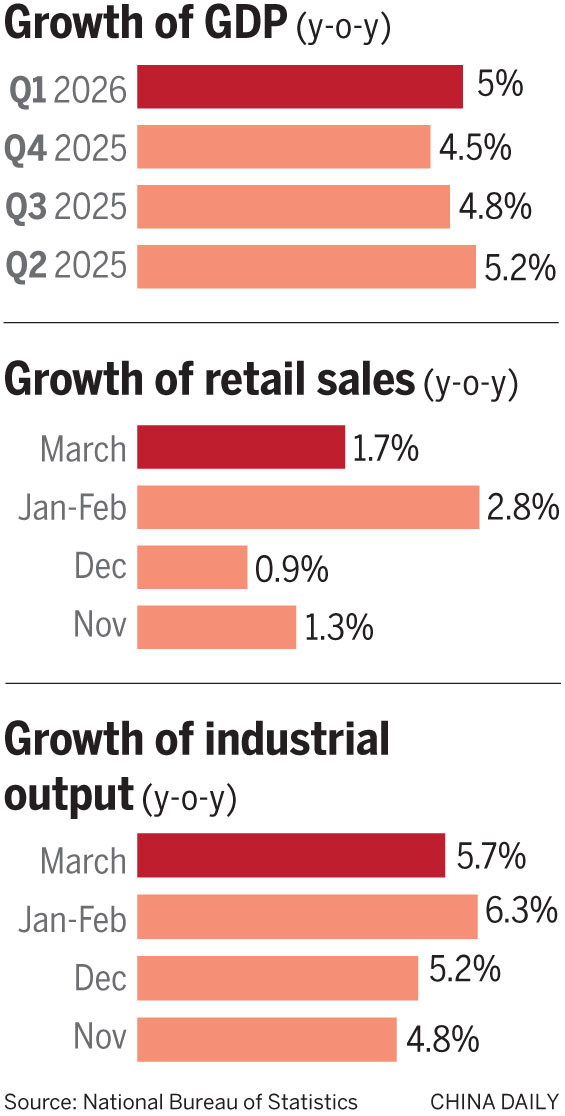
China’s economic growth accelerated to 5 percent in the first quarter of 2026 despite mounting external uncertainties, underscoring that the resilience of the world’s second-largest economy is underpinned by its vast domestic market, officials and experts said on April 16.
Domestic demand contributed more than four-fifths of GDP growth, they said, with investment returning to positive growth and inflation picking up — a trend expected to anchor steady economic expansion in the coming months.
However, analysts cautioned that the recovery in domestic demand may not yet be on a firm footing, given the slowdown in household income growth and continued pressures from elevated international energy costs, highlighting the need for ramping up targeted policy support.
China’s GDP came in at 33.42 trillion yuan ($4.9 trillion) in the first quarter, growing 5 percent year-on-year in real terms and 0.5 percentage point faster than the fourth quarter of 2025, the National Bureau of Statistics said on April 16.
“The Chinese economy got off to a good start, with main macroeconomic indicators improving and new growth drivers expanding rapidly,” said Mao Shengyong, deputy head of the NBS, adding that the economy is well-positioned to maintain steady growth in the coming period.
Beating market expectations, first-quarter growth was supported by improving domestic demand and resilient export growth.
Retail sales, a key gauge of consumption, grew 2.4 percent year-on-year, up 0.7 percentage point from the previous quarter, the NBS said.
Fixed-asset investment rose 1.7 percent year-on-year during the first quarter, reversing a 3.8 percent decline in 2025, as infrastructure spending strengthened and manufacturing investment accelerated, while the contraction in property development investment narrowed.
In total, consumption and investment accounted for 84.7 percent of first-quarter GDP growth, up nearly 30 percentage points year-on-year, the bureau said, pointing to a continued shift toward a growth model driven by domestic demand.
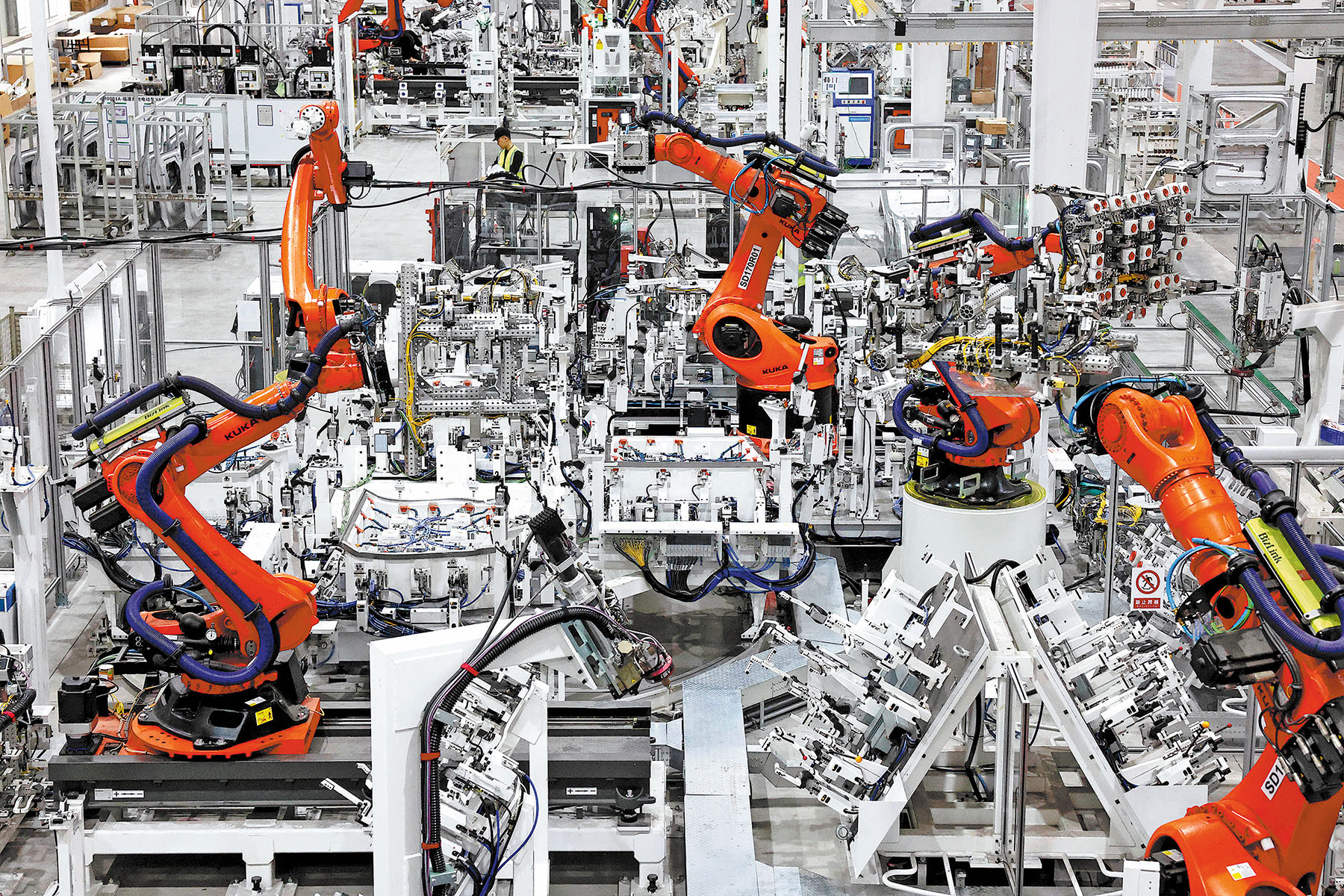
Technological and industrial innovation also provided strong support. High-tech manufacturing contributed 32.6 percent of overall industrial output growth, which is up 6.1 percent year-on-year, 1.1 percentage points faster than in the fourth quarter of 2025.
Inflation has picked up as demand strengthened. Figures calculated by Japanese investment bank Nomura show that China’s GDP deflator — a broad measure of price levels — improved from minus 0.6 percent in the previous quarter to minus 0.1 percent in the first quarter, the highest in three years.
“China’s reflation has transitioned from hope or expectation to reality,” said Xiong Yi, Deutsche Bank’s chief economist for China.
This trend could improve Chinese corporates’ revenue and profitability and further support the recovery of investment and household income, Xiong said, with the bank upgrading the forecast for China’s 2026 real GDP growth to 4.9 percent.
Solid economic performance has provided support for China’s stock market, with the ChiNext Index surging 3.17 percent to close at 3,626.27 points on April 16, an 11-year high.
Junjie Watkins, equity partner at Pictet Group, a Swiss financial services company, said the Chinese market offers “a degree of certainty in an otherwise uncertain environment”, underpinned by its long-term development planning, improving earnings revisions and attractive valuations.
Improving sentiment is also reflected in foreign direct investment trends. A report released by US consulting firm Kearney showed that China climbed two places to rank fourth globally in the firm’s 2026 FDI Confidence Index, with China’s leadership in artificial intelligence and its vast domestic market as key sources of appeal.
Given that the first-quarter growth has laid the foundation for achieving China’s annual GDP target of 4.5 to 5 percent, analysts said the likelihood of launching significant easing measures such as interest rate cuts is low in the near term, especially as rising global oil prices hit the domestic market.
However, targeted support measures may still be needed, with Mao from the NBS calling for more proactive and effective macro policies in the next phase.
Contact the writers at zhoulanxv@chinadaily.com.cn
