

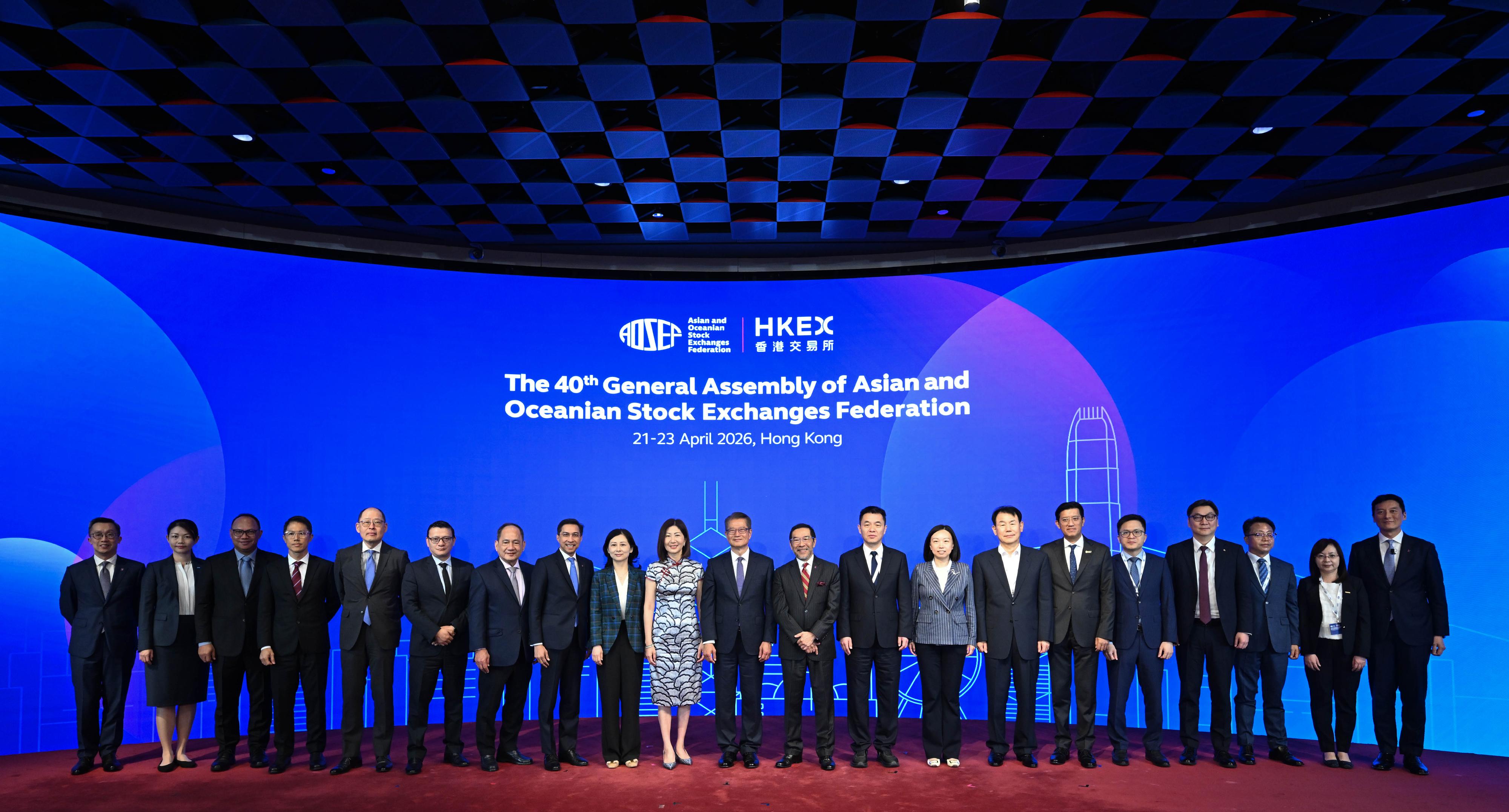
Hong Kong’s finance chief on Wednesday urged Asia’s stock exchanges to move from competing with one another to collaborating as a network to ensure seamless accessibility for investors, so that international capital sees the region not as fragmented markets but as a compelling, coherent whole.
Paul Chan Mo-po made the call while delivering a speech at the 40th General Assembly of the Asian and Oceanian Stock Exchanges Federation (AOSEF) in Hong Kong.
“Together, the federation's 17 members represent roughly one-third of global market capitalization and more than half of the world's listed companies. Yet many international investors still treat Asia as an afterthought. Why? Because of too many global funds, navigating across our markets remains complex and unfamiliar when approaching us one by one,” he said.
Chan said the bourses should address the opportunity and the challenge together, adding: “When a long-term investor can gain exposure to Asian innovation without the hassle of navigating a maze of separate custodian accounts, the entire region wins. Our diversity is our strength, but only if we build the bridges that turn complexity into seamless accessibility.”
Pointing out that Hong Kong's role in the ecosystem is evolving, he said the city has served as a gateway between international capital and the Chinese mainland market for decades, with more than half of Hong Kong’s listed companies being mainland enterprises, accounting for around 80 percent of total market capitalization.
“Our Connect schemes with the mainland now account for roughly 70 percent of international holdings of A-shares and about 60 percent of offshore holdings of mainland bonds,” he added.
He stressed that Hong Kong's role is larger than any single corridor, as it is increasingly becoming a platform where the assets of one Asian market can be packaged and discovered by global investors “who might otherwise never look at it.”
RELATED ARTICLES
- HK unveils first equity ETF targeting premium China, ASEAN assets
- Chan: HKSAR forges stronger ties with Middle East, Central Asia
- HKEX plans to cut trade settlement to one day from end of 2027
- Hong Kong bourse plans to start zero-day options in early 2027
- HKEX plans a multi-asset product ecosystem to capture capital flow
Citing the example of a Hong Kong fund manager working with her Korean counterpart to list leveraged and inverse products in Hong Kong tracking Korean equities, Chan said the instruments have attracted a wave of international investors – many of whom were previously unfamiliar with the Korean market – effectively channeling fresh capital towards Korean stocks.
“This is not a zero-sum transaction. For Korea, this means new global visibility. For investors, more tools to express their views. For Hong Kong, deeper markets. That is collective value creation – and a model we can replicate.”
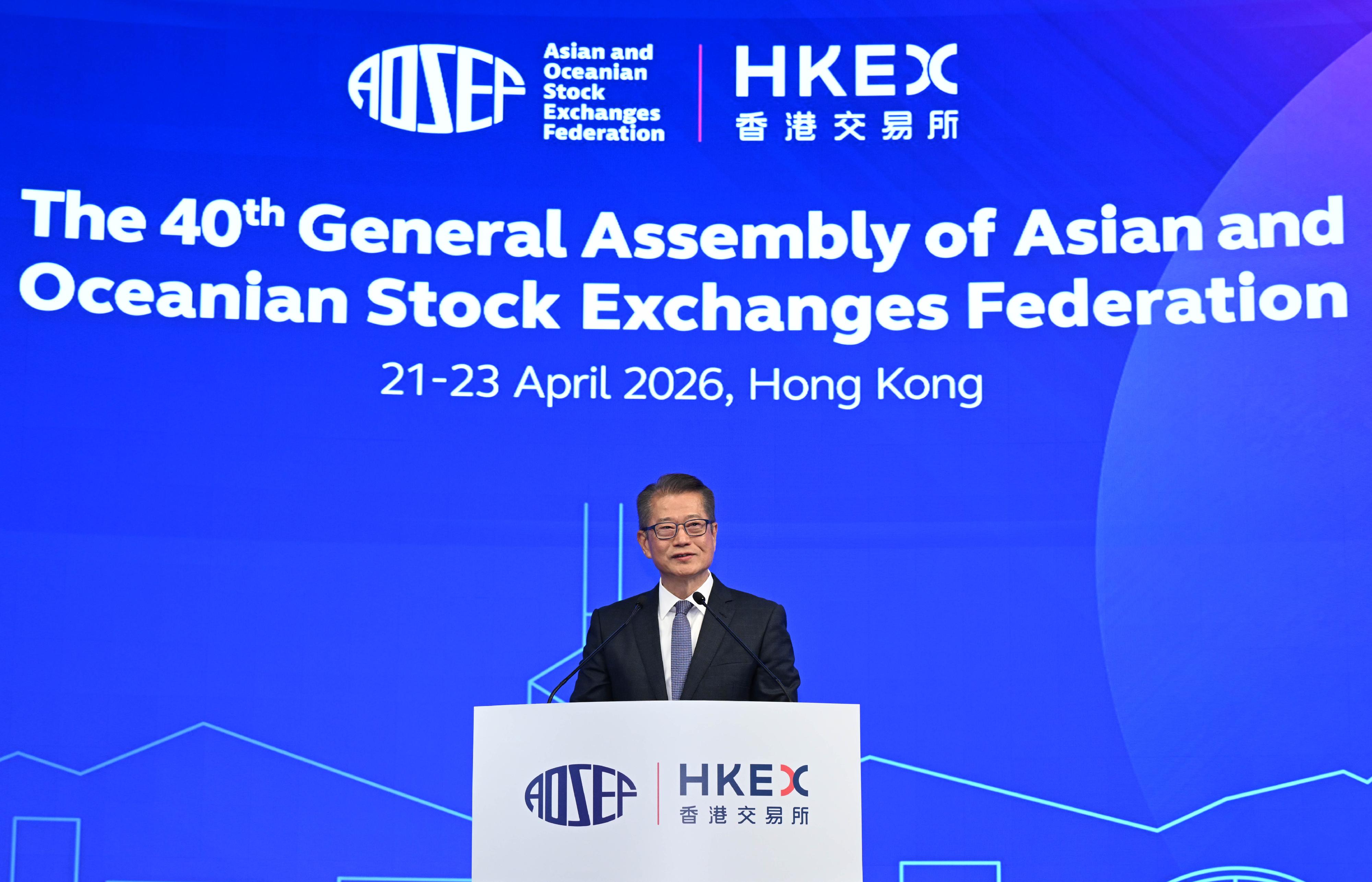
Referring to Hong Kong’s introduction of "Finance+" strategy, he said the objective for this is not to expand the city’s market share alone, but to strengthen Hong Kong as capital-formation infrastructure for the entire region's innovation economy.
Speaking about broadening product ecosystem, the finance chief said Hong Kong has become one of the world’s top three exchange-traded product (ETP) markets, with average daily turnover around $5 billion. The expansion of thematic exchange-traded funds (ETFs) adds vibrancy and vitality to Hong Kong’s market, he said, adding that ETF mutual recognition with Saudi Arabia's Tadawul has created the largest such products in the Middle East.
On connectivity, he said Hong Kong has agreements with 20 exchanges worldwide to facilitate dual listings, and will conclude more across the region.
“Our one-stop, multi-asset custodial platform, CMU OmniClear – a joint venture between the Hong Kong Monetary Authority and HKEX – will enable integrated management of equities and bonds, facilitating cross-asset collateralization that supports the growth of derivatives markets across our network.”
These capital flows fuel the real economy, he said, adding that global institutional investors – actively seeking diversification and long-term growth – are looking for Asia's next generation of enterprises. “Hong Kong's role is to ensure that when that capital arrives, it flows efficiently to where Asia's best opportunities are – wherever they may be listed.”
With supply-chain and industry base reconfiguration creating new industrial clusters, the region's demographic dividend, urbanization, and expanding middle class will drive demand, he said.
Chan proposed to transform the AOSEF from an annual forum into a working group for tangible interoperability: mutual ETF listings, co-developed indices, shared disclosure standards, and eventually, multilateral connectivity that allows capital to move across the region’s markets with greater ease.
“When we collaborate, we create incremental liquidity for each other. When we align our infrastructure, we lower the cost of global participation. When we pool access to international capital, we give every innovative enterprise in our region a better chance to scale and succeed,” he added.
Chairman of the Hong Kong Exchanges and Clearing Ltd (HKEX) Carlson Tong Ka-shing and HKEX Chief Executive Officer Bonnie Chan Yi-ting were present among the dignitaries.
