

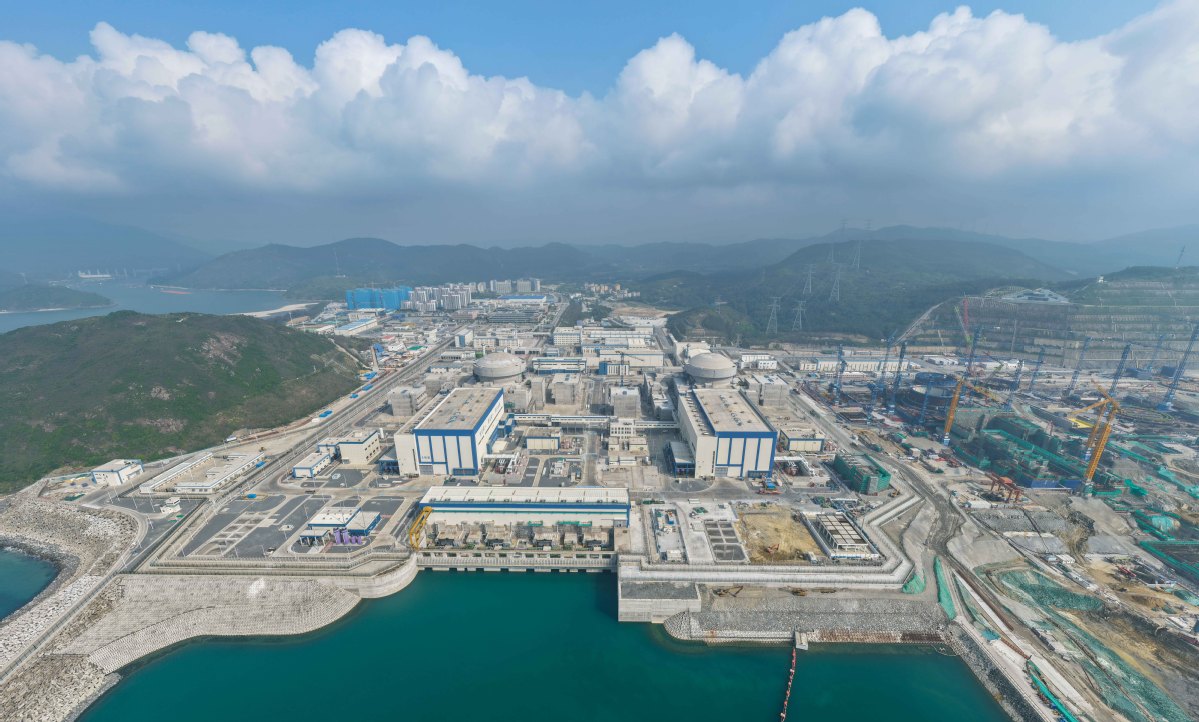
The first Hualong One nuclear power unit in the Guangdong-Hong Kong-Macao Greater Bay Area officially entered commercial operation on Monday, marking a significant milestone in China's independent development of third-generation nuclear technology and its commitment to a green energy transition.
The No 1 unit of the Taipingling nuclear power project in Guangdong province, managed by China General Nuclear Power Group, the country's largest nuclear power plant operator in terms of installed capacity, is now fully operational and capable of generating over 9 billion kilowatt-hours of electricity annually.
This output is sufficient to meet the annual power needs of about one million residents in the Greater Bay Area, one of China’s most economically vibrant and energy-demanding regions, it said.
ALSO READ: Hualong One nuclear tech gains ground in China's Ningbo
According to the group, the unit achieved multiple key technical breakthroughs through independent innovation. Notably, critical components such as the main steam isolation valves have been localized, signaling a firm step forward in the comprehensive autonomy of high-end nuclear power equipment.
The Greater Bay Area has seen a sustained surge in demand for stable and clean energy. In 2025, Guangdong province’s total electricity consumption reached 958.97 billion kWh, a 4.93 percent year-on-year increase, ranking first in the country.
The Taipingling project is planned to house a total of six Hualong One units. Once all six are completed, the plant is expected to generate more than 55 billion kWh per year. This will be equivalent to reducing standard coal consumption by around 16.65 million metric tons and cutting carbon dioxide emissions by about 50.82 million tons annually.
ALSO READ: 2nd Hualong One nuclear reactor in China starts operation
With the unit now online, the group has 29 nuclear units in operation with a total capacity of 33.04 million kilowatts. The company also has 19 units currently under construction, 17 of which utilize the Hualong One technology, making it a cornerstone of China's future energy mix.
