

WASHINGTON/BEIRUT/CAIRO/JERUSALEM/DAMASCUS – US President Donald Trump said on Wednesday that Israel-Lebanon talks will take place on Thursday.
"Trying to get a little breathing room between Israel and Lebanon. It has been a long time since the two leaders have spoken, like 34 years. It will happen tomorrow," Trump wrote on Truth Social.
Israel and Lebanon on Tuesday held a meeting in Washington, where Israel insisted on Hezbollah's disarmament and Lebanon called for a ceasefire and concrete measures to ease the severe humanitarian crisis resulting from the US-Israeli war with Iran, according to a statement from the US State Department.
All sides agreed to launch direct negotiations at a mutually agreed time and venue, according to the statement.
The meeting marked the first major high-level engagement between Israel and Lebanon since 1993, it said.
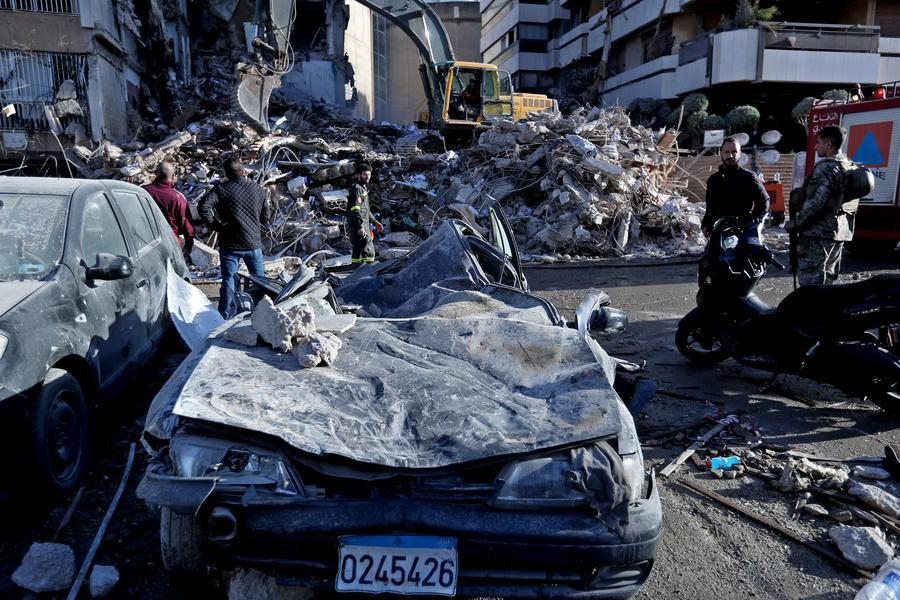
Cross-border fighting has continued along the Lebanon-Israel border since March 2, when Hezbollah launched rockets toward Israel for the first time since a ceasefire agreed on Nov 27, 2024, triggering intensified Israeli airstrikes across Lebanon that have so far killed 2,167 people and injured 7,061 others.
On April 8, Israel carried out its largest single-day attack on Lebanon, which Lebanese authorities said killed more than 350 and injured over 1,100.
Hezbollah agrees to ceasefire with caution
The deputy head of Hezbollah's political council said on Wednesday that the group has agreed to a ceasefire with Israel but remains cautious about its implementation.
Speaking to Al Jadeed TV, Mahmoud Qomati said Hezbollah would not accept a return to the 2024 arrangement, under which one side complied while Israel evaded its obligations.
Any effort toward reaching a ceasefire is appreciated, while warning of potential Israeli breaches, he added.
Qomati also advised residents to avoid traveling to southern Lebanon for the time being, citing ongoing security risks.
Israel has been discussing a possible ceasefire, with its Security Cabinet set to review the option, while parallel US-mediated talks involving Lebanon have made a ceasefire one of the key issues under negotiation.
,Lebanon files urgent UN complaint
Lebanon said Wednesday it has filed an urgent complaint to the United Nations over Israeli airstrikes on April 8 across the country.
The move was based on a cabinet decision issued Thursday, requesting that the complaint also be circulated as an official document of both the UN General Assembly and the Security Council, said the Lebanese foreign ministry.
The same day, the United Nations Interim Force in Lebanon (UNIFIL) said a routine convoy transporting military and civilian peacekeepers, along with contractors, was halted by Israeli forces near the southern Lebanese town of Naqoura the previous day.
The incident was not isolated, UNIFIL said, calling on the Israeli side to respect existing arrangements and fulfill its obligations to ensure the safety, security, and freedom of movement of UN peacekeepers and their logistical convoys.
‘Lebanon offensive to continue’
Israel's military Chief of Staff Eyal Zamir said that he has approved plans for the continuation of fighting against Hezbollah during a visit to southern Lebanon, according to a readout released by the military on Wednesday.
The approval of further operational moves comes amid reports regarding a potential emerging new ceasefire between the two countries.
Zamir met with Israeli commanders and troops who invaded southern Lebanon in early March as part of a ground offensive. "I have instructed that the entire area of southern Lebanon up to the Litani River become a no-go zone for Hezbollah operatives," he said.
He said Israel has killed more than 1,700 Hezbollah militants since the beginning of the Iran war, without providing evidence. He described the strikes in Beirut and southern and eastern Lebanon as "a severe blow" to the group.
"Yesterday, I approved further plans together with the General Staff Forum. We continue to conduct ongoing situational assessments and approve plans, both in Lebanon and in Iran," he said.
He said Iran must be prevented from making strategic gains in its nuclear program or the Strait of Hormuz.
He said the operation in Bint Jbeil continues, as well as ground attacks on the Beit Leaf area, while troops from three additional divisions are preparing what Israel described as a buffer zone on Lebanese soil, which Israeli officials said includes destroying villages along the Lebanese-Israeli border.
277,000 flee Lebanon into Syria
More than 277,000 people have crossed from Lebanon into Syria since early March amid escalating regional tensions and cross-border violence, straining already limited resources in the war-torn country, the United Nations refugee agency said on Wednesday.
According to the United Nations High Commissioner for Refugees (UNHCR), around 277,000 people entered Syria between March 2 and April 12. Among them, about 234,000 were Syrians, including about 67,300 intending to return permanently, and roughly 43,000 Lebanese nationals.
The UN Independent International Commission of Inquiry on the Syrian Arab Republic expressed concern over the impact on stability and human rights in the country, noting that many arrivals are already traumatized by years of war in Syria and recent shelling in Lebanon.
The commission said that the growing number of returnees and displaced people is further stretching Syria's fragile infrastructure and limited humanitarian capacity, as millions across the country continue to rely on aid.
