

The Greater Bay Area, already equipped with institutional, financial and technology strengths, can make itself more distinctive from the country’s two other tech hubs to deepen cross-boundary cooperation and promote complementary competition, say experts. Li Bingcun reports from Shenzhen.
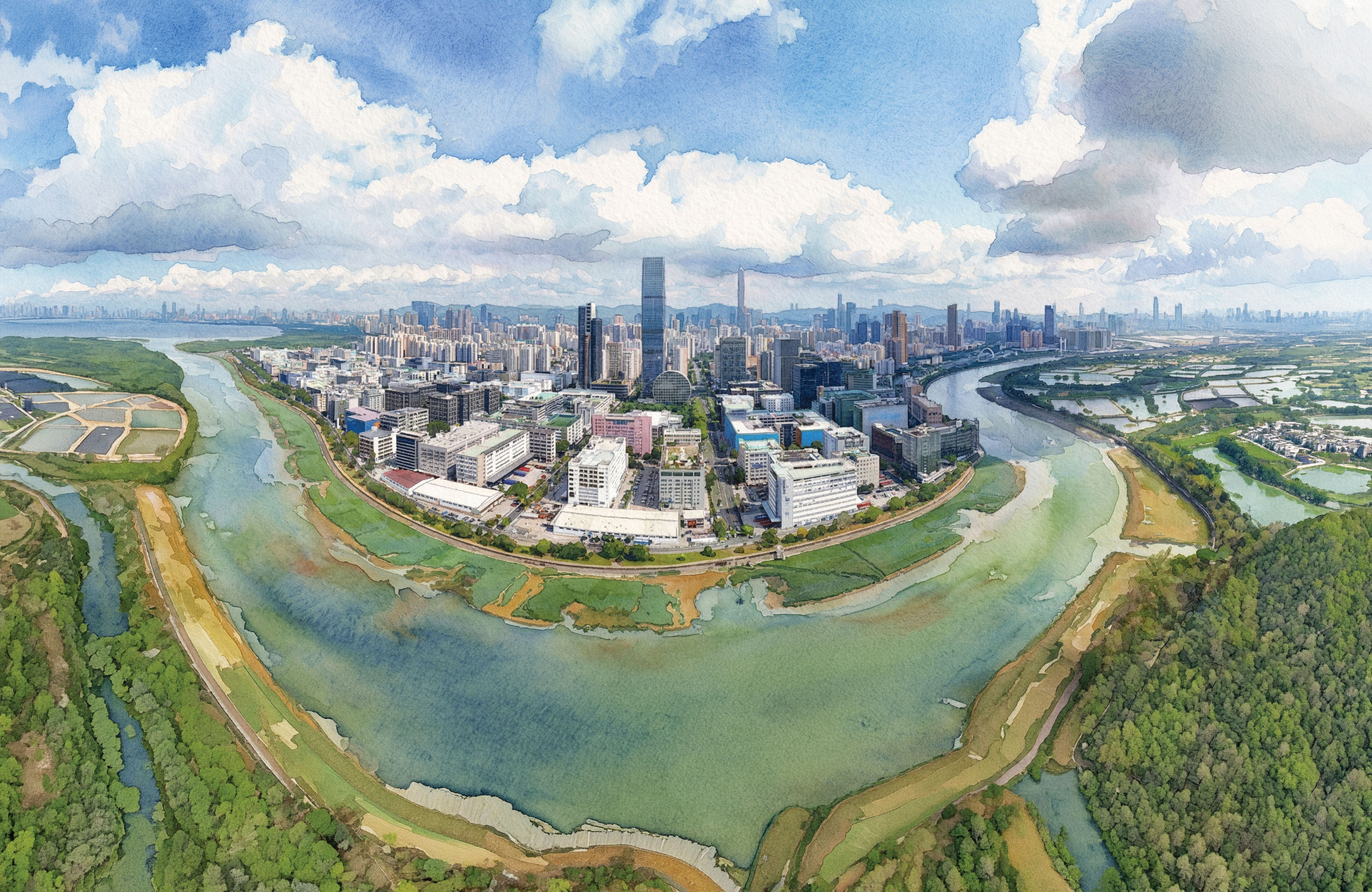
The Guangdong-Hong Kong-Macao Greater Bay Area can make the most of its institutional trump card to deepen cross-boundary innovation, carving out a development path distinct from the country’s two other technology clusters.
Specifically, experts suggest that the 11-city Greater Bay Area can better leverage Hong Kong’s rising strategic role in the nation’s tech landscape, further unleashing the dynamism of enterprises as key innovation drivers, while strengthening macro-level planning for the cross-boundary flow of research resources.
This year’s Government Work Report proposed turning the Beijing-Tianjin-Hebei cluster, the Yangtze River Delta, and the Greater Bay Area into world technological innovation centers to boost technological self-reliance.
READ MORE: New service platform launched in Hetao to boost technological innovation
Beefing up technological connections between the Hong Kong and Macao special administrative regions and the Chinese mainland is also outlined in the recently approved 15th Five-Year Plan (2026-30) for the two SARs’ further integration into national development.
The three innovation clusters have distinct strengths and functions, creating the conditions for complementary competition, says Tu Haiming, vice-chairman of the Committee on Liaison with Hong Kong, Macao, Taiwan and Overseas Chinese of the National Committee of the Chinese People’s Political Consultative Conference.
The Beijing-Tianjin-Hebei cluster boasts the capability to gather national-level scientific resources and talent to catalyze innovation at the source, the Yangtze River Delta excels in deep integration of technology and industry, and the Greater Bay Area has the unique “one country, two systems” framework to build an open ecosystem for collaborative innovation.
Tu believes the Greater Bay Area’s greatest advantage lies in its potential for institutional innovation, which can turn disparities among varying social systems into momentum for technological innovation.
Hong Kong’s role as a global financial hub has also strengthened the cluster’s competitiveness.
Emphasizing Hong Kong’s significance in the region’s inno-tech blueprint, Tu says the city has risen from a “participant” to a “leading force” in the nation’s drive for technology self-reliance, receiving State-level backing in this field.
Hong Kong’s leading role
Leveraging the HKSAR’s strategic role and international connections, Tu says the Greater Bay Area should step up efforts to attract and retain talent, particularly by creating a favorable work and living environment in the Hetao Shenzhen-Hong Kong Science and Technology Innovation Co-operation Zone.
He stresses the importance of seeking breakthroughs in emerging industries, for example, by launching drone delivery pilot programs between Shenzhen’s Qianhai area and Hong Kong to expedite the low-altitude economy; and promoting the scaled commercialization of artificial intelligence in key industries.
Song Xiangqing, vice-president of the Commerce Economy Association of China, believes that cross-boundary innovation and the integration of technology with manufacturing and finance create the Greater Bay Area’s distinct strengths.
To avoid homogeneous competition, the central government should introduce policies to identify the focus of each innovation cluster and guide them to develop key industries based on their respective strengths. It should also enhance cross-regional coordination to promote shared access to scientific facilities and mutual recognition of research outcomes, Song suggests.
Given the Greater Bay Area’s specific circumstances, Song would like to see regional authorities give full play to the role of enterprises in driving innovation, supporting tech giants to increase investment in basic research for long-term breakthroughs.
Whether in terms of the number of high-tech companies, their research-and-development spending, or the patent output they generate, the Greater Bay Area has grabbed pole position within the country, nurturing a large number of trailblazing tech firms and entrepreneurs.
Song also proposes strengthening intellectual property protection in emerging fields. The features of emerging technologies, such as a short iteration cycle, non-physical form, and strong cross-disciplinary integration, significantly increase difficulties with their intellectual property protection, making it imperative to improve systems.
Yang Yongcong, deputy director of the Guangdong-Hong Kong-Macao Greater Bay Area Research Institute at the Guangdong University of Foreign Studies, says many policies promoting the cross-boundary flow of scientific resources are designed to solve concrete problems, but a comprehensive framework to coordinate these efforts is lacking.
The Greater Bay Area should speed up the formation of two innovation corridors: one centered on Guangzhou-Shenzhen-Hong Kong, focusing on frontier fields, such as artificial intelligence and quantum technology; and the other centered on Guangzhou-Zhuhai-Macao, highlighting areas of strength like marine science and technology, biopharmaceuticals and aerospace, he adds.
Building innovation corridors
Last year, the Shenzhen-Hong Kong-Guangzhou cluster ranked first globally in the World Intellectual Property Organization’s list of the world’s top 100 technology clusters. The Zhuhai-Macao cluster also made the list.
Meanwhile, Yang hopes that Guangdong province can proactively seek opportunities from Hong Kong’s new industrialization strategy and Macao’s digital economy development.
For example, Hong Kong could establish advanced manufacturing bases in the Northern Metropolis, in fields such as microelectronics and life sciences, to deepen cooperation with Guangdong. It is also worth exploring how Guangdong can participate in the development of Hong Kong’s key inno-tech platforms, he says.
Yang also advocates establishing a more competitive joint funding mechanism for Guangdong, Hong Kong and Macao to work together to overcome technological challenges and translate research outcomes into applications.
ALSO READ: Macao thrives as collaboration deepens
Besides stepping up coordination, the Greater Bay Area should focus on gathering international innovation resources to promote the global expansion of high-quality tech products and solutions from the mainland.
Hong Kong’s streamlined approval process for new drugs has accelerated the entry of mainland pharmaceutical products into the city, enabling them to reach wider markets. Yang suggests that the same approach could be extended to technology products to help drive the globalization of China’s tech industry.
Under the current Sino-United States relationship and the Middle East conflict, he expects Hong Kong to attract a fresh wave of talent and capital, and hopes the Greater Bay Area will seize this opportunity to retain top-notch tech talent through platforms such as joint laboratories.
Contact the writer at bingcun@chinadailyhk.com
