

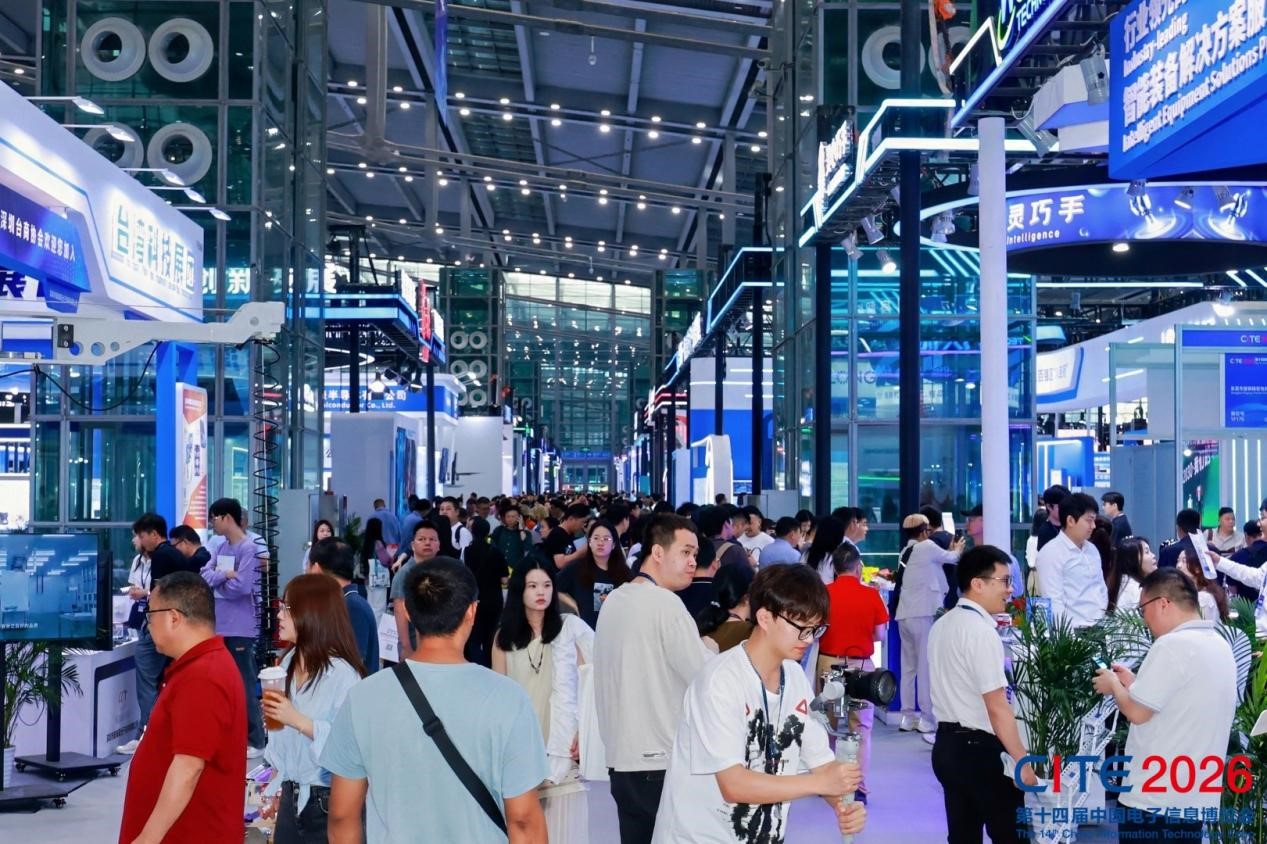
China is accelerating the drive to elevate its new-generation information technology clusters to world-class status, as competition among industry clusters has become the focal point of global industrial rivalry.
During the opening ceremony of the 14th China Information Technology Expo, held in Shenzhen, Guangdong, on Thursday, experts said that the outline of the nation’s 15th Five-Year Plan (2026-2030) identifies developing advanced manufacturing industry clusters as a key task for building a modern industrial system and strengthening the foundation of the real economy.
China currently has 80 national advanced manufacturing clusters, including 17 new-generation IT clusters, covering key sectors such as integrated circuits, smart devices, consumer electronics, software services, the Industrial Internet, and artificial intelligence.
ALSO READ: HKSAR govt official: Hetao Park to pilot imports
Wu Jing, director of the Strategic Cooperation department at China Electronics Information Industry Group Co, Ltd, described the 15th Five-Year Plan period as a vital strategic window for the development of the IT industry.
The outline clearly specifies promoting innovation across the entire industrial chain of electronic information, developing high-end products in short supply, and accelerating breakthroughs in key components, parts, and specialized materials.
As a pillar of China’s manufacturing industry, the IT sector has consistently ranked first in terms of operating revenue for more than a decade among China’s 41 major industrial sectors.
READ MORE: Legal sector urged to align with national growth targets
Last year, China’s IT enterprises above a certain scale generated operating revenue of 17.4 trillion yuan ($2.54 trillion), with its value-added growing by 10.6 percent year-on-year.
Li Yizhong, former head of China’s Ministry of Industry and Information Technology, said that global industrial competition has evolved from comparing individual companies and single products to competing through industrial clusters and broader industry ecosystems.
To strengthen the IT industry’s global influence, he called for enhancing collaborative innovation among different innovation drivers and deepening cross-sector integration of subindustries.
In addition, he underlined the significance of integrating into global innovation and supply chains, learning from the advanced management practices of developed countries, and accelerating the opening-up of application scenarios to drive industrial transformation.
READ MORE: Robots to take center stage in upcoming April tech fairs
He Yingkun, director of the Industrial Culture Development Center under the Ministry of Industry and Information Technology, said that advanced manufacturing clusters represent the highest form of deepened industrial division of labor and agglomeration, and are a key indicator of a manufacturing powerhouse’s competitiveness.
China has been the world’s leading manufacturing nation for 16 consecutive years. “With the world’s most comprehensive industrial system, the largest pool of engineers, and the most dynamic innovation ecosystem, the country has the foundation to build globally competitive manufacturing clusters,” said He.
He added that he believes the core of building internationally leading IT clusters lies in innovation at source, and that he hopes to give full play to existing innovation platforms and to form more influential innovation alliances to achieve breakthroughs in foundational technologies.
The expert added that China has the world’s most complex industrial scenarios and deep penetration of the consumer internet. In specific fields — such as intelligent vehicles, embodied intelligence, and the industrial metaverse — he said he hopes that more diverse application scenarios will be offered to allow enterprises to iterate and refine their technologies.
Contact the writer at bingcun@chinadailyhk.com
