

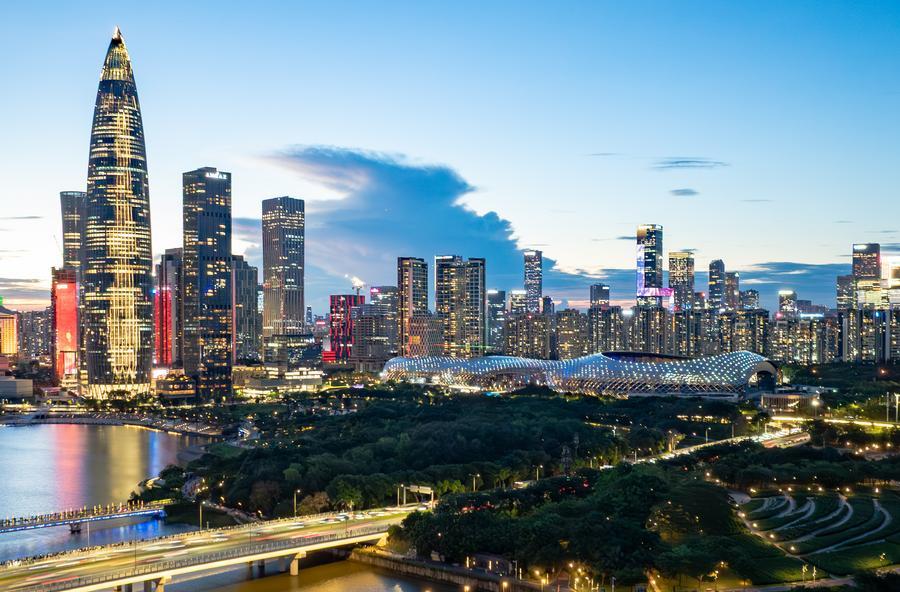
More efforts should be made to enhance financial “soft connectivity” and regulatory coordination to deepen cross-boundary financial integration in the Guangdong-Hong Kong-Macao Greater Bay Area, industry experts said.
Expanding financial connectivity was highlighted in China’s 15th Five-Year Plan (2026-30), as the country strives to promote financial opening-up and enhance its influence in global financial markets.
Boasting twin financial hubs — Hong Kong and Shenzhen — as well as Hong Kong’s unique “one country, two systems” advantage, the Greater Bay Area stands out as a testbed and frontrunner in the push.
The 11-city cluster — especially Shenzhen and Hong Kong — has made remarkable progress in cross-boundary financial connectivity over the past years, with a number of connect programs being launched, including Stock Connect, Bond Connect and Cross-boundary Wealth Management Connect.
ALSO READ: Deeper tech-finance synergy seen key to GBA’s high-tech ambition
Launched in December 2016, the Shenzhen-Hong Kong Stock Connect has accumulated total trading turnover of 131 trillion yuan ($19.05 trillion) over nine years, with 103 trillion yuan in the northbound flow and 28 trillion yuan in the southbound flow.
As of the end of 2025, banks in Shenzhen had served over 67,000 retail investors under the Cross-boundary Wealth Management Connect program, with cross-boundary settlement volume hitting 58.52 billion yuan — accounting for more than 40 percent of the Greater Bay Area’s overall tally.
Despite the achievements, deep-seated structural divides continue to hold back further integration, an industry insider warned. Divergent regulatory frameworks, mismatched market rules, and different social and cultural backgrounds across the region remain major bottlenecks, said Zhu Mei, a senior expert at the Industrial and Commercial Bank of China’s Shenzhen branch.
Guangdong, Hong Kong and Macao operate under separate legal and regulatory frameworks, with different institutional foundations. Three circulating currencies — the renminbi, the Hong Kong dollar and the Macao pataca — follow distinct exchange rate mechanisms and monetary policy frameworks, fragmenting liquidity and pricing dynamics.
READ MORE: New service platform launched in Hetao to boost technological innovation
Cross-boundary business expansion for financial institutions remains constrained by ownership caps and restricted business scope. Divergent retail payment habits and consumer behavior between Chinese mainland people and those from the two special administrative regions further slow financial convergence.
To break the hurdles, Zhu suggested that the region adopt a “phased and zoned” model to push forward with deeper financial integration. Stress tests can initially be carried out in special economic zones, including Hetao, Hengqin and Nansha; and then later, the reform from pilot zones can be expanded to broader areas step by step when it becomes mature.
An integrated financial ecosystem should be established in the Greater Bay Area to promote regional development through enhanced financial “soft connectivity”, she added. This includes expanding the scope of current cross-boundary financial products and developing new ones such as insurance connect and pension connect to facilitate residents’ healthcare and elderly care needs.
Wu Haifeng, director of the Sustainable Finance Research Center of the Shenzhen Institute of Data Economy at the Chinese University of Hong Kong, Shenzhen, stressed the importance of strengthening cross-boundary regulatory coordination.
READ MORE: Shenzhen ramps up drive to go global to seize APEC opportunities
“Deeper alignment can be experimented first across pilot zones, including Qianhai, Hetao, Hengqin and Nansha,” he said, urging authorities to roll out regulatory information-sharing frameworks and introduce innovation tolerance mechanisms within the pilot zones.
Yu Lingqu, deputy director of the department of financial development and State-owned assets and State-owned enterprise research at the China Development Institute — a Shenzhen-based think tank — said he believes Hong Kong’s value in cross-boundary financial integration is fully reflected in its ability to support Chinese enterprises in their “going global” efforts.
“Hong Kong can provide comprehensive financial services for Chinese enterprises to go global, including financing, commodity settlement, risk management, asset management and insurance,” he said, suggesting that a full-fledged financial support system be built to help nurture global leaders.
The city should also expand renminbi-denominated financial services for the Belt and Road Initiative, as this will help diversify financial options and counter dollar hegemony while promoting a multipolar global financial system, he added.
Contact the writer at sally@chinadailyhk.com
