

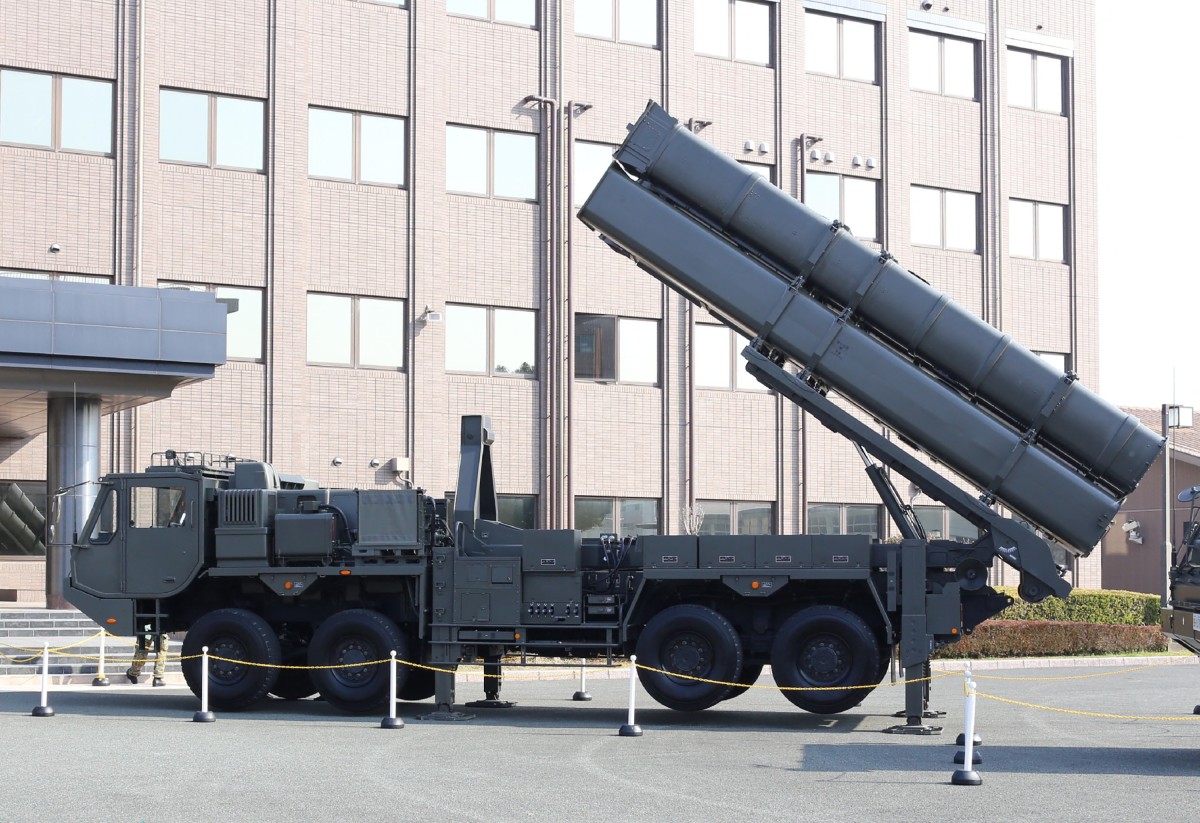
TOKYO - Japan's Defense Ministry said on Tuesday that long-range missiles with counterstrike capabilities have been brought into service for the first time at two Ground Self-Defense Force (GSDF) bases in the country, a move that has sparked domestic opposition.
The deployment of the missiles at Camp Kengun in Kumamoto Prefecture, southwestern Japan, and Camp Fuji in Shizuoka Prefecture, central Japan, marks a significant shift from the country's long-standing exclusively defense-oriented policy under its war-renouncing Constitution, Kyodo News reported.
Camp Kengun has been equipped with a ground-launched version of the upgraded Type 12 land-to-ship guided missile that can fly about 1,000 kilometers, far exceeding Japan's territorial boundaries and widely seen as having clear offensive capabilities.
ALSO READ: Over 1,000 Japanese protest govt's plan to deploy long-range missiles in Kumamoto
Meanwhile, hyper velocity gliding projectiles have been equipped at a training unit at Camp Fuji. Designed for island defense, the deployed model has a range of several hundred kilometers, with the ministry working to upgrade it to around 2,000 kilometers.
Kyodo News noted that "enemy base strike capability" refers to Japan's ability to launch counterstrikes against adversary bases before actual damage occurs, if it determines that an attack is imminent. However, analysts warn that misjudgments could risk violating international law by constituting a preemptive strike.
Atsushi Koketsu, emeritus professor at Yamaguchi University in Japan, told Xinhua that while the government frames the capability as a means of strengthening deterrence, it "clearly goes beyond the scope of self-defense."
On Tuesday, local residents in Kumamoto staged protests near Camp Kengun, holding placards reading "Oppose deployment" and "No missiles needed," Kyodo News reported.
READ MORE: Local officials protest Japan's plan to deploy long-range missiles in Kumamoto
Protesters expressed concern that the deployment could turn the area into a potential military target, and have repeatedly called on the defense ministry to hold public briefings, which have yet to take place, the report said.
Separately, more than a dozen citizen representatives met with defense ministry officials in Tokyo on Monday, urging the government to halt its military expansion measures, including the missile deployment in Kumamoto. Participants criticized officials for providing vague responses and frequently avoiding transparency.
Citizen representative Kujirai said after the meeting that the government's replies followed a "routine pattern," increasingly citing "confidentiality" as a pretext when declining to answer specific questions. He also criticized Prime Minister Sanae Takaichi's push to "make Japan strong and wealthy," arguing it amounts to large-scale military expansion without adequate public accountability. "This is a misinterpretation of the citizens' demands and a very dangerous stance," he said.
Another representative, Akira Saito, told Xinhua that the government officials' response remained very limited. Going forward, in addition to directly questioning Takaichi at the parliamentary level, "it is crucial to continuously expand and amplify our voices through civic movements," he said.
