

Teacher in Handan, Hebei province, on lifelong mission
"We saw you on TV!"
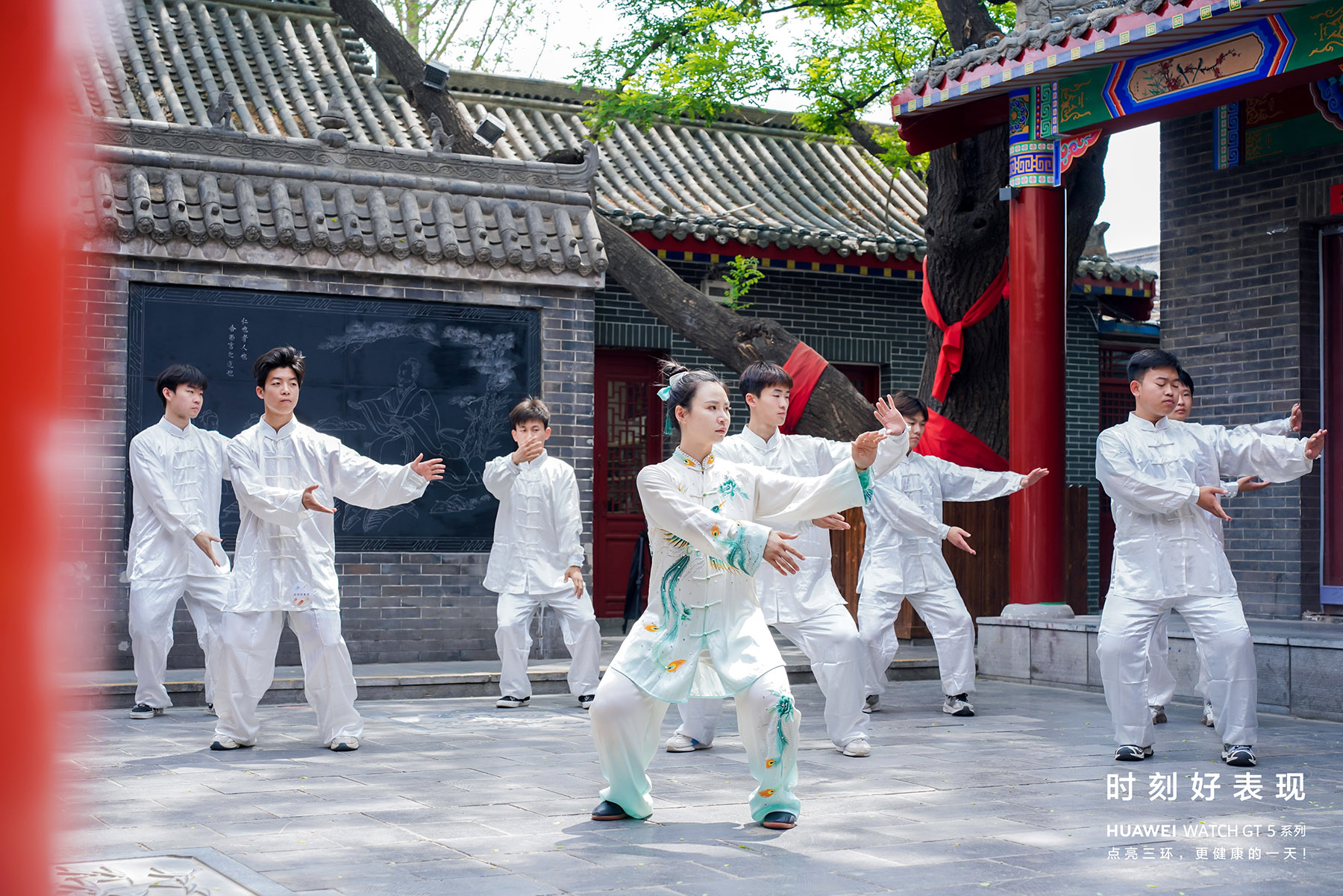
That message was texted to Li Yunyun's phone over and over again on the evening of Feb 16 — Chinese New Year's Eve. The 34-year-old tai chi teacher had just appeared on China Central Television Spring Festival Gala, the most-watched television program in China.
Li's spotlight moment lasted just a few seconds, ending with her signature Xie Fei Shi (oblique flying posture), performed with a folding fan in her hand. But those seconds meant everything.
"Even if I had only one shot, I wanted to show the most authentic tai chi movement," Li told China Daily.
Standing on the Spring Festival Gala stage was not about personal fame, but an opportunity for more people to feel the charm of tai chi's traditional culture.
ALSO READ: Night classes are fit for purpose
The move Li chose combines elements of Yang-style and Wu-style, two major schools that originated in her hometown of Handan, North China's Hebei province. To execute it, one foot firmly steps forward while the other pushes from behind. The upper body leans slightly but remains balanced. The arm extends like a wild goose spreading its wings, the fan opening in a straight, powerful line. "It's a movement that contains openness within closure, softness within strength," Li said. "That's the essence of tai chi — strength that doesn't show itself directly, but exists underneath.
Trick led to lifelong path
Li's journey to the gala stage began 27 years ago, at the age of 7. "I loved dancing when I was little," she said with a smile. "My father told me he was taking me to learn dance. It was a trick. Only after we arrived did I realize it was a martial arts school."
For the first two weeks, Li cried every day. The unfamiliar environment and harsh training were nothing like the graceful dance moves she had imagined. But gradually, something changed. Watching martial arts films like The Shaolin Temple, Li became drawn to the heroic spirit of martial artists. Flipping, practicing fistic techniques, rolling in the sandy training ground — the active child found herself immersed.
"Martial arts training is hard, but the sense of achievement afterward, the confidence that comes from within … that's something nothing else can give you," she said.
Over the years, Li trained in various styles — Xiaohongquan, Dahongquan, Qixingquan — as a child, and later Changquan, and weapons training at the city sports school. "These external styles emphasize speed, power and explosive movements; strength that explodes outward," she said.
Then came tai chi, and everything shifted.
From resistance to passion
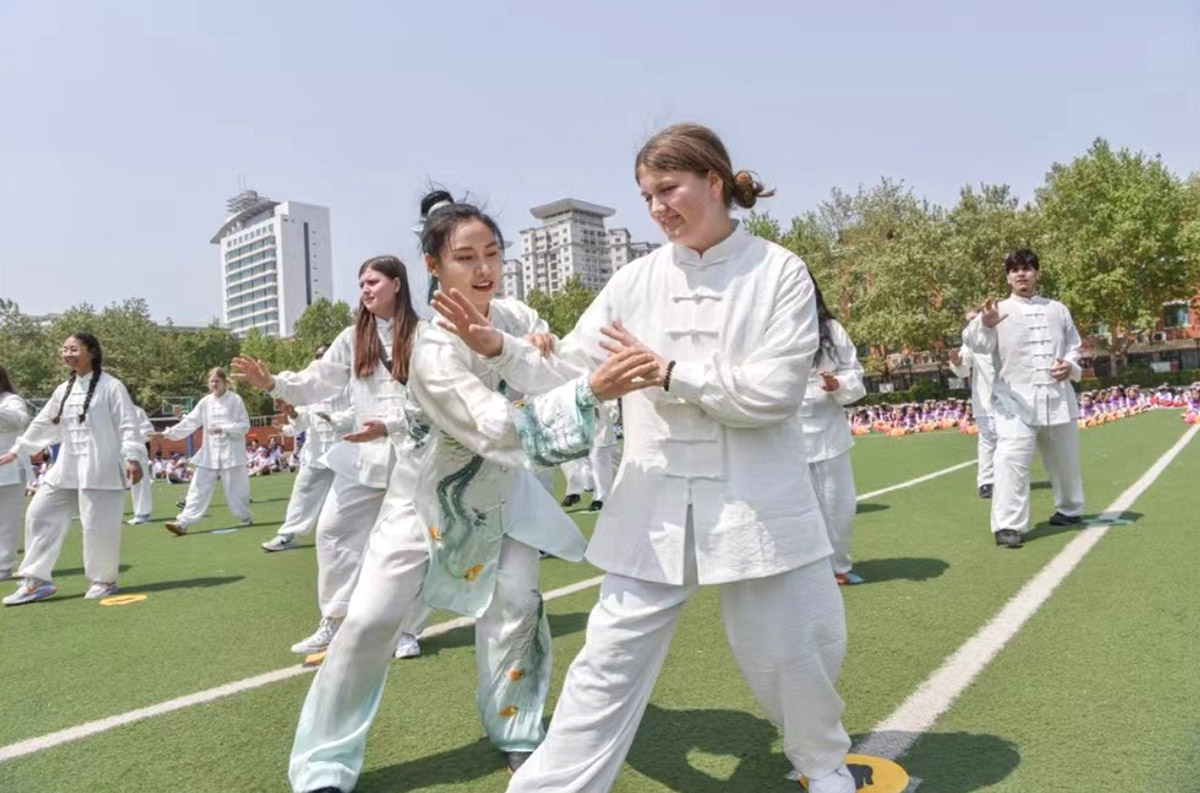
When Li first encountered tai chi at university, she resisted.
"My initial impression was that it was slow and soft, completely different from the powerful styles I was used to," she said. "I preferred the immediate, intense sense of power in external styles."
But a competition opportunity in 2014 led her to train seriously under her coach's supervision. Over a month and a half of intensive practice, something clicked.
"After practicing tai chi, my whole body felt comfortable in a way I'd never experienced. The sweat came from deep inside. My hands and feet felt warm," Li said.
Years of training had left her with injuries, and tai chi began to heal them.
"Sports injuries often come from blocked energy and imbalance," she said. "Tai chi uses slow, circular movements to open the meridians and balance the body's systems. When my hands and feet warmed up, I understood that yin-yang balance isn't just a philosophy — it's the body returning to health. "The biggest change in me is that I've become more composed. True strength isn't just in the explosive moment. It's also in the calm between movements, the steadiness that comes from within. That shift, from focusing on force to focusing on intention, changed everything for me."
Making it cool
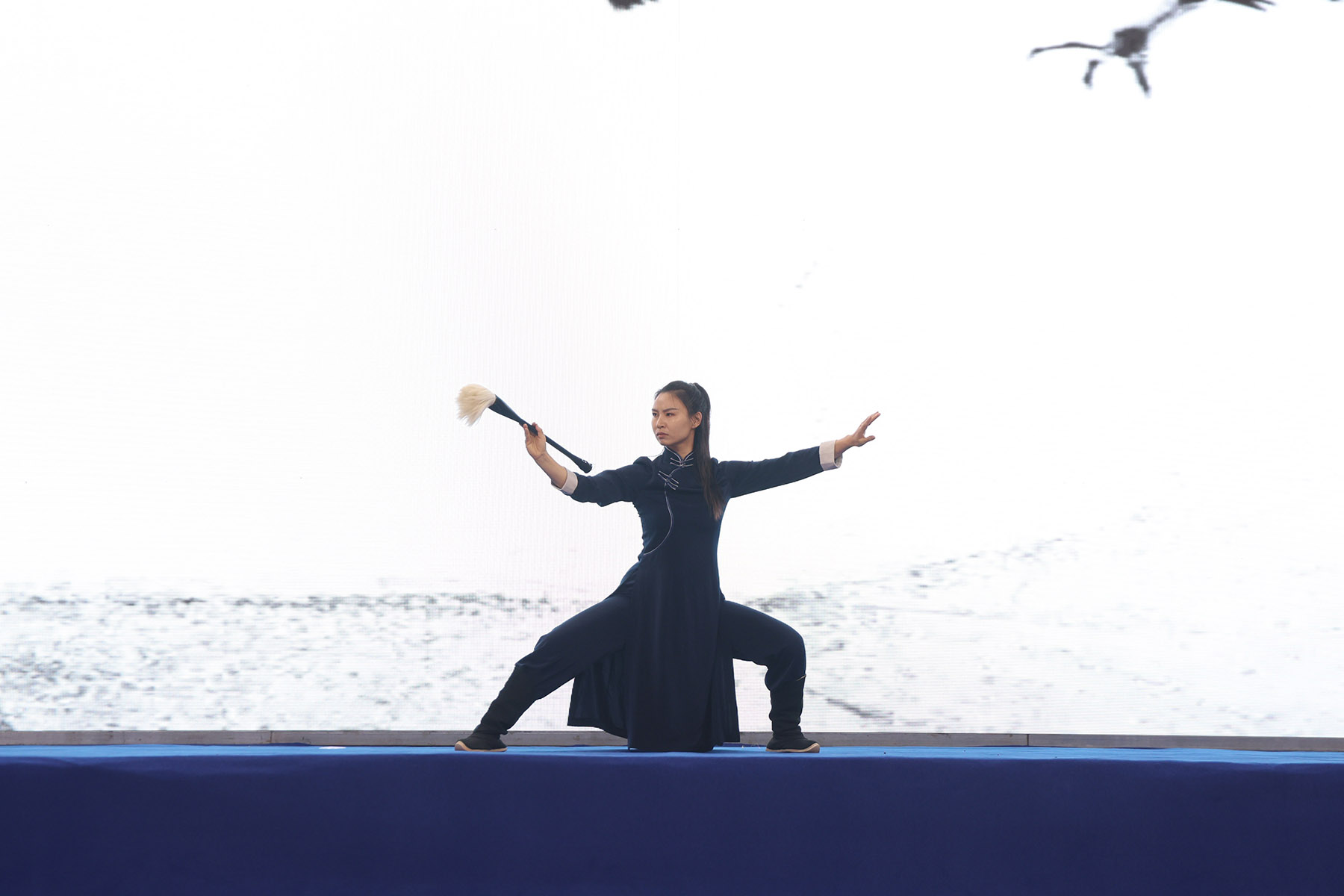
Today, Li teaches at Handan University's School of Tai Chi Culture, the first institution in China to offer bachelor's degrees in tai chi culture. She's also a sixth-generation inheritor of Wu-style tai chi. But her students are Gen Z, raised on street dance and video games. She had to creatively figure out how to make the "slow" art of tai chi appeal to them.
Li breaks tai chi into fun, playful combinations and uses storytelling to keep young students engaged. She also stresses push-hands training, where they experience the principle of "using four ounces to deflect a thousand pounds" by borrowing an opponent's force rather than meeting it head-on.
"At first, I thought tai chi was too slow, not cool at all," said Cheng Zijie, a 23-year-old student majoring in martial arts and traditional sports."And I thought it was for old people."
That changed when Cheng was struggling with exam stress.
"One day I was completely anxious, couldn't calm down in class. Li noticed and practiced 'cloud hands' with me — a slow, flowing tai chi move," Cheng said. "She told me that my mind was full of exams and my body was tense. She asked me to try slowing down each movement, feel my feet on the ground, feel the air against my hands."
Following Li's guidance, Cheng experienced what psychologists call "flow" — a state of complete immersion where nothing else matters. "After that class, the heavy weight in my heart felt lighter. That's when I really started to understand tai chi," she said.
Now Cheng practices daily in the dormitory courtyard and even teaches simple moves to curious roommates. "We do 'cloud hands' together," she said, adding that it has become their way to decompress.
Chen Kaiyang, a 29-year-old graduate now teaching high school physical education, remembers being impressed by Li's classes.
"She showed us how to generate power and the meaning behind each move, letting us see firsthand the coolness of tai chi as a perfect blend of hardness and softness,"Chen said.
Inspired by Li, Chen started a tai chi team at the school where he works and has led students to win honors in district and city-level competitions, passing on tai chi culture to more young people.
Millions of followers
In 2018, as short-video platforms were just taking off, Li began filming herself practicing tai chi.
She didn't expect much. But one video of her performing tai chi received over 800,000 likes. Another surpassed a million likes, with 20 million views. Overnight, her follower count jumped from a few hundred to 200,000. "I never imagined tai chi videos could become this popular," Li said. "It showed me the potential of short videos for promoting tai chi."
Today, she has over 2.1 million followers across different platforms. She films herself practicing everywhere — at the Guangfu ancient town in Yongnian district, on the summit of Taishan Mountain in Shandong province, on the beach in Sanya, Hainan province, and even on the streets of New Zealand.
As her popularity grew, many companies approached her with offers to collaborate on livestreaming sales, a common path for influencers. "But I'm a university teacher. That's my primary job. Short videos are just a platform for me to promote tai chi culture," Li said.
Xu Weilong, dean of the School of Tai Chi Culture, praised Li's approach.
"What moved me most was during her Spring Festival Gala rehearsals,"Xu said, noting that a director suggested simplifying her movements.
"But Li insisted on incorporating that Xie Fei Shi pose. She said that even if with only one shot, she wanted to include tai chi elements. That stubbornness was her guarding the cultural roots, staying clear-minded even under bright lights."
A cultural bridge
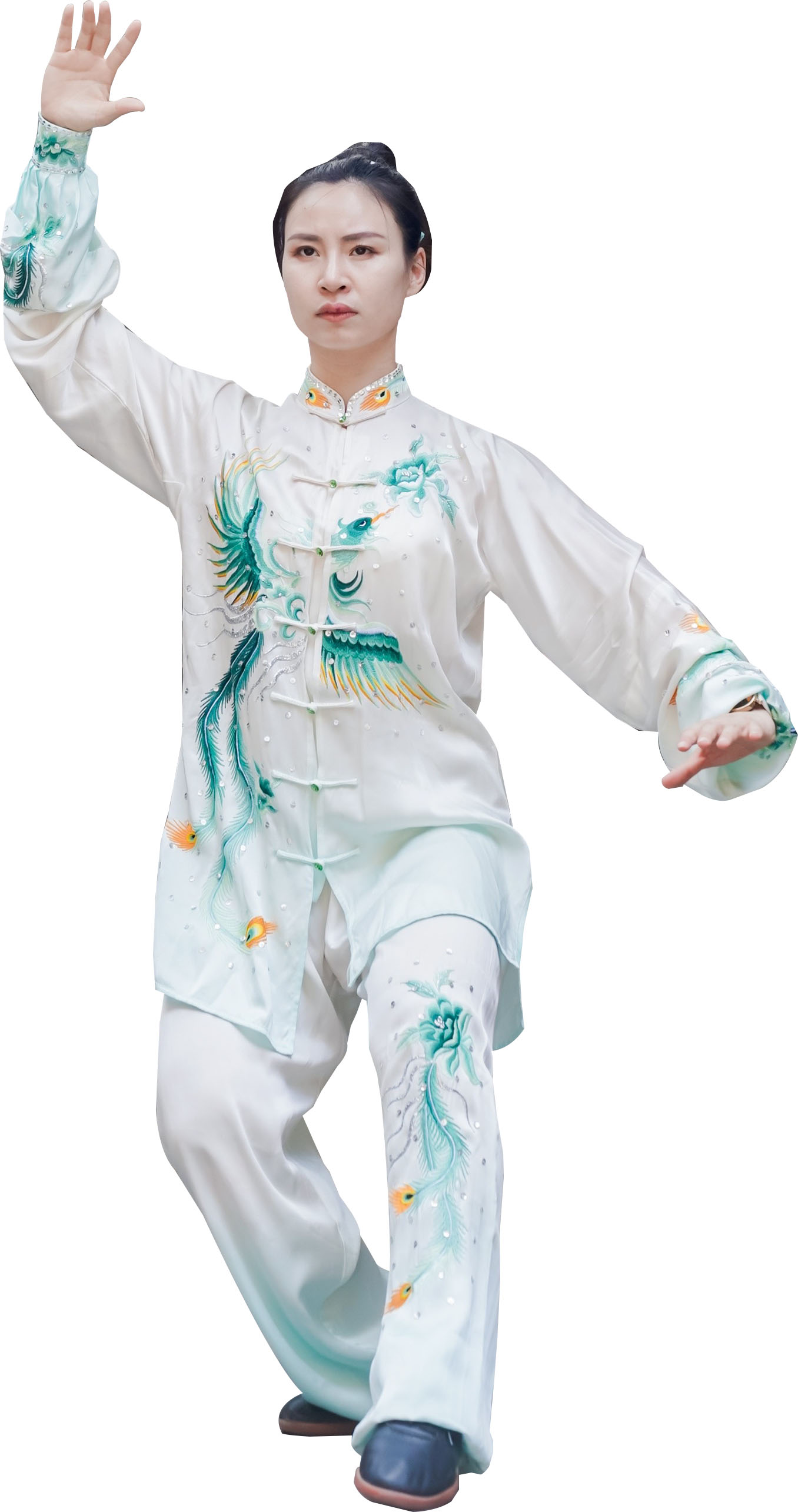
From 2019 to 2020, Li taught tai chi at a university in Belarus, where she witnessed how the practice transcends language and culture.
"What moved me most was that despite language barriers and different backgrounds, we could connect through tai chi," she said, adding that foreign students showed genuine curiosity and respect for Eastern wisdom. "What they saw wasn't just movements, but the gentle, inclusive, inner qualities of Chinese people."
One student, a local painter, took a one-hour train ride daily to attend her class and never missed a single session. Moved by his dedication, Li sent him a pair of professional tai chi shoes from China after she left Belarus.
Handan, known as "the hometown of tai chi", gives Li's teaching a unique foundation.
"This land has given my tai chi its most authentic and profound foundation," she said. The culture and spirit of her hometown are a constant reminder that tai chi is a philosophy for living, overcoming hardness with softness, letting stillness overcome motion, and treating others with sincerity.
At the School of Tai Chi Culture, founded in 2011, the mission extends far beyond the classroom.
ALSO READ: Master of the arts
"Promoting tai chi culture globally has always been one of our core missions," said Xu. "We've built a comprehensive strategy spanning talent cultivation, overseas institutions, platform development and standard-setting."
The school established tai chi academies in Russia in 2014 and in Belarus the following year through partnerships with local universities. The Yang Luchan Tai Chi Institute, based in Handan, now has branches in Russia, South Korea and Germany."These overseas institutes serve as long-term bridges for cultural exchange," Xu said.
Faculty members regularly teach abroad, including Li's 2019-20 tenure in Belarus. The school has also dispatched teachers and volunteers to 10 countries, from Mongolia to Malaysia, Chile to Colombia, while international students come to Handan to learn tai chi at its source.
"Rooted in its heritage and supported by overseas branches and official certification, the school is bringing tai chi from its hometown to the world," Xu said.
Yue Zhijuelin contributed to this story.
Contact the writers at zhangyu1@chinadaily.com.cn
