

Metal’s versatility and surprising ability to evoke emotions and atmosphere make it the favorite medium of a number of artists featured in Hong Kong Art Week. Gennady Oreshkin reports.
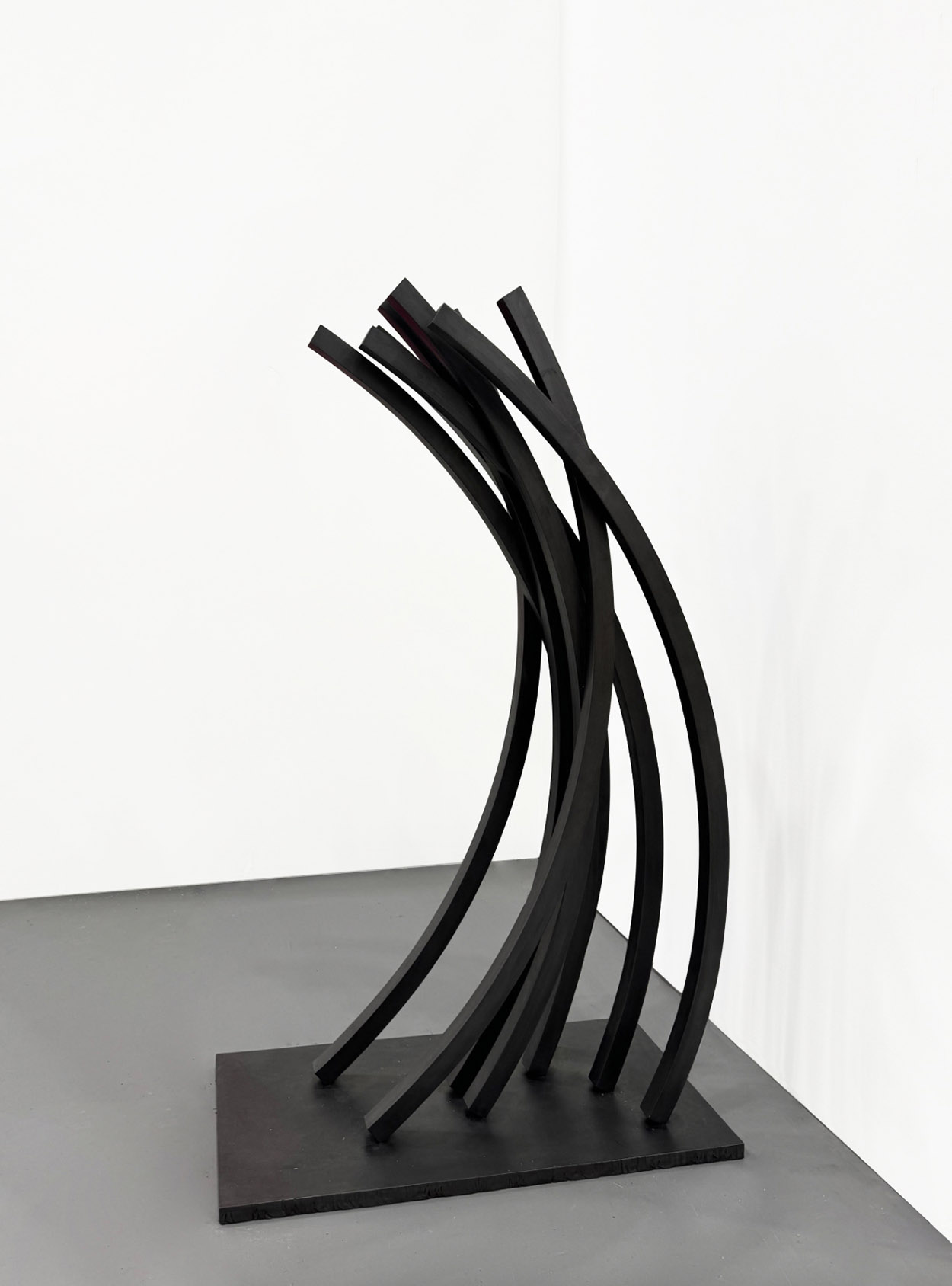
The presence of metal resonates widely across the exhibition venues of the ongoing Hong Kong Art Week — the city’s flagship annual international cultural event. At Art Basel Hong Kong (ABHK), for instance, an almost 2-meter-tall, rolled-steel sculpture of closely juxtaposed arcs by French sculptor and conceptual artist Bernar Venet is attracting attention.
In Asia, Venet is perhaps best known for his 18-meter sculpture Convergence: 52.5° Arc x 14, a gift to China from France to mark the December meeting in Beijing between the presidents of the two countries, Xi Jinping and Emmanuel Macron. Curved steel rods — often shaped in the form of broken, imperfect circles and piled against each other — represent Venet’s signature style. The artist once said that his works are informed by science and mathematics.
READ MORE: Machines like me
Brought to ABHK by De Sarthe, Venet’s metallic sculpture, 84.5˚ Arc x 8 (2017), appears in dialogue with his two charcoal works on paper: Arcs (2023) and Indeterminate Lines (2023). While it’s easy to mistake the drawings as studies for the sculpture, they are, in fact, “parallel works that share the same conceptual foundation,” according to the artist’s statement.
Metal and scraps
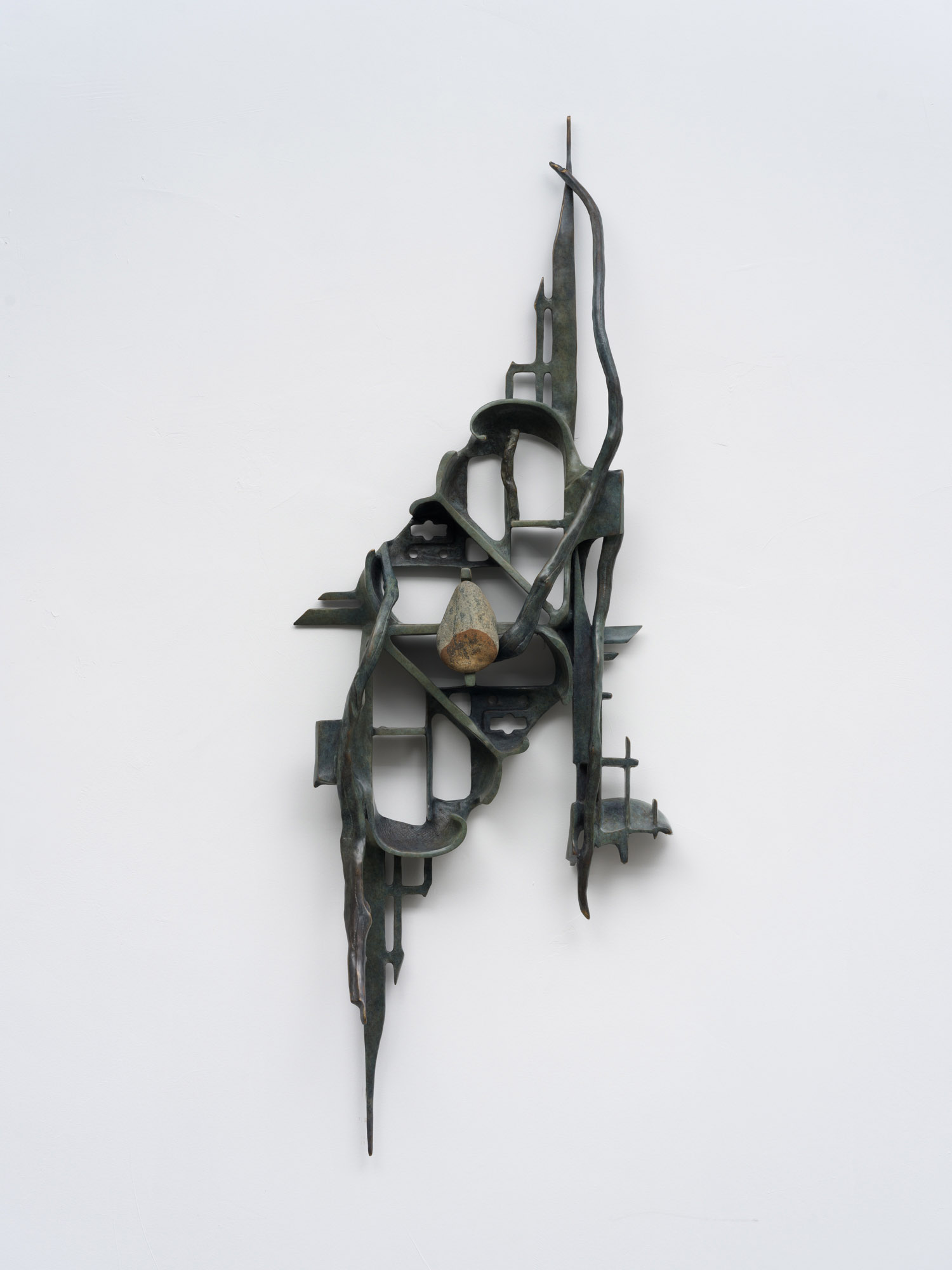
Like Venet’s, Hong Kong sculptor Leelee Chan’s pieces on show at ABHK are also presented as a dialogue between the old and new. Hosted by Klemm’s and Capsule Shanghai, Chan’s wall-mounted sculptures, Cambium Wanderer (2024) and Sensitive Circuit (2026), share the same visual language and come with a metallic finish, though the first is made out of a found plastic shipping pallet, “cut and sculpted into a mysterious wall relic… interwoven with gnarled root forms, amber-colored resin, and bronze wildflowers,” per the artist. The second is primarily made up of lost-wax cast bronze.
Chan is inspired by the “mundane yet essential parts of our infrastructure — like the shipping pallet — and the ecosystem — like the underground mycorrhizal network — that we often overlook”.
ALSO READ: A feast for the senses
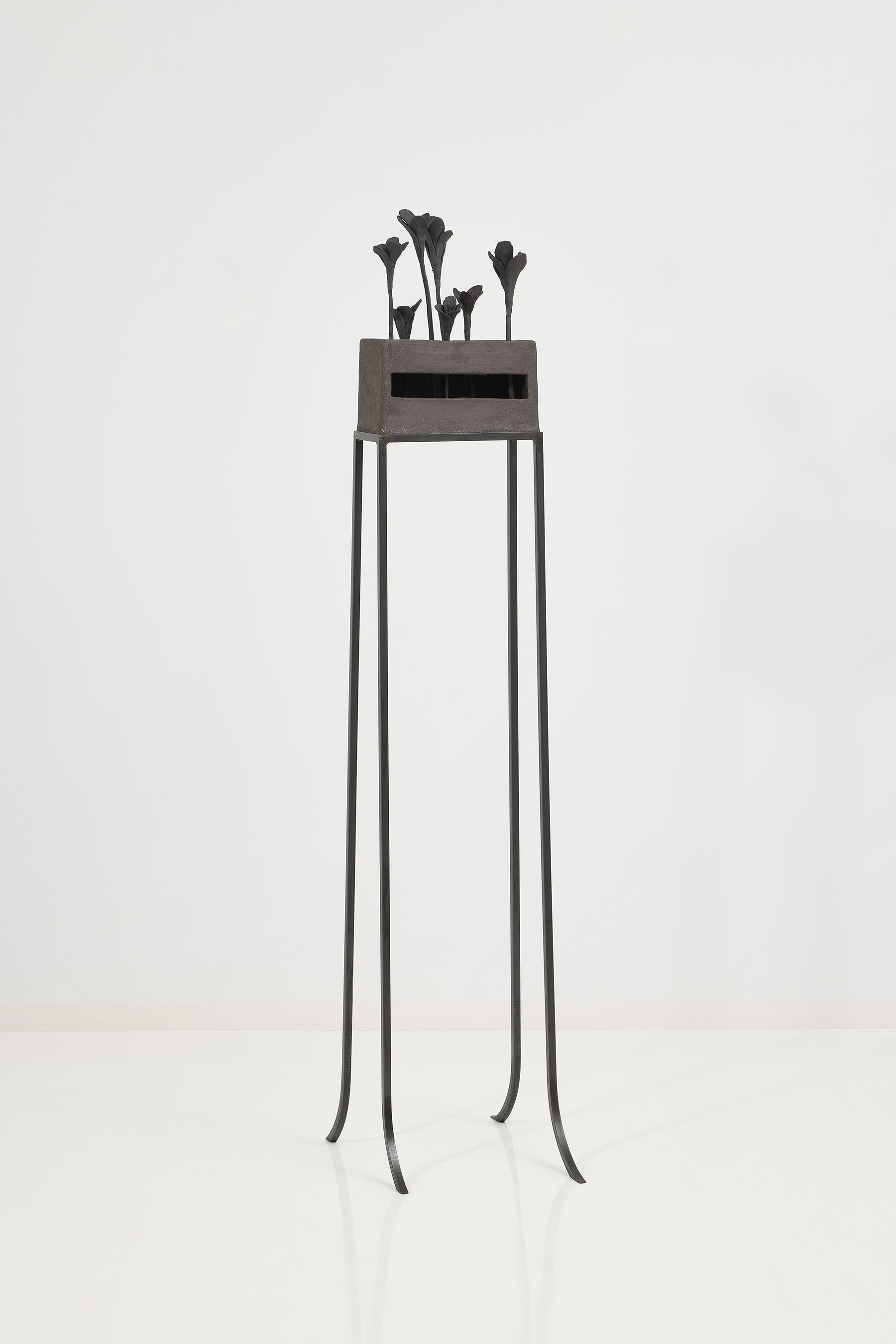
Klemm’s and Capsule Shanghai also represent New York-based Elizabeth Jaeger, who is interested in conjuring up “scenes of post-apocalyptic tranquillity”. Sculpted out of ceramic and blackened steel, her 2024 sculptures, Colma, Woodside, Borella, and Isola San Michele, are named after cemeteries around the world. The sculptures look like graves mounted on unusually long-legged stands, with flowers sprouting on the surface. There are also sculptures of two rats and a bird, cast in ceramic with bronze details. In this psychological garden, rats act as “intelligent urban scavengers that feed on and clean the remnants of human activity,” says Jaeger in her artist’s statement, while the bird represents the omnipresent observer, or perhaps the artist herself.
Focus on the familiar
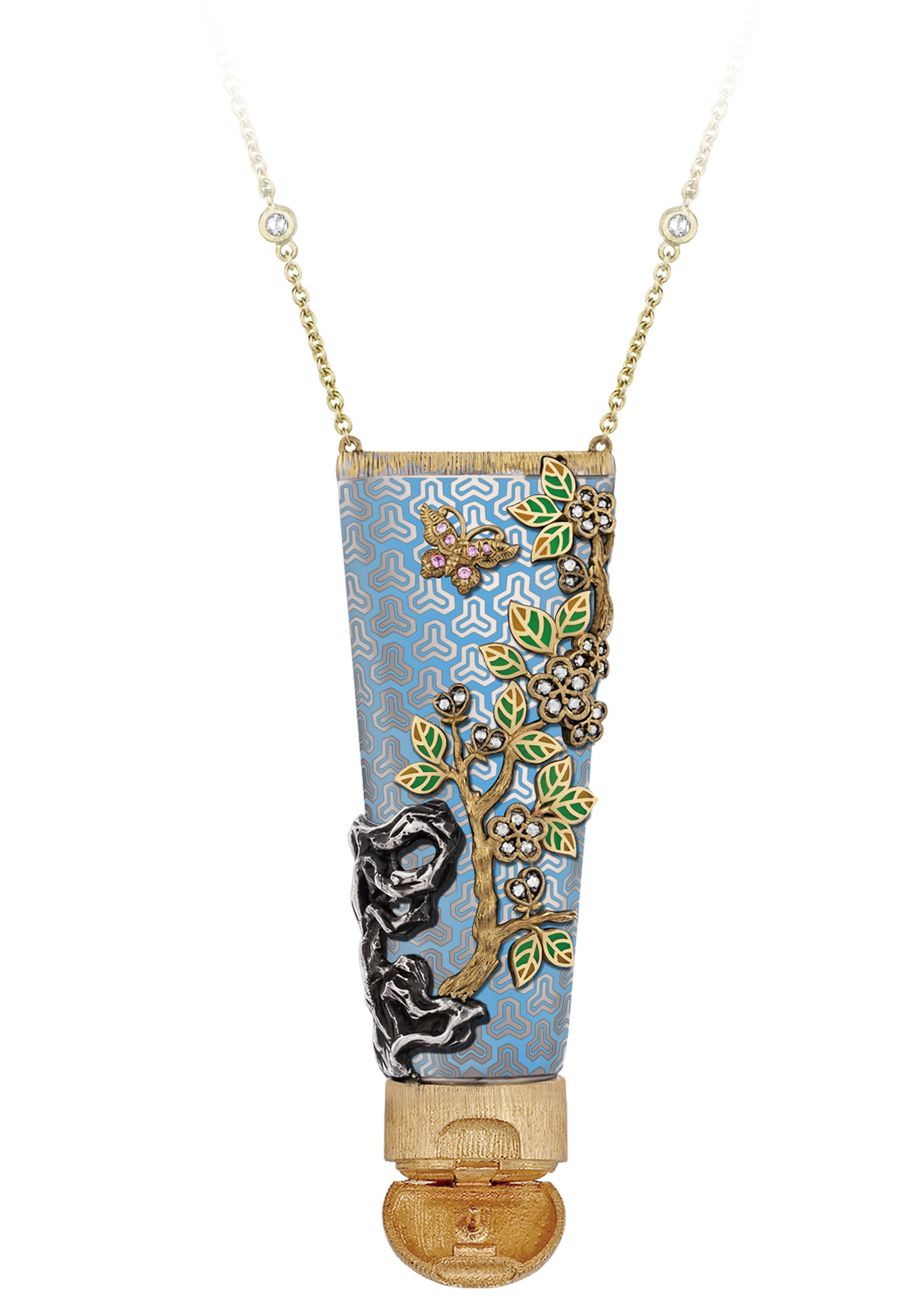
Over at Art Central, Hong Kong artist Dickson Yewn is presenting his No Man’s Land series of “wearable art” in partnership with Literati Artspace. Some of these pieces are miniaturized versions of household objects — coffee cups, squeeze tube-shaped pendants, etc. — cast in gold and silver and decorated with enamel, diamonds, and pink and yellow sapphires. They also come with barcodes, which appear strange next to motifs seen in traditional Chinese landscape paintings. Yewn says that No Man’s Land is meant to draw attention to environmental issues in a way that puts China at the center of the narrative, seeing that “China is the biggest exporter of green innovative technology in the world”.
Sharp and spiky
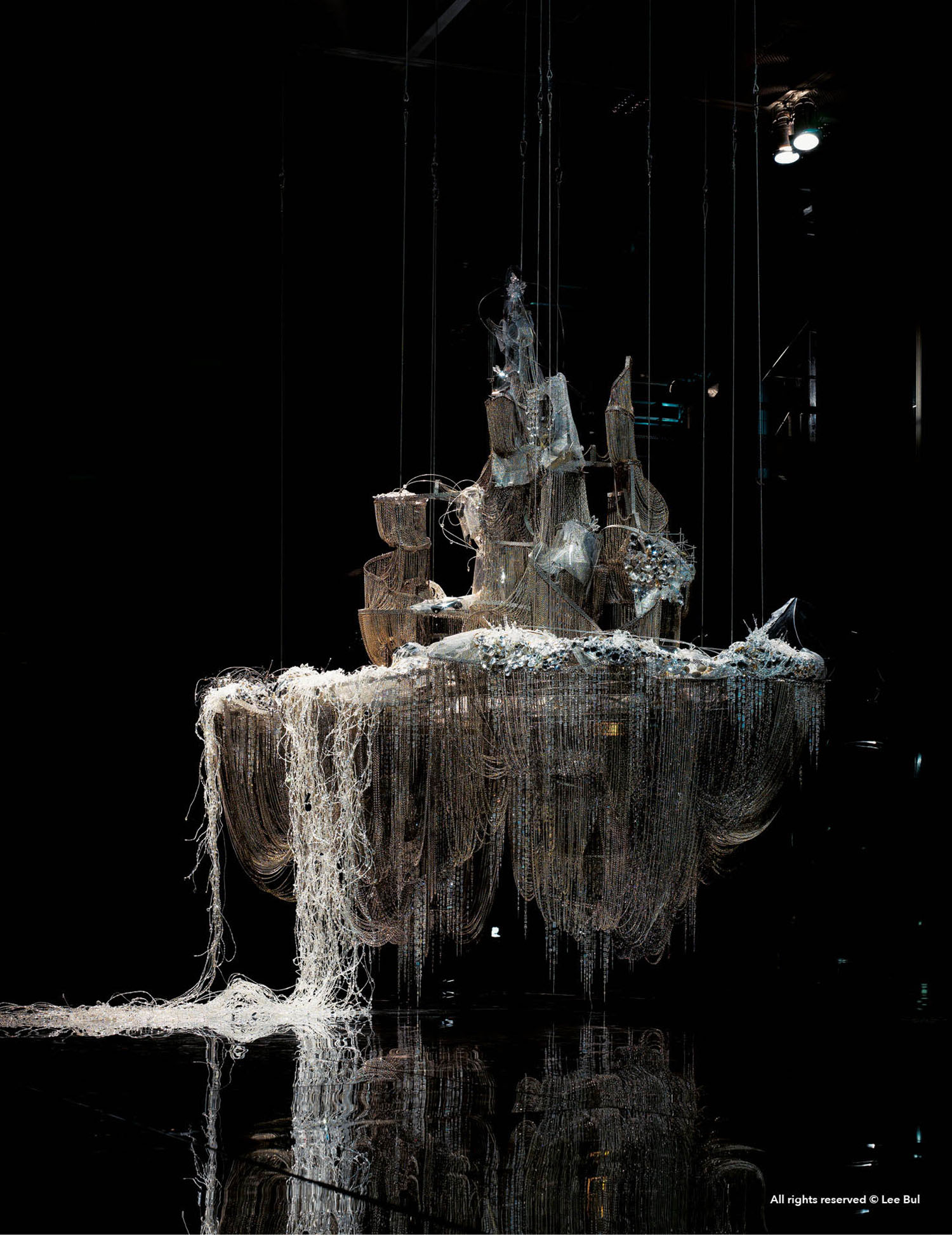
M+ is hosting Lee Bul: From 1998 to Now, a comprehensive exhibition of works by the generation-defining South Korean contemporary artist. Lee, whose works play up the materiality of her mediums, uses metal bars, strips, and chains to build intricate contraptions that can look like architectural maquettes, or metallic landscapes.
“Her work rediscovers and recuperates ornamentation, tackling the bias against decorativeness in modern and contemporary art head-on,” says Doryun Chong, M+ artistic director and chief curator. Inspired by German architect Bruno Taut, who imagined fantastical Alpine cities made of glass, Lee’s After Bruno Taut (Beware the sweetness of things) (2007) is an imposing structure containing stainless steel, aluminium, copper and glass. It looks like a giant chandelier but on closer examination is revealed to be an intricately crafted floating palace. “Taut imagined impossible architecture — a city that could self-sufficiently float in the air — and this utopian aspiration is what, I think, Lee found interesting,” Chong says. He also notes how the artist has made ample use of metal’s reflective properties to enhance the fantasy element in her works.
Her Aubade V (2019) is a steampunkish installation that loosely resembles a cell tower. Constructed in cast steel, its rusty main structure was collected from the Korean Demilitarized Zone (DMZ). “It’s also utopic in a sense,” says Chong. “Because the DMZ is virtually untouched by humans, it’s become a sanctuary for several endangered species that exist alongside a heavily militarized area.”
Among the figurative works in the exhibition are Titan (2013). Made using polished steel wires with sharp edges, aluminium and steel rods and mirror shards, the piece resembles a child’s body with hooves and an antler. Plexus (1997-98), which shows a leather female bust cut in half, exposing myriad metal wires strung with beads and sequins resembling blood vessels, is definitely not for the faint-hearted. Infinite Starburst of Your Cold Dark Eyes (2009) — a suspended female figure without arms, made with stainless steel, mirror, aluminum, copper and nickel wires, glass, and wood, comes across as eerie and alluring at the same time.
The human effect
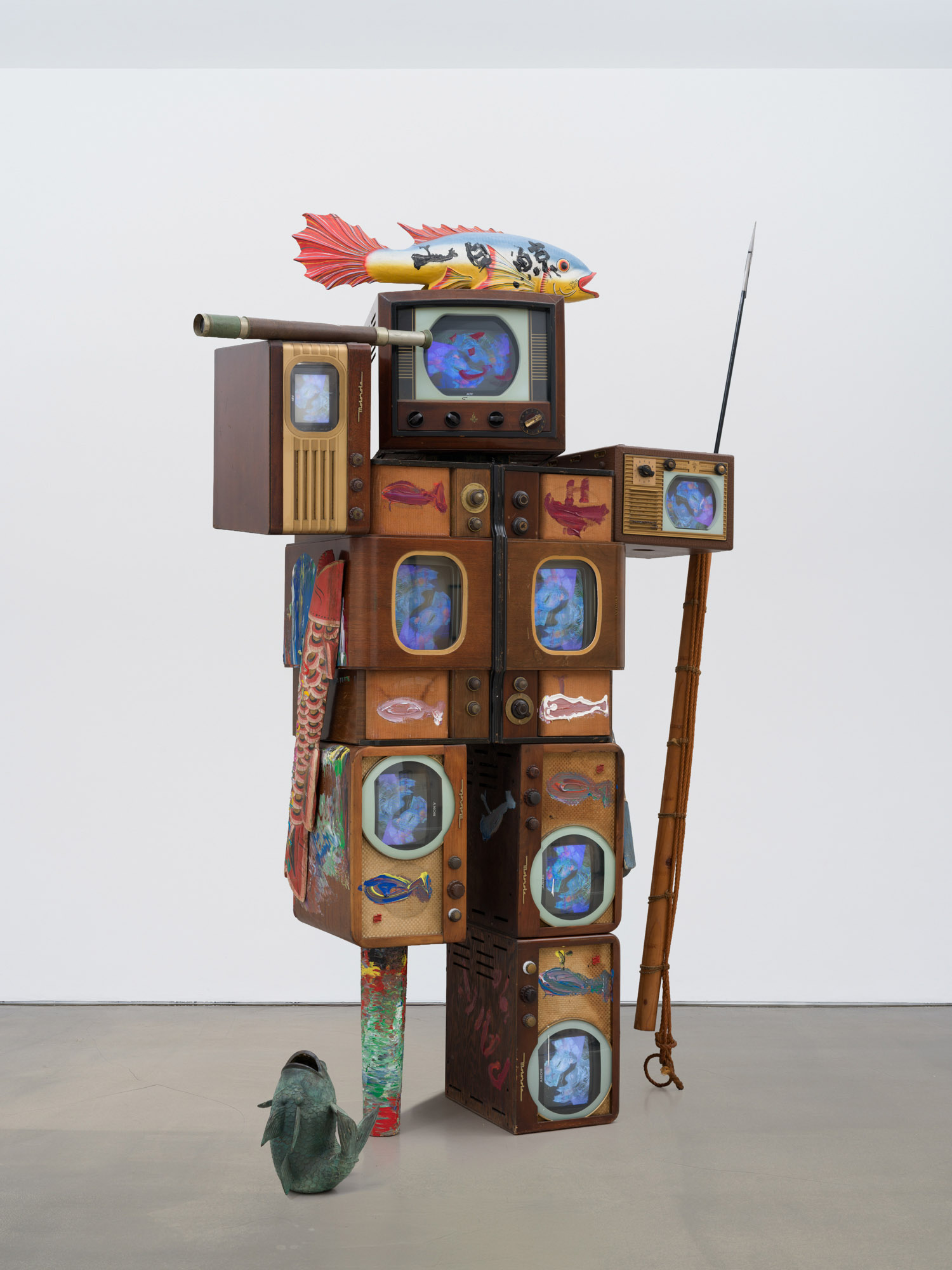
Another South Korean stalwart, Nam June Paik (1932-2006), is a highlighted artist in Art Intelligence Global’s (AIG) new exhibition, The Uncanny. The use of metal in his work is implicit, seeing how the material is integrated into the TV cabinets and at least one fish sculpture that is a part of his installation piece, Captain Ahab After Melville (1990). Named after the protagonist of Herman Melville’s Moby Dick, the piece consists of eight vintage portable television sets stacked together to appear like a human figure. The Arctic Sea context of the novel is reflected in the harpoon, telescope and piscine elements. The Sotheby’s website quotes the artist as saying that the piece is meant “to humanize the technology and the electronic medium, which is progressing rapidly”.
ALSO READ: Gateway to Asia
“Many of the works in our exhibition, including Nam June Paik’s robot bodies exist on a human scale,” says Alexander Gardiner, an associate at AIG. “We instinctively respond to them as if they were bodies or presences drawn from the everyday. This makes their distortion of the familiar so immediate and unsettling.”
From Paik’s mechanical humanoids to Venet’s mathematical arcs to the delicate ecosystems fashioned out of found objects by Leelee Chan, metal emerges as a profoundly versatile material that artists of today are using to redefine the idea of traditional sculptures. Evidently, metal can be sculpted to express utopian visions, crafted to conjure up scenes of “postapocalyptic” quietude, and molded into imaginary forms of the post-human body.
The writer is a freelance contributor to China Daily.
