

Hong Kong is on course to make itself a global gold trading hub by cooperating with Shenzhen in processing and refining the precious metal, as well as offering tax incentives to eligible institutions doing bullion trading in the SAR. Gaby Lin reports.
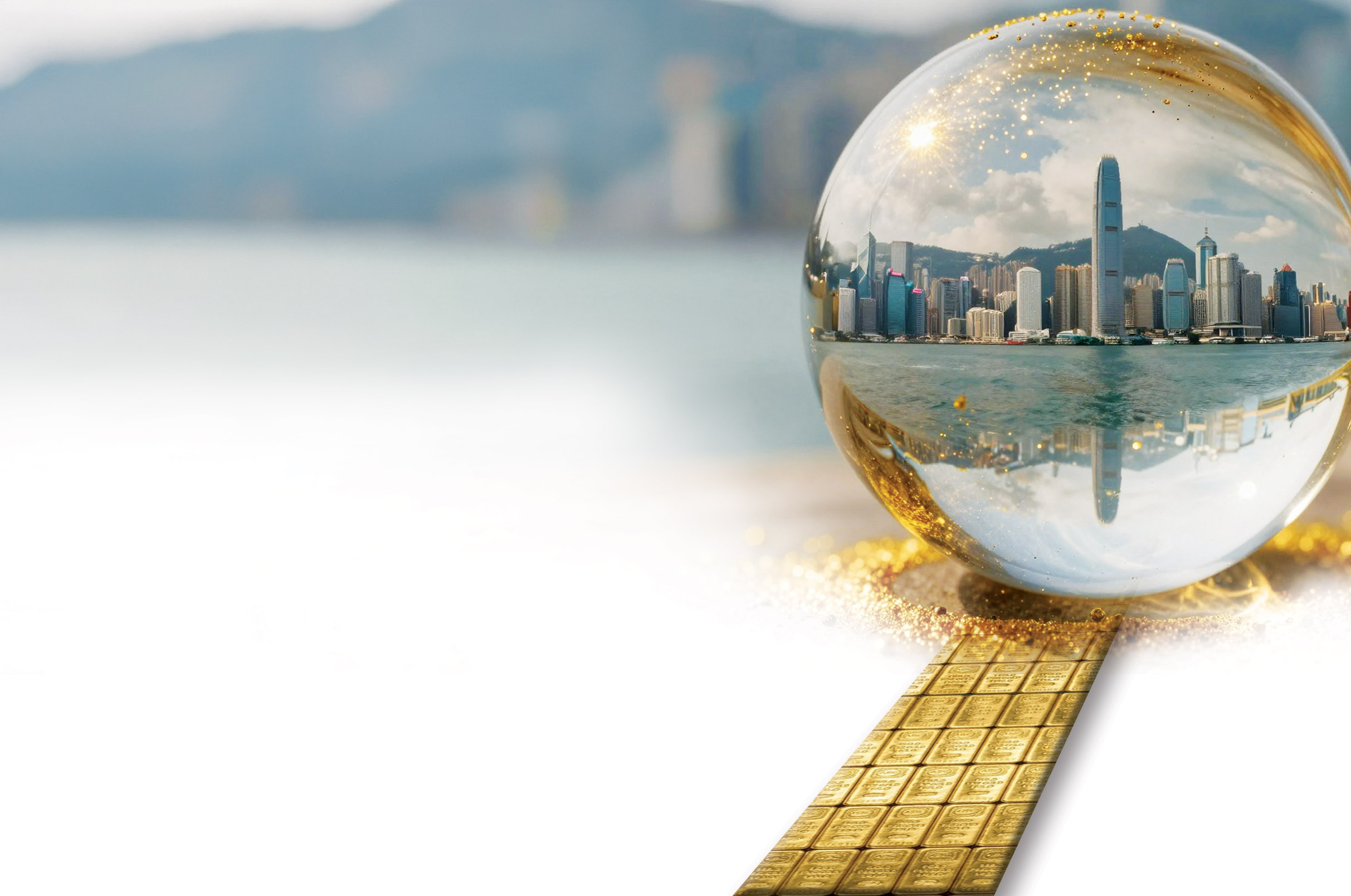
It has been more than half a year since Hong Kong Chief Executive John Lee Ka-chiu unveiled an ambitious blueprint to turn the city into a world gold trading hub in his Policy Address last September. With spot gold prices showing an overall upward trend, despite the recent dip, Chinese mainland and overseas stakeholders, including precious metals firms, financial institutions, investors and retail buyers, are on the edge of their seats pondering Hong Kong’s next move.
The special administrative region has heard them loud and clear, and responded with a flurry of initiatives. Among the key steps taken so far is a memorandum of understanding signed with the Shenzhen Municipal Financial Regulatory Bureau to deepen precious metals processing trade cooperation between Hong Kong and the southern mainland’s financial and technology powerhouse — home to the country’s largest and most integrated gold and jewelry cluster.
Some companies, like Point Gold International, have moved ahead of the curve, laying the groundwork to spur growth in the SAR’s gold business.
“After years of operations, we think we have the capability to establish our own plant in Hong Kong and serve global markets… From manufacturing and refining to trading — we can do it all,” says Point Gold Chairman Huang Wenbin, whose company set up its Hong Kong office several years ago.
READ MORE: Hong Kong optimistic about equity, gold trading
Planning to pour about $150 million (HK$1.17 billion) into its first phase of investment, the Shenzhen-based precious metals enterprise leased an 80,000-square-foot site in Hong Kong’s northern Tai Po district two years ago for a refinery. The plant will focus on refining and purifying gold, while extending into silver and platinum-group metals, such as platinum, palladium and rhodium.
Highlighting Point Gold’s proprietary processing technology and its designation as a high-level green factory by mainland authorities, Huang says their efficiency “will definitely not be worse than” its overseas counterparts.
He expects the Hong Kong plant’s business to radiate across international markets, noting there are relatively few providers of platinum-group metals refining services in Asia. “Running our business in Hong Kong, thus, should be relatively competitive,” he says.
Point Gold’s Shenzhen facility has won accreditations from recognized organizations like the Shanghai Gold Exchange (SGE) and the London Bullion Market Association — the global authority setting refining standards for precious metals — to supply standard gold and silver ingots. It is also a qualified supplier of platinum, palladium and rhodium sponges to the London Platinum and Palladium Market Association.
According to Huang, the Hong Kong refinery will seek similar qualifications as soon as possible. For now, gold refined in Hong Kong is sent to Point Gold’s Shenzhen base for processing before being exported back to the SAR for international trading.
Such a processing pattern exemplifies the so-called “both-ends-outside” model the HKSAR government is pursuing — importing raw materials through Hong Kong, processing them on the mainland, and trading finished goods from the SAR.
The strategy fully leverages “one country, two systems” by capitalizing on Hong Kong’s unique status as a separate customs territory outside the mainland, ensuring that gold supply meets national needs while revitalizing the precious metals industry and spurring international trade.
Both-ends-outside model
As the world’s largest gold consumer, China maintains a strict export regime on the precious metal, with only a handful of recognized organizations allowed to sell gold and its products overseas, in order to prioritize domestic consumption amid a persistent supply shortfall.
Last year, consumer demand for gold on the mainland and in Hong Kong reached 816 tons, according to the World Gold Council. Yet, official figures from the China Gold Association showed that China’s domestic production, using both local and imported raw materials, totaled just 552 tons.
“If the gold to start with originated from offshore, for example, from somewhere outside China, it merely flows through Hong Kong SAR, and then proceeds to Shenzhen for processing or refinery,” Secretary for Financial Services and the Treasury, Christopher Hui Ching-yu says. “This gold, since it originated from abroad, can be exported out of the country once it has been processed in Shenzhen.”
He says the adopted model can harness Shenzhen’s refining and processing capacity, and “at the same time, ensure that through this process, we can develop our gold ecosystem”.
“It’s not just benefiting the financial system per se, but also the manufacturing, processing, and logistics ecosystem across the (Guangdong-Hong Kong-Macao) Greater Bay Area.”
Benjamin Wong Kwok-fan, head of transport, logistics and industrials at Invest Hong Kong (InvestHK), says the authorities may expand the scope of the “both-ends-outside” model when its mechanism matures so as to include more businesses and suit their diverse needs.
InvestHK — the HKSAR government’s investment promotion arm — has been aggressively courting a broader range of precious metals players to establish a foothold in the city.
According to Wong, every part of the value chain is the agency’s priority — from refining and storage to traders, insurers and legal services — plus talent development. “It’s all interconnected,” he says.
Aiming to expedite Hong Kong’s development as a world gold trading center, the HKSAR government will expand the city’s gold storage capacity to more than 2,000 tons within three years.
The HKSAR government also pledged in its 2026-27 Budget to explore tax incentives for eligible institutions conducting gold trading activities locally, while developing an industry training framework.
With the government-led gold trading central clearing system, in partnership with the SGE and backed by more than 10 local and global banks already on board, slated to start trial operation this year, Hui says Hong Kong aims to be a “market organizer”.
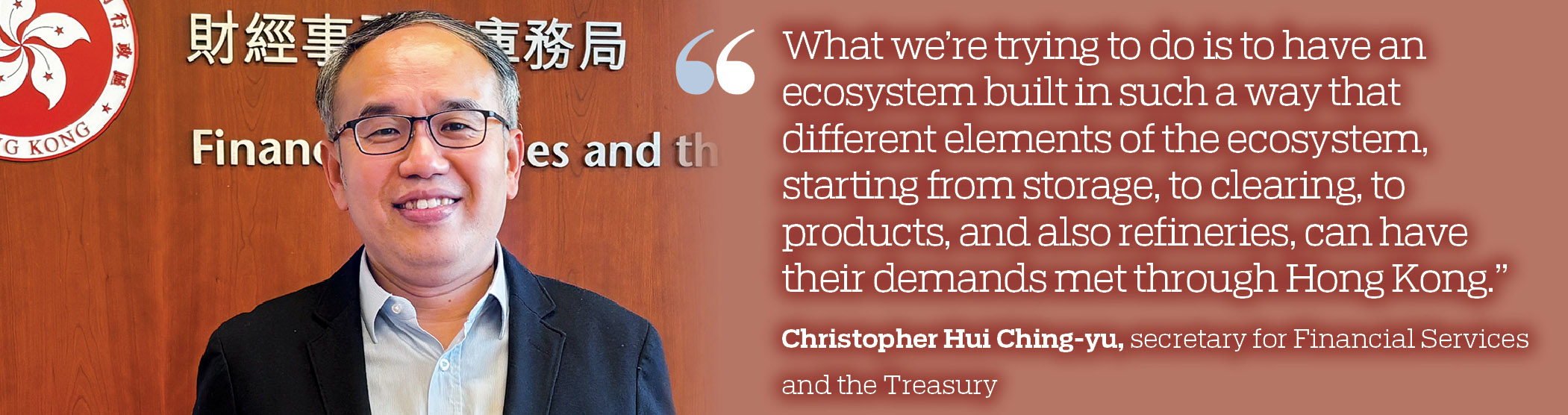
“What we’re trying to do is to have an ecosystem built in such a way that different elements of the ecosystem, starting from storage, to clearing, to products, and also refineries, can have their demands met through Hong Kong,” he says.
Building the ecosystem
Currently, the global gold market is predominantly driven by London, New York and Shanghai, with the first two financial centers dominating over-the-counter transactions and futures trading, while Shanghai’s role as a key physical gold market continues to grow.
Hui believes Hong Kong-Shanghai cooperation offers the SAR an unprecedented chance to be more competitive and claim a meaningful market share.
In Asia and countries engaged in the Belt and Road Initiative, there is strong gold demand, he says. “We’ll make sure that when we get this system going, we’ll be able to target the growing demand for gold and precious metals in this part of the world.”
A stronger voice in gold pricing would ensure that Hong Kong “is needed by global investors when the market is up or down”, he adds. “Initial public offerings or transactions come and go,” he says. “But, that said, if we can have the system, along with the infrastructure, in place, no matter how the market evolves, either going up or down, Hong Kong will be needed by global investors.”
“That’s why the impact Hong Kong’s going to make, together with Shanghai, in this time zone is very important,” Hui stresses, adding that the HKSAR government is optimistic about helping amplify the country’s influence in the global precious metals sector by combining Hong Kong’s financial center strengths with Shanghai’s established market.
Renminbi pricing power
Haywood Cheung Tak-hay, chairman of Hong Kong Gold Exchange, says if Hong Kong, as a premier offshore renminbi hub, could wield greater influence over gold pricing, it would help lift the currency’s international standing.
For decades, gold has primarily been priced in US dollars, while renminbi could be a reliable alternative for sector stakeholders, according to Cheung. He says if more gold transactions are priced, settled and delivered in renminbi, it would drive a wider circulation of the currency across global markets.
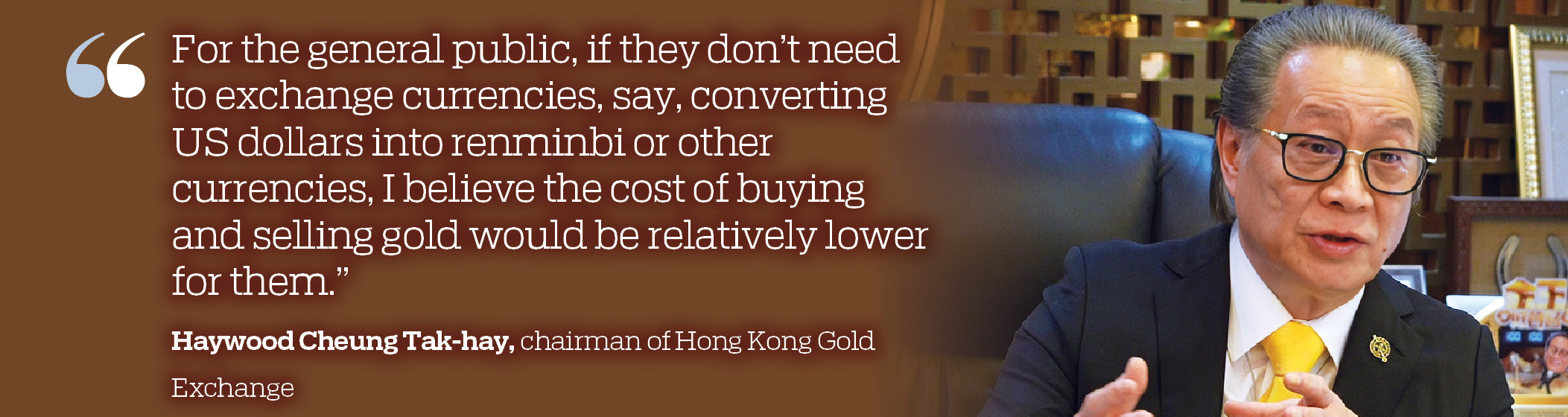
“For the general public, if they don’t need to exchange currencies, say, converting US dollars into renminbi or other currencies, I believe the cost of buying and selling gold would be relatively lower for them,” he says.
However, he emphasizes that to elevate Hong Kong’s voice, the city must boost local gold-related financial activities, whether on-exchange or over-the-counter, otherwise, investors would move their physical holdings elsewhere at any time.
“To encourage people to keep their gold in Hong Kong, there has to be a wide range of derivatives to support it,” he says. Only when Hong Kong can offer more options, including physically-backed gold futures, exchange-traded funds and tokenized gold, will “gold assets truly remain here”.
ALSO READ: Laopu Gold shares soar most in 2 months after revenue jumps
Cheung says that the local precious metals exchange, which was reorganized last year from a membership-based institution to its current corporate structure, has also been keeping pace with the times and is committed to responding to different market players’ needs.
In January, the HKGX announced a tie-up with TGX Technology — a subsidiary of Alibaba’s AGTech Holdings — to develop a new precious metals trading platform with multi-product support and multi-currency pricing, settlement and clearing.
Cheung says the platform involves an initial investment of HK$1 billion, and aims to launch as early as September this year. He hopes the channel will link up with the government-led central clearing system, allowing local industry efforts to complement official plans.
He suggests the authorities leverage the foundation built by local players.
“Hong Kong’s gold industry has been conducting international trading for at least 60 years — it’s a fact that can’t be ignored… With such an established foundation, we’re confident of significantly fast-tracking the city’s ambition to be a global gold trading hub,” he says.
Contact the writer at gabylin@chinadailyhk.com
