

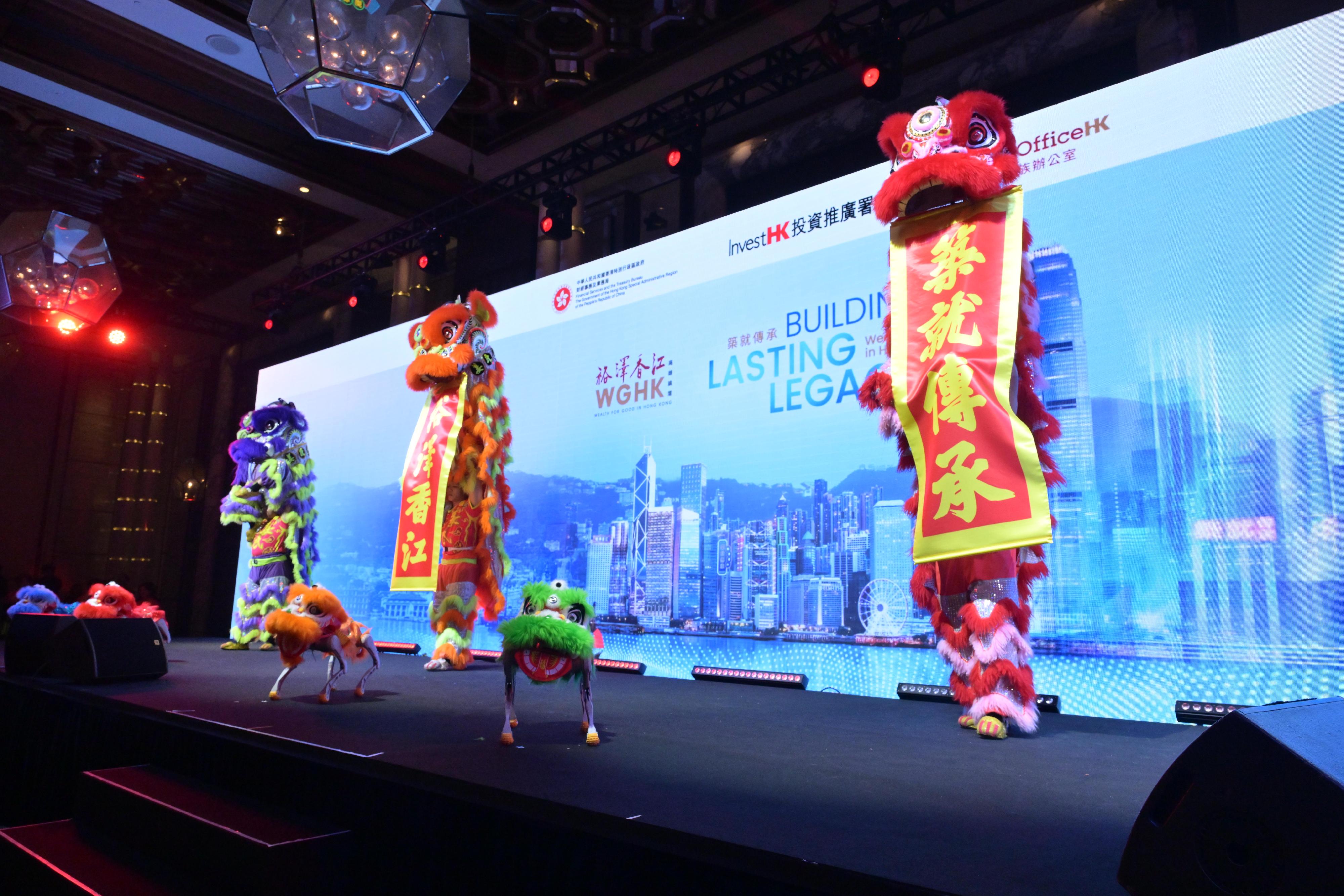
With tensions flaring up in the Middle East and changes in the international situation, Hong Kong’s stable environment, growth potential, cultural allure and technological prowess are cementing the special administrative region’s status as a safe harbor for global capital.
About 400 family office decision-makers and next-generation successors from Asia, Europe, the Americas, Oceania, and Africa joined the fourth Wealth for Good in Hong Kong (WGHK) Summit on Tuesday.
Themed “Building Lasting Legacies”, the summit explored how family offices can make strategic investment decisions and create social legacies and impacts through philanthropy.
Deputy Financial Secretary Michael Wong Wai-lun said Hong Kong is a perfect base to support the prudent diversification of investments by family offices.
ALSO READ: Hui: HK to boost role as asset management hub amid Mideast conflict
“Hong Kong offers something that is quite rare and precious. Under ‘one country, two systems’, Hong Kong provides an economic and business environment with policy predictability and institutional trust,” Wong said in a speech.
The city’s common law legal system, independent judiciary, open economy, free flow of capital, freely convertible currency, simple tax regime, and a vibrant financial market are all attractive for global family offices, he added.
Hong Kong’s assets under management (AUM) rose 13 percent annually to over $4.5 trillion in 2024, which was 11 times the city’s GDP. That momentum continued into 2025, with Hong Kong-domiciled funds registering strong net inflows of $45.8 billion last year. In terms of the number of ultrahigh-net-worth individuals, Hong Kong ranks second in the world.
The special administrative region is working to expand the preferential tax regimes for funds, family-owned investment holding vehicles of single family offices and carried interest, and the administration hopes to have new legislation ready by June.
“Family offices in Hong Kong will soon enjoy more flexibility as their investment portfolios evolve.” Wong added, as qualifying investment vehicles will be extended to private credit, precious metals and commodities, carbon credits, insurance-linked securities, and digital assets.
He said the SAR government has introduced tax incentives designed to encourage philanthropic giving. The city does not levy estate duty, capital gains tax, or any tax on dividends, which are attractive to family office managers.
READ MORE: 91% of surveyed family offices have invested in HK, report says
Under Secretary for Financial Services and the Treasury Joseph Chan Ho-lim, said more than 20 family offices leveraged InvestHK’s assistance to establish or expand their businesses in Hong Kong in January and February.
“After family offices have established their bases here, they can utilize the city’s efficient refinancing platform for activities such as share placements and bond issuances, and even operate other businesses, expanding the breadth and depth of the market.
The Hong Kong family office ecosystem is maturing, forming a powerful network that can match different family offices with alternative or impact investing opportunities, facilitating resource integration,” Chan said.
InvestHK — the overseas direct investment promotion agency of the Hong Kong SAR — had assisted 242 family offices in establishing or expanding their businesses in Hong Kong as the end of February, an increase of more than 20 percent compared to September last year.
Another 156 family offices are preparing or have decided to set up in Hong Kong, of which 60 percent are from the Chinese mainland and Hong Kong, the remainder are from Europe, the United States, the Middle East and other regions.
Hong Kong now is home to over 3,380 single family offices — a 25 percent increase in the past two years.
Chan said family office business will stimulate Hong Kong’s economy, as such businesses directly create approximately 10,000 jobs, and generate over HK$10 billion ($1.27 billion) in economic benefits annually from operating expenses such as office rentals and professional services, and inject stimulus into the consumer market.
