

Ancestral ties of overseas Chinese redefined in Southeast Asia
Editor's note: In this weekly feature China Daily gives voice to Asia and its people. The stories presented come mainly from the Asia News Network (ANN), of which China Daily is among its 20 leading titles.
Uncertainty is common among Singaporeans venturing to China in search of their roots, or xun gen, as the process is known among overseas Chinese people.
But as China progressed from one of the world's less developed nations to the second-largest economy, the lives of its people were transformed — along with their relationships with descendants of overseas Chinese, especially those in Southeast Asia.
Since China opened up in 1978, more than 800 million people have been lifted out of poverty, reducing global poverty by 75 percent, according to World Bank standards.
Its gross domestic product exceeded 100 trillion yuan ($14.54 trillion) in 2020, with national per capita disposable income reaching 32,189 yuan — doubling since 2010.
READ MORE: Cultural identity
These changes are felt most keenly not in statistics, but when overseas Chinese return to meet relatives they barely know.
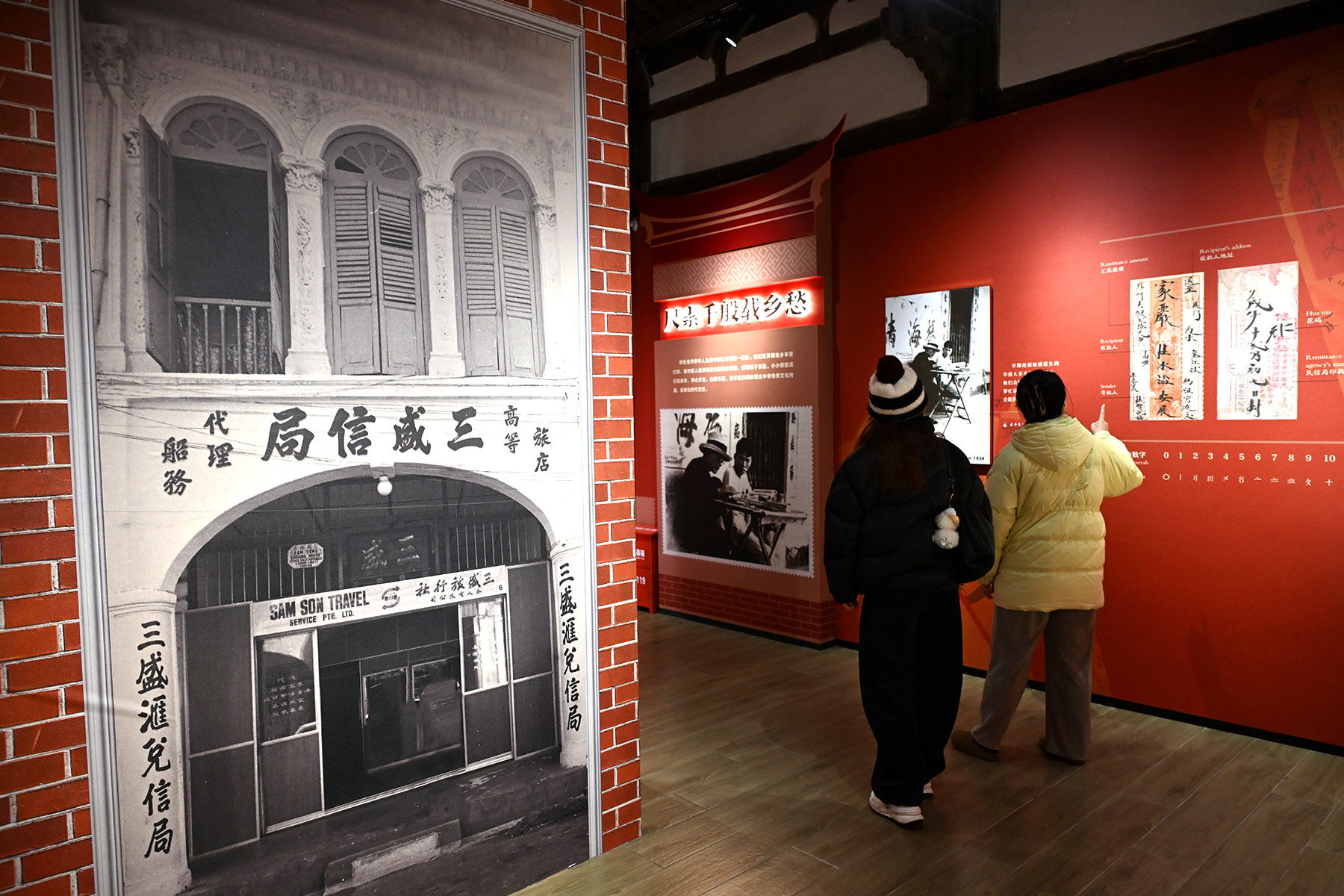
Earlier generations of overseas Chinese in Singapore typically sent money, daily necessities and letters to their relatives in China — a tradition often passed down for at least one generation.
They also organized fundraising activities to build basic infrastructure, such as schools, roads and temples, for their ancestral villages or helped new immigrants from their hometowns settle in Singapore.
Clan associations — based on hometowns, surnames or dialect groups — were formed to act as a bridge across borders.
Some associations organized trips from Singapore to China, a tradition that continues to this day.
Francis Phua, deputy secretary-general at the Singapore Federation of Chinese Clan Associations, or SFCCA, which has close to 230 members, said: "Overseas Chinese in Singapore (in the past) would think about returning home to China one day, or what is known as luo ye gui gen."
The proverb describes fallen leaves returning to their roots.
Waves of Chinese Singaporeans started visiting China to xun gen in the 1980s, during China's earliest years of opening up.
In the past, common gifts to bring back to China included money, lard and rice, said Or Teck Seng, chairman of the Nanyang Hwu Clan General Association in Singapore.
Or himself dug into his savings and sold one of his condominium units in Singapore to finance the rebuilding of his ancestral home in Anxi county in Fujian. The 68-year-old vice-president of an engineering company has taken on five such rebuilding projects, comprising four ancestral houses and a temple.
He first visited his ancestral home in 1997 and has since made more than 30 trips there.
"It was my duty to make sure my ancestors could 'live comfortably' so that they could continue blessing my family and me," he said.
In the past, traveling to China was arduous. Travelers were required to fly to Hong Kong first, before making their way to ancestral villages in rural China. SFCCA's Phua said that Chinese Singaporeans would visit their hometowns in groups to save on transport costs and for company.
He recalled that when he first went to South China's Hainan province in the 1980s with his parents and his wife, his face was covered in dust after a four-hour journey from the airport in Haikou to his hometown, due to the sandy roads.
Improvements to China's roads over the years have shortened the trip to no more than an hour or two, he said. Car rides are now smooth and efficient, a marked change from the bumpy journey he used to take.
Phua said early generations of Chinese braved the grueling journeys not only to see their childhood friends and relatives, but also to show their children what village life had been like before they left for Singapore.
Spotting the trend, travel agencies started offering xun gen tours in collaboration with clan associations, he noted.
Understanding history
While older trips often involved rebuilding temples, ancestral halls, or providing financial aid, modern tours are more focused on understanding family history.
Or said Singaporeans were "mostly curious about their ancestors' hometowns", and some took part in traditional rituals to pay respect to their ancestors.
Some visitors went on unplanned xun gen trips when in China for other purposes. For instance, Lee from Char Yong (Dabu) Association went in search of his ancestral hometown in 2018, when he was in Guangdong for a conference.
His grandfather left Dabu county for Singapore to work as a tailor around the 1930s shortly after getting married. His job supported a household of 11 people.
"Though money was tight, my grandfather would still squeeze out money to send home to China whenever requests came," he said.
Lee visited his ancestral village with a 1982 photo of a bridge that his grandfather had donated.
For his visit coming back to his grandfather's hometown, he not only found the bridge but also a distant aunt who was still living there."I was so lucky," he said.
His aunt showed him the room where his grandfather lived before moving to Singapore.
"The ancestral home has largely been abandoned after the roof caved in and became unsafe, but I'm very touched to have seen that part of my grandfather's life," said Lee.
As for Phua, his mother had urged him to visit their ancestral home in Hainan after he got married. His parents used to show him letters from their relatives, and he even helped them write back.
"So I actually wanted to go back and see what they were like," he said.
That first trip turned out to be memorable.
"There was no language barrier, as we grew up speaking the Hainan dialect," said Phua. "Neighbors would visit us every night to talk to my mother until the wee hours, while my wife and I would hang out with my cousins, whom we were meeting for the first time."
Engine of growth
Today, China has one of the largest populations living abroad. There were about 10 million Chinese living overseas in 2020, according to the International Organization for Migration.
Overseas citizens are a key part of its growth story. Media reports show that their investments accounted for about two-thirds of the country's foreign investment in its early development years.
The history of Chinese migration stretches back centuries. Records at the Overseas Chinese Museum show that a wave of Chinese emigrated abroad to seek refuge between the 1890s and 1920s amid frequent wars and turbulence.
Media reports also note that overseas Chinese were among the first to invest in China in the 1980s. For decades, the diaspora — even after acquiring foreign citizenship — reportedly accounted for as much as 70 percent of foreign direct investment.
The southern or eastern coasts include Guangdong, Fujian and Hainan provinces, which are the ancestral homes of most Chinese Singaporeans. While some moved directly to Singapore, others traveled to a third Southeast Asian country first, such as Malaysia and Vietnam.
History professor Zhuang Guotu at Xiamen University said that by the early 1940s, there were about 8.5 million Chinese worldwide — with more than 90 percent in Southeast Asia.
According to the latest data compiled by The Straits Times in February, in Indonesia, over 2.83 million residents identify themselves as ethnic Chinese. In Thailand, between 7.1 and 7.5 million people identify as ethnic Chinese, while an additional 9.3 to 10 million claim partial Chinese ancestry. Malaysia is home to approximately 7.6 million ethnic Chinese, and Singapore has around 2.76 million. Meanwhile, Vietnam reports about 749,466 ethnic Chinese residents. These figures provide an overview of the ethnic Chinese population in Southeast Asia.
New immigrants
While older Singaporeans look back and reflect on their roots in China, new immigrants are planting theirs in Singapore as part of a global migration surge.
SFCCA's Phua said that unlike earlier groups of overseas Chinese who became Singaporeans, new immigrants from China are "much wealthier, with a number having moved to Singapore due to investment migration".
Zhuang said that new migrants, who arrived in Singapore after China opened up, differed in their views on China from earlier groups.
ALSO READ: Changing Chinatowns
Having seen or experienced the economic growth firsthand, they formed their own views of China's system, he noted.
This group continues to maintain strong ties with their Chinese relatives back home, with some migrants holding substantial business in China as well.
"They see themselves more as global Chinese, with strong connections to China, rather than as 'Straits Chinese'," Zhuang said. Straits Chinese are defined as the descendants of early Chinese immigrants to Southeast Asia who blended Chinese traditions with Malay and British cultures.
"They view transnational mobility — and even returning to China — as a normal way of life and career development, representing a departure from the traditional immigrant mindset of (returning to their roots)," he added.
