

The lone silhouette of a skier gliding down a mountain is, for many, the enduring image of winter sports. For visually impaired athletes, however, their experience on the snow may be just as cold and sometimes as cruel, but it is never lonely.
Of the 70 para athletes representing China at the 2026 Milano-Cortina Winter Paralympics, seven compete in the visual impairment category, each with a sighted guide shadowing them on training runs and in actual races. It is only through their joint efforts and absolute trust that they can conquer fear and chase glory, they say.
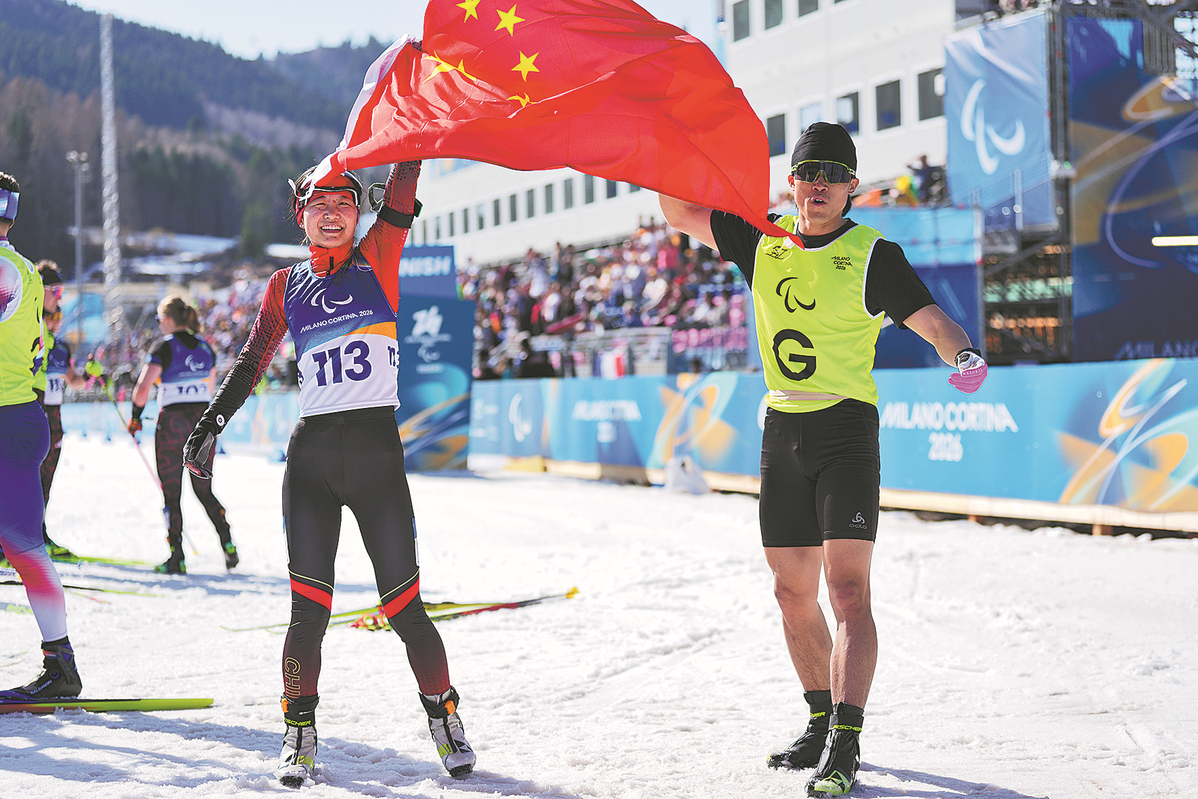
When Wang Yue crossed the finish line first in the women's sprint biathlon event on Saturday, she collapsed on the ground and buried her face in her hands to fight back tears. Her guide, Chen Guo-ming, gently removed her skis and poles and lifted her up.
"Right before I crossed the line, Chen told me through the earpiece that I was the first," she said. "At that moment, I was extremely excited, proud and thankful for my guide and all the people who have helped and supported me along the way."
Wang was born with congenital cataracts, limiting her vision to perceiving only the perimeter of light. She began training in winter sports in 2016 and won a silver and a bronze medal at Beijing 2022.
"From the very beginning, we shared the same goal of standing atop the podium at the 2026 Paralympics," said Chen, a former professional cross-country skiing athlete. "She is exceptionally self-disciplined and has a strong conviction," he said during an interview with Hebei Daily, a newspaper from Wang's native province. "She always asks for extra training, and I naturally stay with her throughout," he said. "Now her dream has come true, and so has mine."
On skiing courses, visually impaired athletes and their guides wear earpieces and microphones to communicate, with the guide skiing in front and often glancing back to check on the athlete. For the shooting section of the biathlon event, skiers use electronic rifles to aim at targets emitting infrared signals, which are converted into sound in their headphones. The sharper and more constant the sound grows, the closer they are to the target.
ALSO READ: Cai claims first gold for China
"Every time before we enter the shooting range during the race, I tell him through the earpiece to adjust his heart rate and rhythm," said Lu Hongda, guide for para skier Dang Hesong.
On Saturday, Dang missed the podium by just 0.7 seconds in the men's sprint biathlon. Knowing his partner could be frustrated by the narrow miss, Lu consoled him, advising him to stay calm and focus on giving the next race their best effort. The following day, they claimed the gold medal in the men's individual biathlon event.
Looking back, Dang said it was a matter of serendipity that their partnership began last summer. "In the beginning, he didn't know much about para skiing, and I had to brief him on important points and details," Dang said. "Gradually, through training, we've become more in sync with each other, and together, we've made important breakthroughs."
Para alpine skier Wang Xingdong has been training with his guide, Chen Zhicheng, for eight years. Chen said the course at the Tofane Alpine Skiing Centre in Cortina is one of the most difficult and complicated terrains they have ever faced."I am his eyes," he said. "It is my job to relay everything I see to him early enough so he can calculate in his mind how to pass through gates and poles. Only with sufficient trust can we complete the race."
The cues Chen delivers on the slope are succinct, often just one-word instructions like "left," "right," or "press". Eight years of cooperation mean they can understand each other instantly. Like many para athletes, Wang said skiing has made him more outgoing and confident. "Since acting as a guide for Wang, I've also changed, becoming more meticulous and patient in life," Chen added.
