

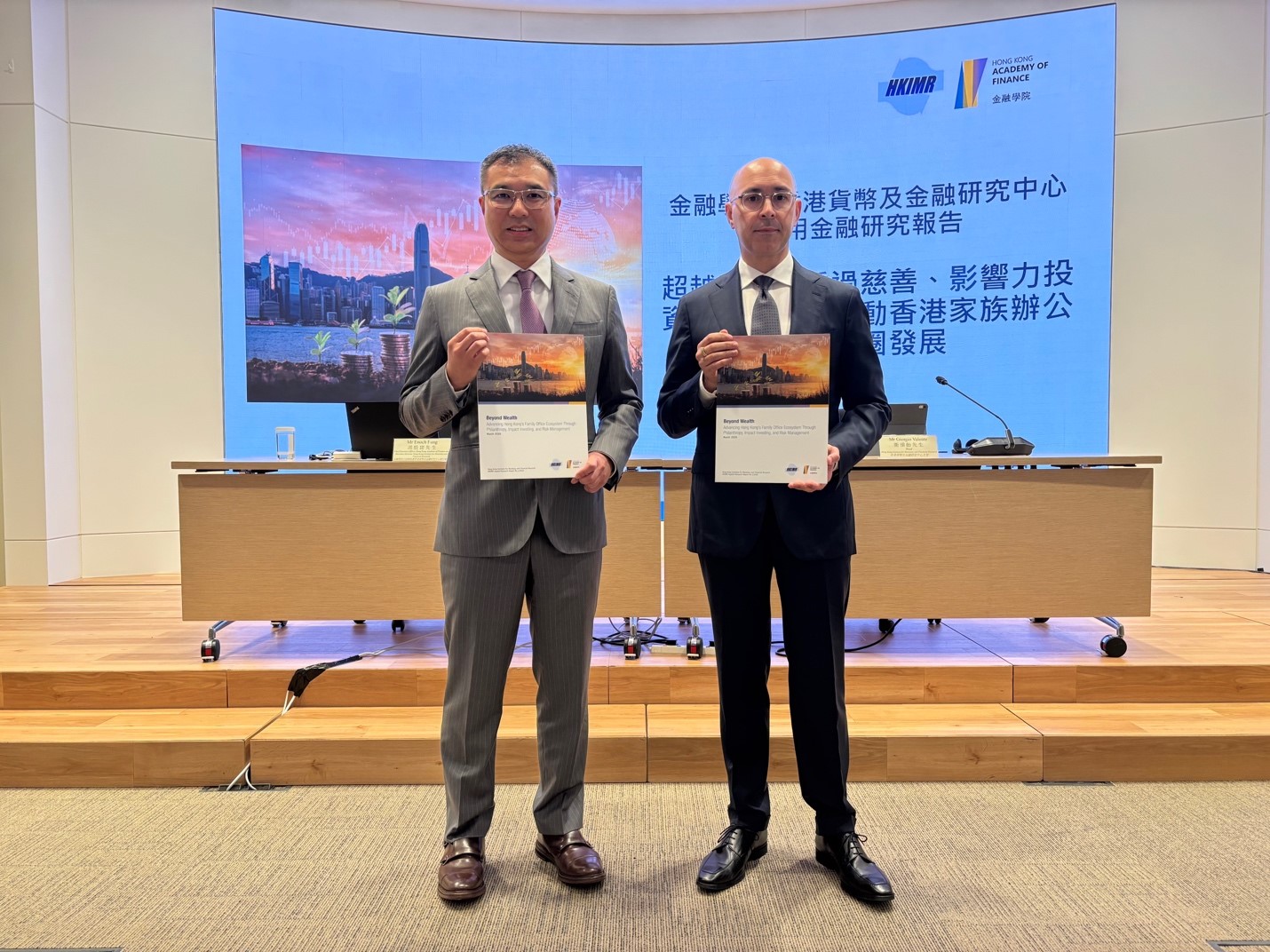
Hong Kong’s family office sector continues to exhibit robust momentum, with increasing demand for private social investment and risk management strategies emerging as a key driver for future expansion alongside traditional wealth management, according to a new report.
“Hong Kong’s appeal as a premier family office destination is increasingly evident, with 91 percent of survey respondents already invested in the city, citing its favorable regulatory framework, free flow of capital, deep capital markets, and competitive tax regime,” the Hong Kong Institute for Monetary and Financial Research (HKIMR) said.
The research arm of the Hong Kong Academy of Finance (AoF) on Tuesday released the findings of its latest study, which is based on a survey covering 101 institutions – including single and multiple family offices -- and interviews with more than 30 industry stakeholders, such as scholars, experts and professional associations.
The report shows that surveyed family offices boast a strong capital base, as more than 80 percent of respondents managed a net worth of at least $50 million, with 44 percent overseeing portfolios exceeding $1 billion.
Wealth managed by these entities or institutions largely originates from the Hong Kong Special Administrative Region, the Chinese mainland, and other parts of Asia, it adds.
ALSO READ: Effective family governance structure operates with trust, clarity and transparency
“In terms of asset holdings, several respondents mentioned that they are currently investing in conventional asset classes, including equities and fixed income securities. But their appetite is growing for alternative investments, including private markets and digital assets,” said Giorgio Valente, head of the HKIMR.
Equities made up 91 percent of the assets managed by respondents, while money market funds accounted for 83 percent, the report shows.
However, more than one-third of respondents said they plan to increase allocations to private markets over the next three years. The research projects that family offices’ participation in philanthropy will jump to over 60 percent, while impact investing (investing in companies or funds that aim to generate a positive social or environmental impact alongside a financial return) will rise to 43 percent.
“Families and affluent individuals are increasingly more aware of the social responsibility of their activities,” Valente said. “Impact investing indeed provides them with a dual value proposition that allows them to pursue environmental and social impacts while also delivering international returns.”
The research also found that more family offices have shown interest in expanding their purchases of risk management products, driven mainly by the goals of wealth preservation and hedging against market volatility amid broader uncertainties.
READ MORE: Hong Kong sees 25% jump in family offices over two years
Over the next three years, the purchase of investment-related risk products in Hong Kong is expected to rise from 54 percent to 78 percent, with the purchase of non-investment risk management products rising to 61 percent, the report says.
When asked whether the recent tensions in the Middle East have prompted more family offices to look to Hong Kong, Enoch Fung Yan-lok, chief executive officer of the AoF, said that decisions to relocate or expand a family office’s footprint are usually medium- to long-term and are typically not swayed by one-off incidents.
Fung added that Hong Kong, as an international financial center which offers many unmatched advantages -- including a deep pool of professional services talent and a well-established financial environment -- will give family offices strong confidence and provide a reliable platform for their development.
As of the end of 2025, over 3,380 single-family offices were in operation in Hong Kong, representing an increase of about 680 over the previous two years, or a growth of more than 25 percent, according to Invest Hong Kong, the HKSAR government’s investment promotion arm.
Contact the writer at gabylin@chinadailyhk.com
