

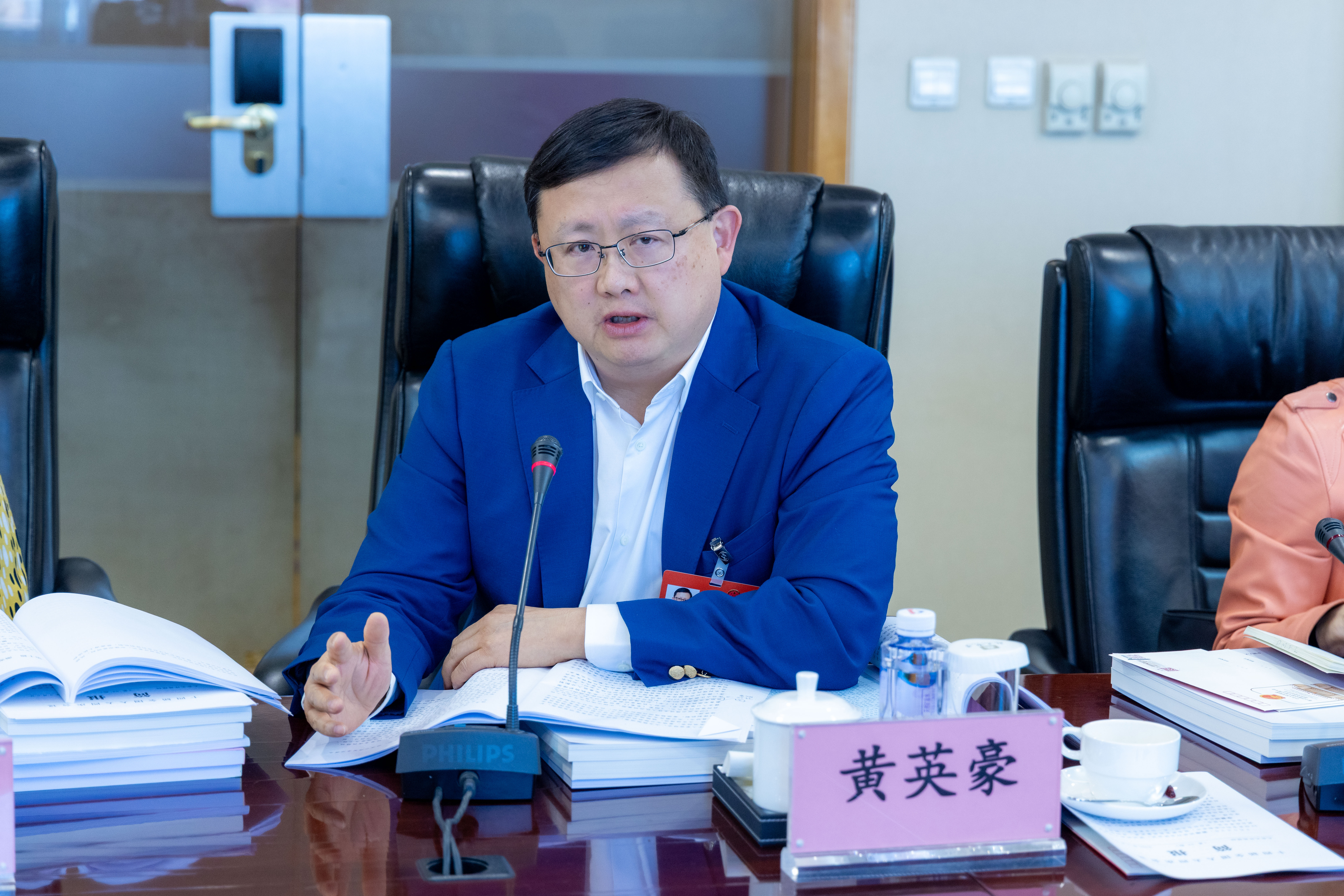
Kennedy Wong Ying-ho, a Hong Kong deputy to the National People’s Congress, advised an integrated multi-model e-commerce logistics pilot zone in Jiangmen city to better align Guangdong's manufacturing capabilities with Hong Kong's global shipping and aviation network.
The initiative will boost coordinated development within the Guangdong-Hong Kong-Macao Greater Bay Area, where lagging development of the 11-city cluster’s west wing has long been a concern, and upgrade Hong Kong’s trading sector with broader strategic depth and more resilient supply chains, reinforcing its international trade, shipping, trade and aviation status in line with the nation’s 15th Five-Year Plan (2026-30), the national legislator said in an interview at the ongoing national two sessions.
The NPC — the nation’s top legislature — and top political advisory body the National Committee of the Chinese People’s Political Consultative Conference, convened their annual plenums in Beijing on Thursday and Wednesday, respectively.
The draft outline of the 15th Five-Year Plan was submitted for review during the opening of the fourth session of the 14th NPC.
Wong, representing the import and export sector at Hong Kong’s Legislative Council between 2022 and 2025, said his tenure as a lawmaker helps him recognize the opportunities arising from modern e-commerce development, particularly cross-border e-commerce, for Hong Kong.
ALSO READ: Taobao ramps up for HK’s Double 11 as local e-commerce market heats up
However, site visits and exchanges with industry players, including those from Hong Kong conducting business in other Greater Bay Area cities, revealed many logistical challenges and bottlenecks, especially in the 11-city cluster’s west wing, which Wong believes are mainly caused by inadequate logistics infrastructure and poor connectivity.
By analyzing feedback from the sector, Wong — at this year's national two sessions — focused more on initiatives to narrow the development gap and achieve coordinated development.
The Hong Kong International Airport (HKIA) has built a logistics park in Dongguan to carry out multi-model transportation, an initiative that has significantly reduced transportation times, costs and procedures for Chinese mainland cargo shipping overseas through HKIA.
Inspired by the successful model in Dongguan — the east bank of the Pearl River Delta — Wong has advised erecting a new integrated logistics system in the Greater Bay Area's west wing — Jiangmen.
Compared with Dongguan, Jiangmen can better cater to the freight demands of western Guangdong province and the broader South and Southwest China, including the provinces of Yunnan, Guizhou and Sichuan, and the Guangxi Zhuang autonomous region, covering a vast and underserved hinterland, said Wong.
The city also boasts abundant land resources with relatively low operating costs, a natural strength for developing large logistics parks, bonded warehouses and port-side industrial zones, he added.
Jiangmen has the potential to develop into a comprehensive transport hub, Wong said, citing the under-construction Guanghai Bay deep-water port — a rare asset on the Greater Bay Area's west wing, multiple rail lines, and its proximity to the planned Pearl River Delta Hub Airport in adjacent Foshan city.
A multimodal transportation network integrating waterway, railway, airport and highway is taking shape in Jiangmen, Wong said.
The city is also an emerging manufacturing hub focusing on high-end equipment, information technology and biomedicine, Wong said, adding that he believes the integrated logistics system could directly serve these industrial clusters, if established, by providing customized and high-efficiency supply chain solutions.
The benefits extend beyond Jiangmen — it will strategically upgrade the entire logistics landscape in the Greater Bay Area, including Hong Kong, Wong said.
A new logistics hub in Jiangmen would position Hong Kong to better utilize the land resources on the western side of the Greater Bay Area, according to Wong. For instance, Wong said, exports can be processed and stored in Jiangmen, then shipped to Hong Kong via freight trains, fast ships, rail shuttles or roads, enabling the Hong Kong Special Administrative Region to release more land resources for high-value-added purposes.
Wong said that the planned Pearl River Delta Hub Airport in Foshan could also complement HKIA.
HKIA could concentrate on long-haul international passenger services and high-end cargo transportation, while the new airport can accommodate a large share of regional passengers and cargo services. As long as they are connected by an efficient transportation network, they can serve a larger market together, Wong said.
In this way, Hong Kong will better secure its long-term leadership as an international shipping and aviation hub amid intensifying global competition, and the whole Greater Bay Area will gain enhanced supply chain resilience. The new logistics system will also serve as a backup for eastern routes during disruptions like extreme weather.
Combining the mainland's vast market, Hong Kong's global reach and Guangdong’s complete industrial chains, the region’s status as a world-class commercial and logistics hub is set to be consolidated, added Wong.
Yet challenges remain, Wong said. Establishing a logistics system across two customs territories is a long-term undertaking fraught with challenges, from regulatory differences to data exchange.
There are also risks of long payback periods and operational losses before cargo flows achieve economies of scale, as industrial clustering and supply chain maturity in the western wing still lag behind the east, according to Wong.
He said he hopes that Hong Kong can fully leverage the advantages of "one country, two systems" and the central government’s steadfast support to advance the vision, while also utilizing its strengths as a financial center to attract investment for this mega project.
"By responding to the nation's call for regional integration, Hong Kong can also reap the huge benefits of this expansion and empowerment," Wong said.
Contact the writer at amberwu@chinadailyhk.com
