

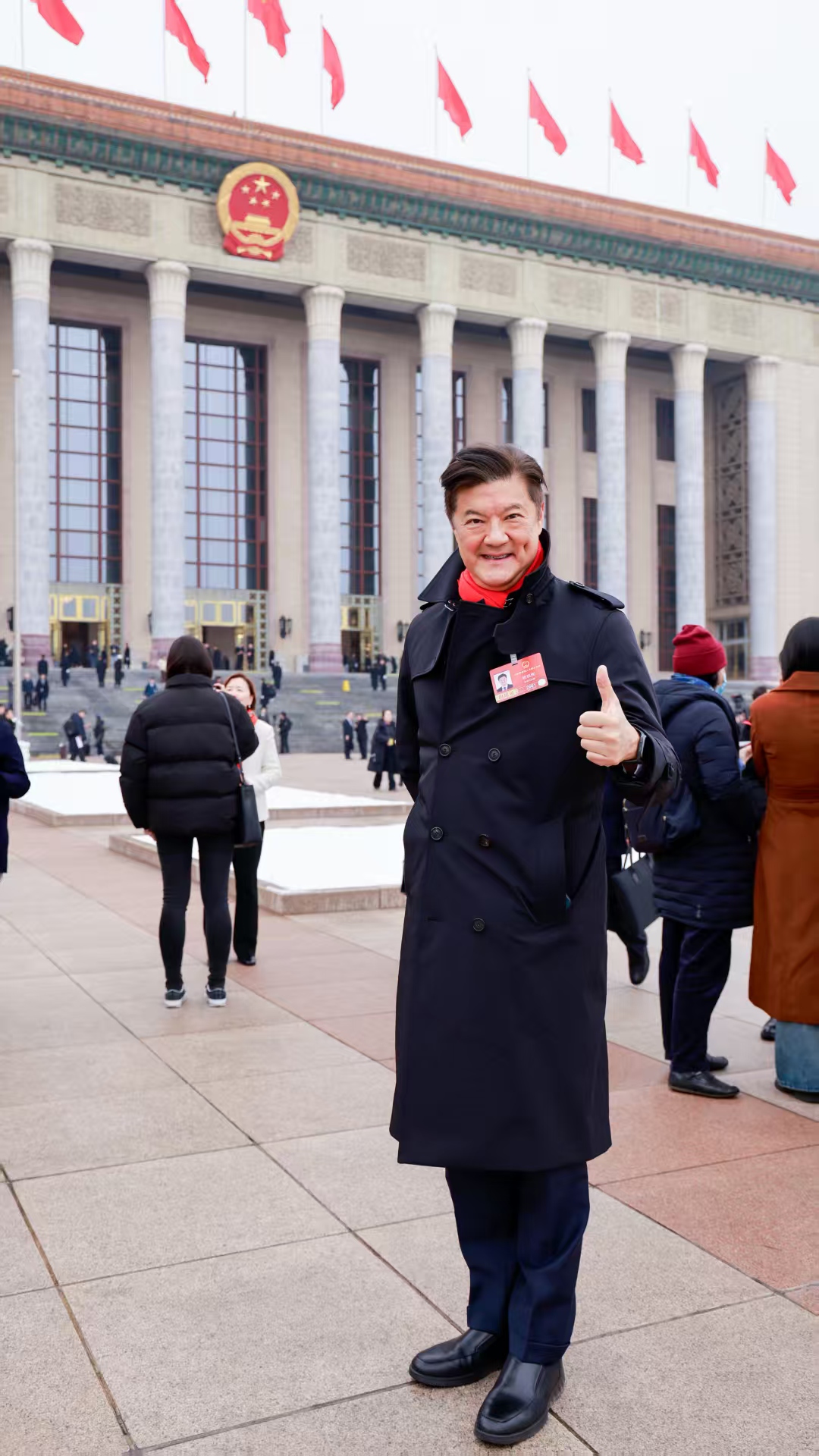
The Hong Kong Special Administrative Region should accelerate efforts to cultivate new growth drivers and play a bigger role in the country’s broader economic strategy, a national lawmaker said as China charts its priorities for the next five years.
Andrew Yao Cho-fai, a Hong Kong deputy to the National People’s Congress, made the remarks in an interview with China Daily during the fourth session of the 14th NPC in Beijing.
While reviewing a draft outline of the country’s 15th Five-Year Plan (2026-30), currently under deliberation at this year’s session, Yao said his “strongest takeaway” was that “Hong Kong must embrace technology and new industries”.
The draft outline said China aims to build a modernized industrial system and move faster to achieve greater self-reliance and strength in science and technology.
Beyond finance, Yao noted that the Hong Kong SAR should pay closer attention to emerging industries in which the country is making progress, such as the low-altitude economy, advanced manufacturing and semiconductors.
Representing Hong Kong’s commercial sector in the city’s Legislative Council, Yao said he has been encouraging local companies to upgrade technologically, a transition he has experienced firsthand.
Having worked in heavy industry for more than a decade, a field relatively uncommon in Hong Kong, Yao said he has increased the use of automation equipment such as robotic arms in his factories over the past two years.
“After seeing many ‘dark factories’, or unmanned manufacturing facilities, on the Chinese mainland, and how artificial intelligence is being used to empower advanced manufacturing, I realized we have to change,” he said.
He admitted that in the past, he was reluctant to make investments that might take as long as a decade to pay off. “But now I realize that if we don’t invest, we will lose our competitiveness,” he said.
“While Hong Kong may not need to become deeply involved in every emerging technology field, it should at least understand them,” Yao added, so it can better serve advanced technology companies that choose to expand in the city.
ALSO READ: HK’s NPC deputies vow action, share views on Ding’s expectations
He cited a mainland bathroom-product maker that has been growing rapidly in recent years. Unlike some established international brands that often take more than a year to develop a new product, the company can design and launch a new item in about a month.
In addition to speed, the company also focuses on user experience, Yao said. Its smart bathroom mirror, aimed at young consumers, features lighting designed to create a more flattering look, along with a mini built-in refrigerator and a hair-drying function. “It made me think about how Hong Kong can do more to help companies like this expand overseas,” he said.
Yao suggested that the city should update its service mindset and address the practical needs of companies and professionals, including housing and schooling for employees’ children. Such measures, he said, would help encourage technology firms, particularly industry leaders, to establish regional headquarters in Hong Kong rather than simply listing on its stock exchange.
Coordinating GBA ports
At this year’s NPC session, Yao proposed developing a “combined port” model in the Guangdong-Hong Kong-Macao Greater Bay Area, under which a collaborative mechanism among ports could be established to channel some high-value cargo through Hong Kong.
His suggestion came as similar discussions are underway in the region’s aviation sector, where Hong Kong’s airport and those in nearby Shenzhen and Guangzhou, Guangdong province, are exploring coordination to reduce competition caused by overlapping airspace and developing complementary functions.
Despite remaining one of the world’s busiest container ports, Hong Kong’s throughput is expected to fall to about 13 million twenty-foot equivalent units in 2025, down from more than 20 million TEUs at its peak, according to estimates by the Hong Kong Maritime and Port Development Board.
Meanwhile, other ports in the Greater Bay Area have expanded rapidly. The ports of Nansha in Guangzhou and Yantian in Shenzhen handled over 20 million TEUs and 17 million TEUs respectively in 2024.
“In the future, competition will not be port versus port, but region versus region,” Yao said. “If the three ports can coordinate effectively, the combined effect will be greater than the sum of their parts.”
Shifts in international trade are reshaping shipping routes, he said. For instance, products that once moved directly from Chinese ports to the United States may now be sent to Southeast Asia or Mexico for further processing before entering the US, as global supply chains become more fragmented. Citing recent instability in the Middle East, he added geopolitical tensions can also force vessels to reroute.
READ MORE: NPC deputies: Tech measures in govt work report create new opportunities for HK
“In this environment, coordination among ports becomes even more important,” Yao said.
