

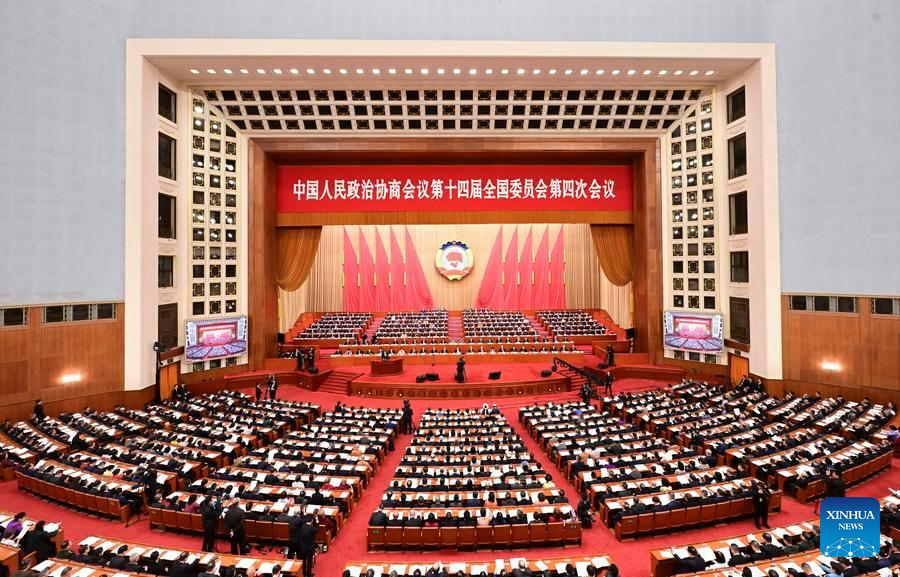
BEIJING - China's top political advisory body on Saturday held its second plenary meeting of the annual session in Beijing.
Wang Huning, a member of the Standing Committee of the Political Bureau of the Communist Party of China Central Committee and chairman of the Chinese People's Political Consultative Conference (CPPCC) National Committee, attended the meeting.
At the meeting, 14 members of the CPPCC National Committee shared their views and put forward suggestions.
Huo Jinhua said homegrown, risk-controllable foundational technologies underpin national security, stability and continuous innovation, and China should persistently strengthen R&D efforts and investment in these technologies.
ALSO READ: CPPCC members attend group interview before 2nd plenary meeting
To foster new growth momentum, Huang Qunhui suggested implementing policies tailored to specific industrial sectors and strengthening enterprises' principal role in innovation.
Xie Dong urged incentivizing leading enterprises to boost funding for fundamental research while expanding financial support for tech startups.
Jiang Liping called for efforts to improve policies and measures that aim at enhancing the well-being of people from Taiwan, enabling them to enjoy equitable access to public services.
Zhou Zhihua stressed the need to optimize the coordination and distribution of AI research and use AI to guide a paradigm shift in scientific research.
READ MORE: Chinese leaders pool wisdom from lawmakers, political advisers
Mo Rong urged efforts to help human resources better adapt to advances in AI technologies and the needs of industrial transformation and upgrading.
Other political advisors shared their views on reform and innovation, poverty alleviation, the modern industrial system, the private sector, the Hainan Free Trade Port, education, and support for childbirth.
