

In an age of viral labels and AI-generated content, young viewers increasingly value stories that present influencers as complex human beings.
Whether in a restaurant or on the subway, it has become increasingly common to see young people absorbed in their phones, endlessly scrolling through short videos. Their eyes stay glued to the screen as their fingers swipe repeatedly, refreshing a steady stream of new content every few seconds.
But 21-year-old Wu Haoyu is an exception.
A sophomore at the Communication University of Zhejiang, Wu prefers to watch a single documentary-style video while eating, typically one that lasts 20 to 30 minutes.
"When you watch a longer video, your hands are free — you don't have to keep swiping," Wu explained. "One meal is just enough time to finish it."
Among young people, this habit is often described as enjoying "digital side dishes" — videos consumed alongside a meal.
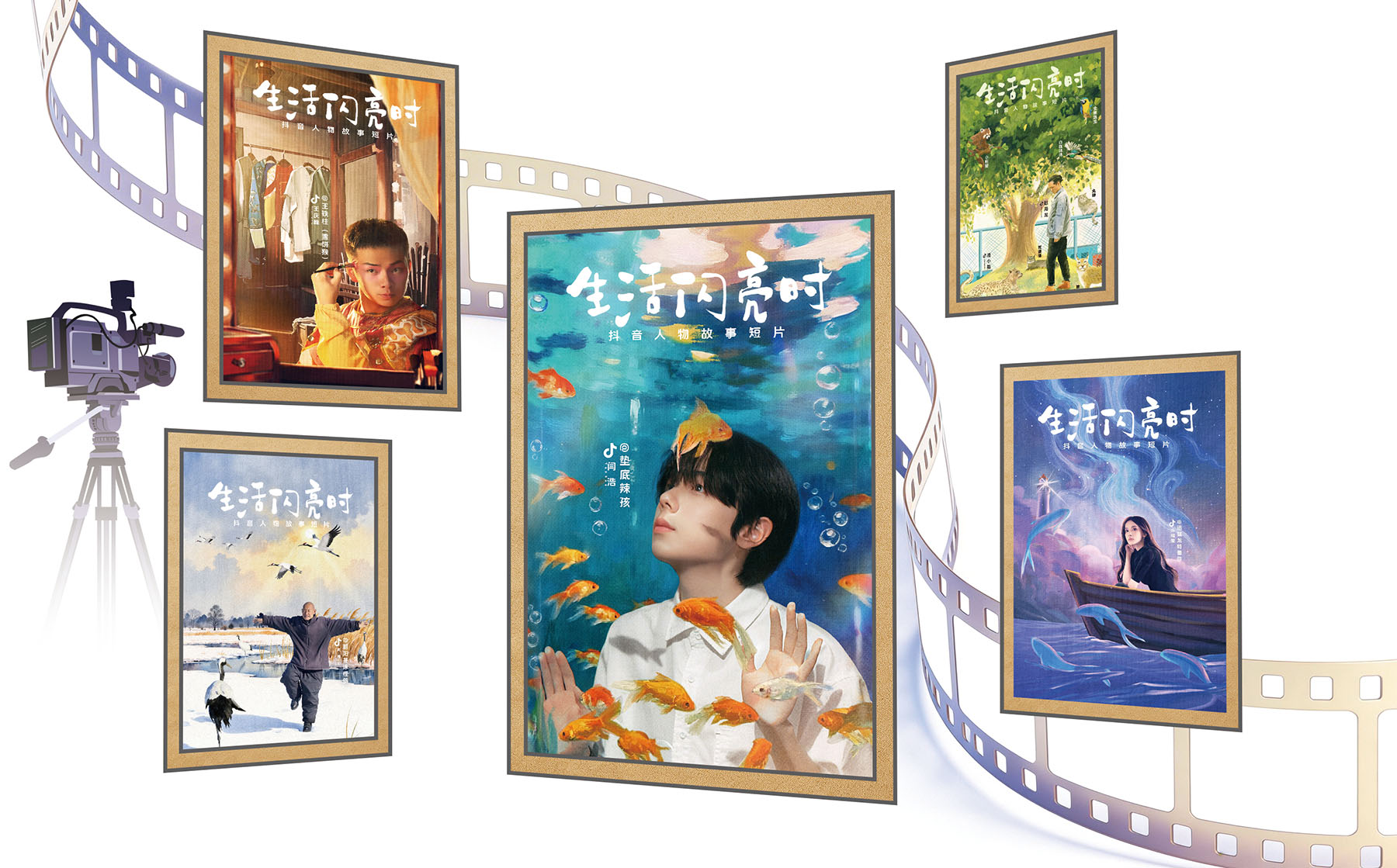
One of Wu's favorite programs is When Life Shines on Douyin, the Chinese version of TikTok. Produced by the Douyin Trends team, the series delves into the personal stories of internet celebrities, revealing the lives they lead beyond the spotlight to uncover the struggles and emotional scars hidden behind their fame.
For Wu, the appeal goes far beyond its convenient length. He first discovered the series through an episode about poet Yu Xiuhua, but soon realized it offered more than a typical profile: the program explores confusion, anxiety, and inner conflict — experiences that resonate deeply with many young viewers.
"Labels are everywhere online these days. But I don't want to see a flat tag. I want to understand a real, three-dimensional person. This show allows me to do that," Wu said.
Since its launch in 2021, When Life Shines has released more than 70 episodes and attracted 27.5 million core viewers. According to Wang Xueqiao, 35, the program's executive producer, the largest segment of its audience is between 18 and 30 years old, accounting for 51.5 percent.
"Young people in the short-video era are still craving depth," Wang observed.
When he first began planning the series, he noticed a troubling trend emerging from the world of short videos: hot topics would pop up quickly, and viral figures were often either overly praised or harshly criticized, leaving little room for nuance.
"As public expression shifts from text to video, people are increasingly reduced to simplistic impressions. That leads to a one-sided view," Wang said.
In response, the team aimed to create a space where individuals could speak for themselves — allowing those boxed in by online stereotypes to be seen as complex human beings and encouraging young audiences to reflect on truth, empathy, and deeper comprehension.
Beyond quick clips
Mo Zhiying, one of the directors, joined the program in late 2021. With nearly a decade of experience in television documentaries, he recalled that traditional productions often focused on familiar subjects or educational themes, such as food or cultural heritage.
"They were designed to tell known stories in a more refined way, usually unfolding slowly and steadily," Mo explained.
Documentaries made for online platforms, however, follow a different logic.
"Although they are longer, they still operate under the rules of the short-video era," he said. "You need to capture attention within the first 10 seconds by spotlighting a central conflict or tension."
Driven by the program's pursuit of a more layered and unpolished kind of truth, the production process begins well before filming. Mo reconstructs each subject's public image using available online material and works to understand their inner motivations. By sifting through livestream clips, comments, and online debates, he searches for clues that reveal deeper truths — a process that can take weeks.
One of Mo's most memorable cases involved "Wanyan Huide", a Douyin influencer and psychological counseling content creator.
In 2023, her strong accent, unconventional views, and the label of a "Peking University psychology graduate" triggered heated debate online. "She once received more than 400 harassing phone calls in a single day,"Mo said.
When the team first approached her with cameras, they found someone guarded, cautious about speaking publicly.
Instead of amplifying controversy, the team focused on how someone marginalized in the internet age attempted to rebuild human bonds.
As Mo gathered more information, he discovered that even before going viral, the woman — in her 50s — had been livestreaming psychological counseling sessions two or three times a day, despite having very few viewers.
"If it were about money, it wouldn't make sense," Mo said. "We felt she was seeking something — perhaps comfort or healing through helping others."
That effort to understand, rather than exploit, eventually broke the ice.
In the documentary, the exaggerated internet meme faded away, revealing a real person yearning for genuine connection amid digital noise.
The 16-minute episode received more than 3.3 million likes, offering viewers a fresh perspective on someone who had once been widely mocked.
Mo recalled that the earliest episodes of When Life Shines were only about 10 minutes long. Viewers quickly voiced their desire for more, saying the episodes felt "too short".
In response, the Douyin Trends team extended the format, with each episode now running between 20 and 30 minutes. Starting in 2025, the program also began releasing new episodes weekly, with a fresh installment every Thursday.
"People assume long videos won't survive in a short-video era. But if the story is compelling enough, viewers are willing to invest their time," Mo said.
Truth matters
Wang observed that with the rise of AI-generated content in recent years, authenticity has become increasingly rare — and therefore more valuable.
"As artificial intelligence advances, people care more and more about what is genuine online," he said.
This hunger for truth is why Mo's camera always seeks to capture what lies beneath the surface. Some viewers question why influencers — often perceived as successful — still choose to reveal vulnerability.
"I don't see it as exploiting suffering," Mo explained. "Suffering is simply part of who they are."
ASO READ: Finding belonging across Strait
For young audiences watching on the other side of the screen, this raw honesty offers emotional validation and comfort.
Wu shared that seeing even successful influencers struggle with strict parents or appearance anxiety made him feel understood.
"It's a relief," Wu said. "It shows me I'm not alone in feeling this way."
Mo added that influencers are often more relatable than traditional celebrities or sports stars, who are admired for their exceptional talent or appearance. Many creators on short-video platforms, by contrast,"are ordinary people navigating the challenges of everyday life".
"No matter the era, there has always been a deep need for real emotion," Mo said.
Contact the writers at mengwenjie@i21st.cn
