

Flurry of GPU-related initial public offerings puts nation's high-tech on global stage

A wave of initial public offerings is sweeping China's graphics processing unit, or GPU sector, marking a critical phase in the nation's push for self-reliance in advanced computing power.
On Jan 22, Shanghai-based Enflame Technology's application to list on Shanghai's Nasdaq-style STAR Market was accepted by the exchange. This move paves the way for "The Four Dragons" — Enflame, Moore Threads, MetaX and Biren Technology — to complete their convergence in the capital markets.
This follows the successful listing of another Shanghai GPU firm, Iluvatar CoreX, on the main board of the Hong Kong stock exchange on Jan 8. It became the second homegrown GPU company to go public in Hong Kong after Biren. Earlier, industry leaders Moore Threads and MetaX had already debuted on the STAR Market to significant investor interest.
READ MORE: Scientists pave way for faster, more stable chips
The listing momentum which started from late 2025 extends beyond dedicated chip designers. Baidu Inc has announced plans to spin off its non-wholly owned subsidiary Kunlunxin for an independent listing. Informed sources told China Daily that Alibaba Group is also considering a similar spin-off plan for its chip design arm T-Head.
This IPO rush unfolds against a backdrop of stringent US semiconductor export controls and an explosive growth in domestic artificial intelligence applications, thus driving demand for alternative computing solutions.
At a recent news conference, Li Chao, a spokeswoman for the National Development and Reform Commission, highlighted China's deepening "AI+" initiative, which "provides extensive application scenarios for AI computing chips". Li pointed to "rapidly growing demand and vibrant innovation across all types of computing chips", adding that "domestic chip products are accelerating their adaptation across different scenarios with very good results".
The comments acknowledge the sector's vitality while setting higher expectations for its future development. Computing power forms the bedrock of the digital economy, a strategic resource underpinning data flow, algorithm training and intelligent application deployment.
If AI is a lush crop, computing infrastructure is the "fertile black soil" it depends on. As the global computing industry shifts from scale expansion to qualitative leaps, building a secure ecosystem — from underlying chips to applications — has become imperative for China to secure its developmental sovereignty, experts said.
Dong Peng, a senior economist and member of the assets committee of the China Enterprise Confederation, described this listing wave as "a collective breakthrough for domestic computing power during a strategic window of opportunity".
"Beneath the surface heat in capital markets lie two fundamental drivers," Dong said.
"First, the national demand for autonomy and controllability in AI and high-end manufacturing has created an unprecedented dual engine of policy and market support. Second, Washington's export restrictions on US leaders like Nvidia have opened a precious market window for domestic firms."
He emphasized that listing is not merely about fundraising, but a crucial step to establish industry standards and ecosystem influence."The race to go public is about seizing the advantage in technology iteration, customer lock-in and brand recognition while the competition landscape is still taking shape. This is a battle for survival and, more importantly, for future power."
The Hong Kong stock exchange and the STAR Market, as preferred boards for "hard tech" firms, have provided a streamlined pathway for these companies. Driven by continuous investment in AI infrastructure and the escalating strategic priority of technological self-reliance, China's domestic AI chip sector is poised for substantial market expansion, experts said.
Zhou Di, a senior engineer and expert with the National Science and Technology Expert Database of the Ministry of Science and Technology, said China's AI computing market is likely to evolve toward a "dual-track, domestically led" new market landscape.
"Nvidia is likely to retain a share in the high-end AI training market, represented by the demand of hyper-scale internet companies and cutting-edge research institutes, by virtue of its technical advantages. Domestic GPUs, leveraging cost-performance ratios, customized services, policy support and security advantages, are positioned to dominate vertical sectors like government affairs, finance, industry and healthcare, as well as broader cost-performance-sensitive markets,"Zhou said.
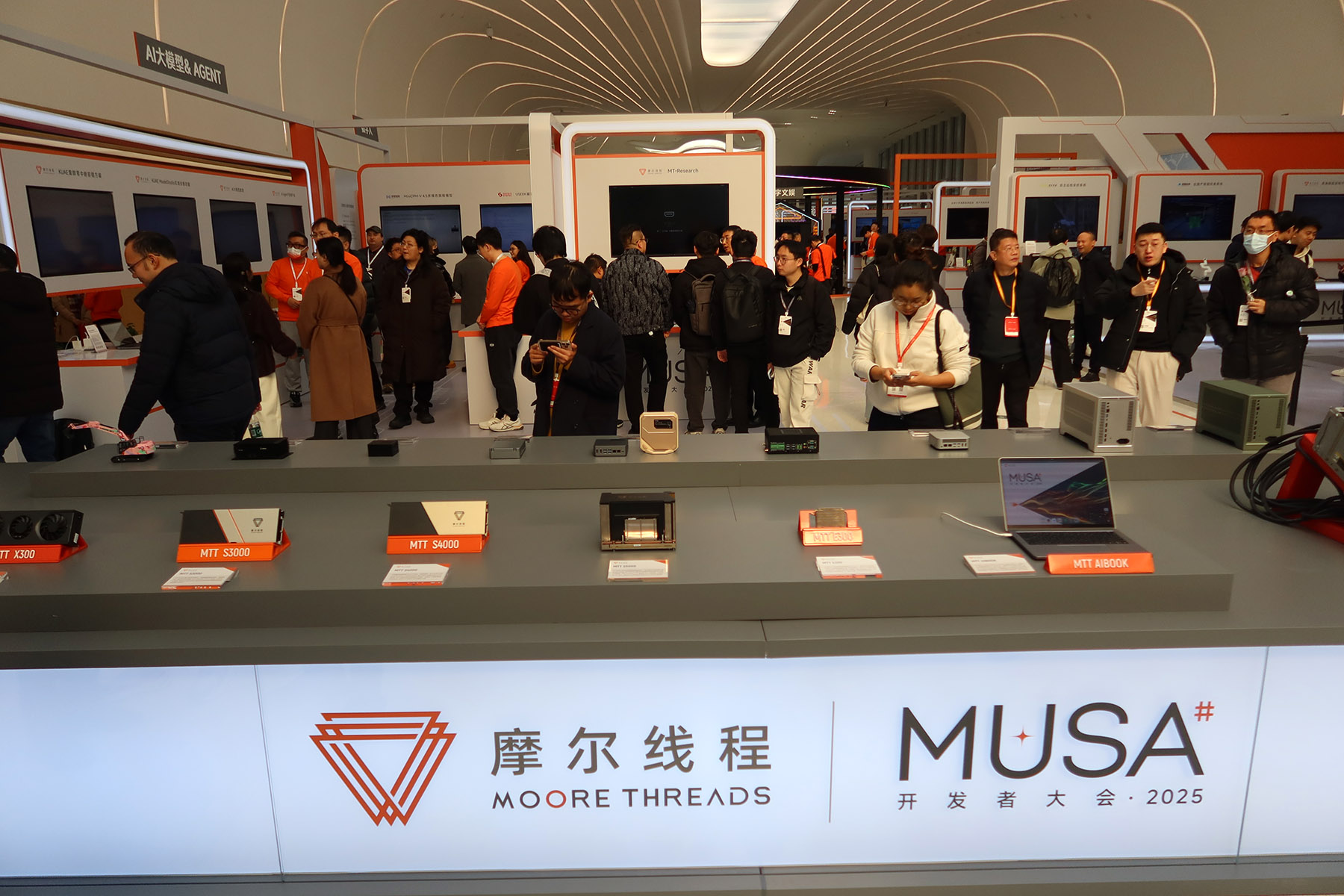
The wave of listings also comes as China's push for self-sufficiency in AI processors is gaining remarkable momentum, with at least nine domestic chip companies having surpassed a significant threshold of 10,000 units in terms of order shipments.
This 10,000-chip club signals that domestic AI chips are gaining tangible market traction based on their performance, stability and cost. It heralds a shift from mere scale competition to a more comprehensive battle encompassing software ecosystems, commercial services and sustained reliability, experts said.
The cohort includes the in-house chip divisions of tech heavyweights such as Huawei's Ascend, Baidu's Kunlunxin and Alibaba's T-head, alongside listed or soon-to-be-listed AI chip specialists such as Cambricon, Moore Threads, Enflame and Iluvatar CoreX. Even some startups, including Sunrise and Tsingmicro, have crossed this volume threshold.
Companies with the largest scale of shipments, such as Huawei, Baidu and Alibaba, have reached several hundred thousand.
He Hui, semiconductor research director at the United Kingdom-based tech research firm Omdia, said, "Alibaba's T-head is at the forefront in terms of AI chip shipments, benefiting from its early start and massive internal demand."
According to US market research company International Data Corp, in the first half of 2025, the size of China's server market powered by AI chips reached $16 billion, with over 1.9 million units shipped. Nvidia held about 62 percent of the market share, while Chinese chips captured about 35 percent.
IDC ranked Huawei's Ascend series first in market share among domestic chips in the first half of 2025. Backed by its parent company's vast ecosystem, Ascend enjoys stable demand, whose chips are used in large-scale clusters by telecom operators and tech firms.
Omdia's He said Chinese internet companies are adopting a two-way approach. On the one hand, they are making efforts to buy Nvidia's advanced chips within regulatory frameworks. On the other hand, they are supporting the development of domestic AI processors as much as possible. For instance, ByteDance is testing and using chips from Baidu's Kunlunxin and Cambricon, while Tencent is using processors from Enflame.
The growing demand for Chinese AI chips is also reflected in the documents filed by listed enterprises. Prospectuses submitted between late 2025 and early 2026 by companies such as Moore Threads, Iluvatar CoreX and Enflame show accumulated shipments surpassing 10,000 chips. Iluvatar CoreX, for example, reported delivering 52,000 AI chips to 290 clients across finance, healthcare and transportation sectors by June 30.
Industry insiders said they view the emergence of multiple 10,000-chip vendors as a critical transition. Roger Sheng, vice-president of research at US market research company Gartner, said it marks the entry into a "large-scale verification" phase for this round of industrial trial and error, as Chinese AI chip companies make progress.
ALSO READ: Chipmakers driving AI boom
But challenges exist. Sheng outlined critical areas for improvement, including adopting advanced packaging technologies and optimizing computer algorithms through cooperation with Chinese large language model providers.
Xiang Ligang, director-general of the Zhongguancun Modern Information Consumer Application Industry Technology Alliance, a telecom industry association, said that Nvidia's dominance in the global AI chip market relies not only on chip performance, but also on its entrenched CUDA ecosystem — a 20-year-old framework for AI compatibility.
While Chinese chips, such as Huawei's Ascend series, can technically rival certain Nvidia chips, they lack CUDA's universal adaptability for AI large language models, Xiang said."However, geopolitical uncertainty is driving users toward Chinese chips, and developers are now shifting their focus to compatibility layers for domestic alternatives, eroding Nvidia's ecosystem advantage," Xiang added.
Omdia's He said that with domestic manufacturing capacity for AI chips expected to be ramped up in 2026, the industry anticipates "another wave of explosive growth".
Zhang Wen, founder, chairman and CEO of AI chipmaker Beijing Biren Tech, said, "The production capacity of advanced domestic AI chips will be crucial for the future of China's AI industry."
Contact the writers at masi@chinadaily.com.cn
