

Businesses located inside government buildings change public perceptions, create new jobs
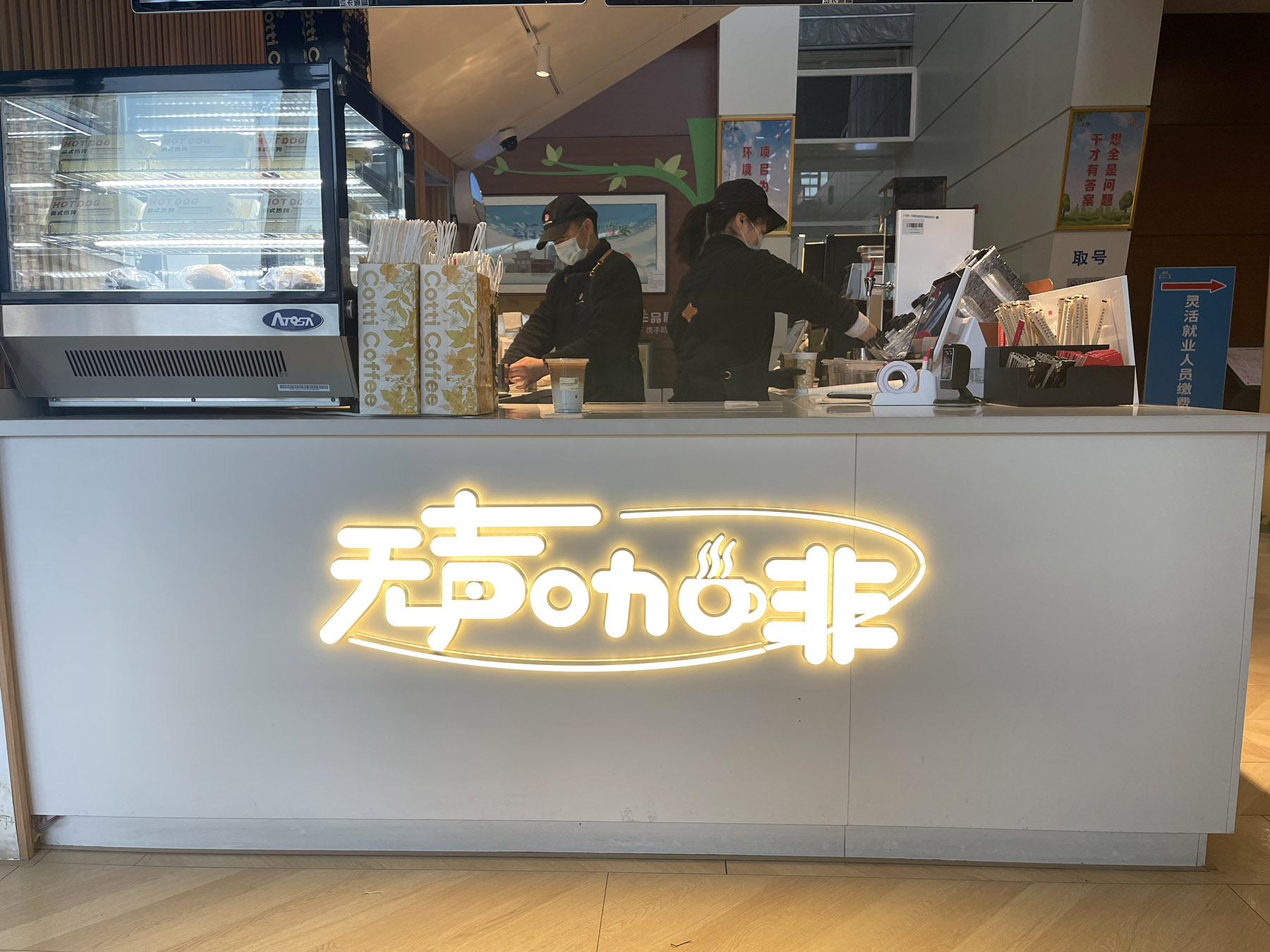
Amid the usual sounds of office work, a familiar noise fills the air in a government service hall in Huai'an, Jiangsu province — the gentle whir of coffee grinders and the soft hiss of steam.
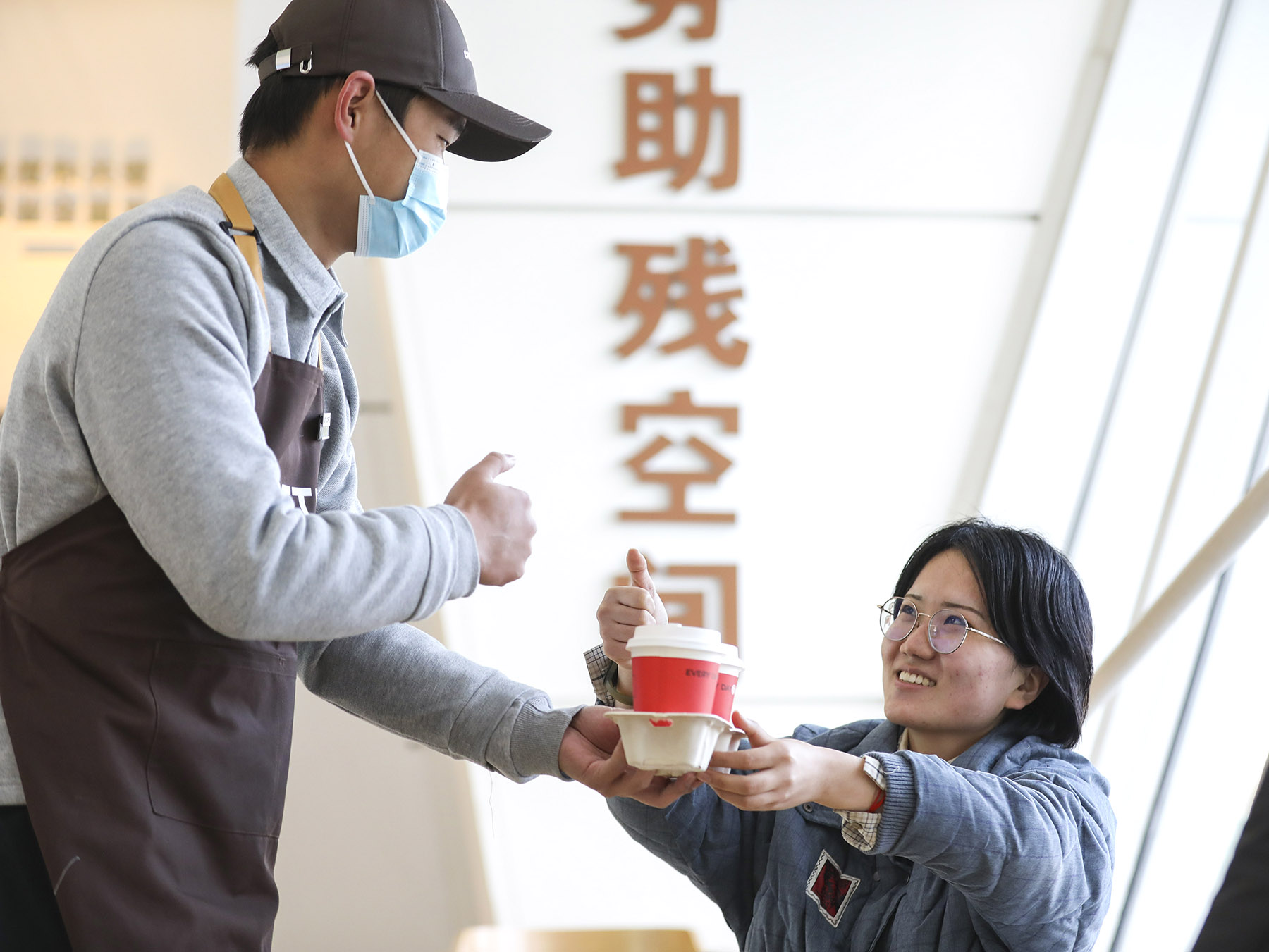
But this is not a typical outlet. It is a "silent cafe", where baristas communicate through warm smiles and sign language. Created as part of a local government effort to employ people with disabilities, the shop run by Cotti Coffee, a national brand, has become a beacon of opportunity for the city's deaf and hearing-impaired community, opening new career paths and raising their public visibility.
Customers place orders by scanning a QR code or using the shop's online platform, minimizing the need for verbal communication.
For any last-minute order changes, the cafe is equipped with a tablet featuring voice-recognition software and a writing board. The model has proved popular, making the cafe a bustling hub. Delivery drivers — usually a rare sight inside a government building — are frequent visitors, carrying takeout orders across Huai'an.
READ MORE: Service with a silent smile
The cafe is part of a broader disability assistance center that opened in December 2023, which also displays work for sale by disabled artists and offers wheelchair rentals. The cafe — opened just one month later — has become the vibrant, beating heart of the space.
For barista Wang Jiali, working at the cafe has been life-changing. The 39-year-old, who has severe hearing loss and uses a cochlear implant, first discovered the shop while visiting the government hall two years ago. With no prior experience, she was trained from scratch and learned to handle the full menu.
Now, on a typical day, she and her team prepare up to 200 beverages. The work is demanding, and for Wang and her colleagues, it comes with an additional, unseen challenge: navigating the occasional misunderstandings that arise, given that a cafe staffed entirely by deaf and partially deaf baristas is still a relatively new concept in a public space.
She remembers one busy shift when the noise of a steam machine drowned out a customer's voice. Unaware of the order, she continued working. "He got very angry and couldn't understand why no one was responding," Wang said.
She quickly went over to him. "After I explained, he felt embarrassed," Wang said. "Once we communicated, he understood. It was a relief for us, too."
This role is a transformative one for Wang. Compared with previous jobs, the constant interaction has become her greatest source of growth. "It has helped me build courage and improved my communication skills," she said.
Her evolution from a silent world to confidently engaging with the public encapsulates the program's biggest success, which has been replicated elsewhere. In July, a second government-assisted space with a silent coffee shop opened in a similar service hall in Huaian's Huaiyin district.
Local government figures show that the program's training has already helped over 20 people with disabilities, eight of whom have become certified baristas now working in the two locations.
Launch of project
Behind these Cotti Coffee outlets is franchise partner Wang Xian. Inspired by the local Disabled Persons' Federation's initiative, she left her corporate sales career to launch the project. Her motivation is personal, shaped by her hearing-impaired aunt and uncle, who were never formally employed and instead earned a living by selling tofu on the streets.
She initially doubted her team could master the dozens of coffee recipes, but their commitment proved her wrong. "It's not easy for our hearing-impaired staff to master these skills," she said. "But they proved me wrong."
She shared the story of one team member, Xiao Qi.
"She had never worked before joining us," she said. However, after seven months of training, Xiao transformed from someone who "used to speak very little" into a confident store manager who now steps out from behind the coffee bar to greet and assist customers. Her journey reflects the cafe's core mission to unlock potential through empowerment and patience.
The project has flourished thanks to strong institutional support. The government service center provides the space rent-free and covers all utilities, a crucial endorsement of its social value. Delivery riders are welcomed without restrictions, ensuring the business runs smoothly.
"The center has been extremely supportive," Wang said, highlighting how public-private partnerships can create meaningful opportunities.
Pioneering effort
The silent cafe initiative is part of a broader, pioneering effort in Jiangsu to promote quality employment for people with disabilities — a group that often faces significant barriers such as workplace discrimination and inaccessible facilities.
One approach involves harnessing the growing consumer demand for innovative cultural products. By training disabled workers in time-honored techniques like paper-cutting, eggshell carving, and embroidery under the guidance of intangible cultural heritage masters, the program creates skilled employment that bolsters both income and personal dignity. These initiatives have established Jiangsu as a national leader in advancing the welfare of China's estimated 85 million people with disabilities, a population disproportionately affected by financial instability due to limited work opportunities.
This focus aligns with broader national priorities. In late October, the Communist Party of China Central Committee, in its recommendations for formulating the 15th Five-Year Plan (2026-30), emphasized that improving support systems for vulnerable groups, including persons with disabilities, is crucial for strengthening the nation's social security system.
The silent cafe program reflects an emerging model outlined in a three-year campaign starting in 2025 to bolster employment for people with disabilities. Key measures include incorporating support services for disabled individuals into government procurement and encouraging social forces to develop assisted employment opportunities.
Early hurdles
However, introducing coffee into a government office was initially a hard sell.
Zhu Pengcheng, Party secretary of the Huaian Disabled Persons' Federation, said the proposal was met with significant bureaucratic resistance, which stemmed from a reluctance to introduce commercial activities into a space dedicated to official business.
"They were not easily persuaded," Zhu said. Some decision-makers feared the informal ambience of a cafe would be incongruous with the formal government environment. This led to months of negotiation and advocacy.
To gain approval, officials had to prove the project's commercial worth alongside its social mission.
Sun Jun, chairman of the Huaiyin District Disabled Persons' Federation, said the breakthrough came by framing the partnership with Cotti Coffee as a strategic opportunity rather than charity. "We had to convince them that they were accessing a premium market within the government service center," Sun said.
He highlighted the steady consumer base of civil servants and visitors — a high-end demographic distinct from the general market. The setting offered the brand a strategic foothold among valuable patrons, making the silent cafe a viable business proposition.
Even then, negotiations required further refinements. The brand initially insisted on its signature black storefront, but officials held firm for a design that blended with the center's aesthetics. The financial terms of the arrangement also had to be settled.
"Cotti Coffee's standard franchise fee is over 140,000 yuan ($20,150)," Sun said. "After repeated negotiations, we got it down to 100,000 yuan."
The significant discount was secured by appealing to the brand's corporate social responsibility. "A business needs a positive image," Sun said. "Supporting the disabled is part of that."
Zhu said the cafe represents a strategic push to redefine "high-quality employment" for the disabled community. The goal is to move beyond basic job placement — which might secure a monthly wage of just a few hundred yuan — toward roles that offer sustainable income, social insurance, and genuine career pathways, he said.

Power of visibility
Local officials have praised the placement of silent cafes inside government buildings. By situating the cafes in hubs frequented by professionals and businesspeople, the project integrates people with disabilities into the professional world, directly showcasing their capabilities to potential employers.
Before 2023, Huaian had no such model. Now, with silent cafes, tea shops, and bakeries staffed by disabled employees gaining visibility, a shift is underway. "Many enterprises are now coming to us asking, 'Where can we find more personnel like this?'" said Zhu.
The power of changing public perceptions of people with disabilities was on full display at the 12th National Games for Persons with Disabilities and the 9th National Special Olympic Games, which were held in December.
There, athletes broke 15 world records and 156 national records — a performance actively reshaping public understanding of what people with disabilities can achieve.
Clips from the games circulated widely on social media. One featured swimmer Jiang Yuyan, who has earned the moniker "Wing-Clipped Flying Fish".
The 21-year-old from Zhejiang province, who lost her right arm and leg as a child, was shown training with a prosthetic leg and then cutting through the water. Her dedication led her to win all eight of her events at the games.
Equally inspiring was high jumper Zhong Zhiqiang from Guangdong province, who lost his left leg at the age of 5, and cleared a height of over 1.66 meters with a single-leg takeoff.
Posts about the event trended on Sina Weibo. One focusing on the closing ceremony gained over 3 million views and drew comments such as, "Salute to the tenacity of life," and, "No act of persistence should go unseen."
Broader partnership
The silent cafe is just one part of a broader local initiative by the Disabled Persons' Federation to partner with enterprises in creating quality employment.
The collaboration with the homegrown milk tea brand Hao Hao Prince indicates this model works. With federation support — including training, free venue space in government centers, and negotiated zero franchise fees — entrepreneurs like Shan Wei are transitioning from beneficiaries to business leaders.
After a car accident resulted in Shan's leg disability, he returned to Huaian and discovered a milk tea training program advertised by the federation in 2023.
ALSO READ: Raising a glass to accessibility
With comprehensive support, he became manager of the first Hao Hao Prince silent milk tea shop. His dedication helped turn the store's modest initial monthly revenue of 15,000 yuan into a thriving business that now employs multiple disabled staff. His success has been so compelling that the brand was inspired to launch a special product line co-branded with the federation and is now actively seeking to hire more disabled individuals across its stores.
Zhu said the next goal is to bring the silent cafe inside the closed compound of the municipal government building itself — not just the public-facing service center. He describes government compounds as a "scarce resource" and a protected market. "It guarantees our business volume," he said, as external competitors cannot enter.
The strategy is to leverage this support to create stable, high-traffic outlets, using these visible platforms to shift perceptions among decision-makers and the public, Zhu said.
Contact the writers at lilei@chinadaily.com.cn
