

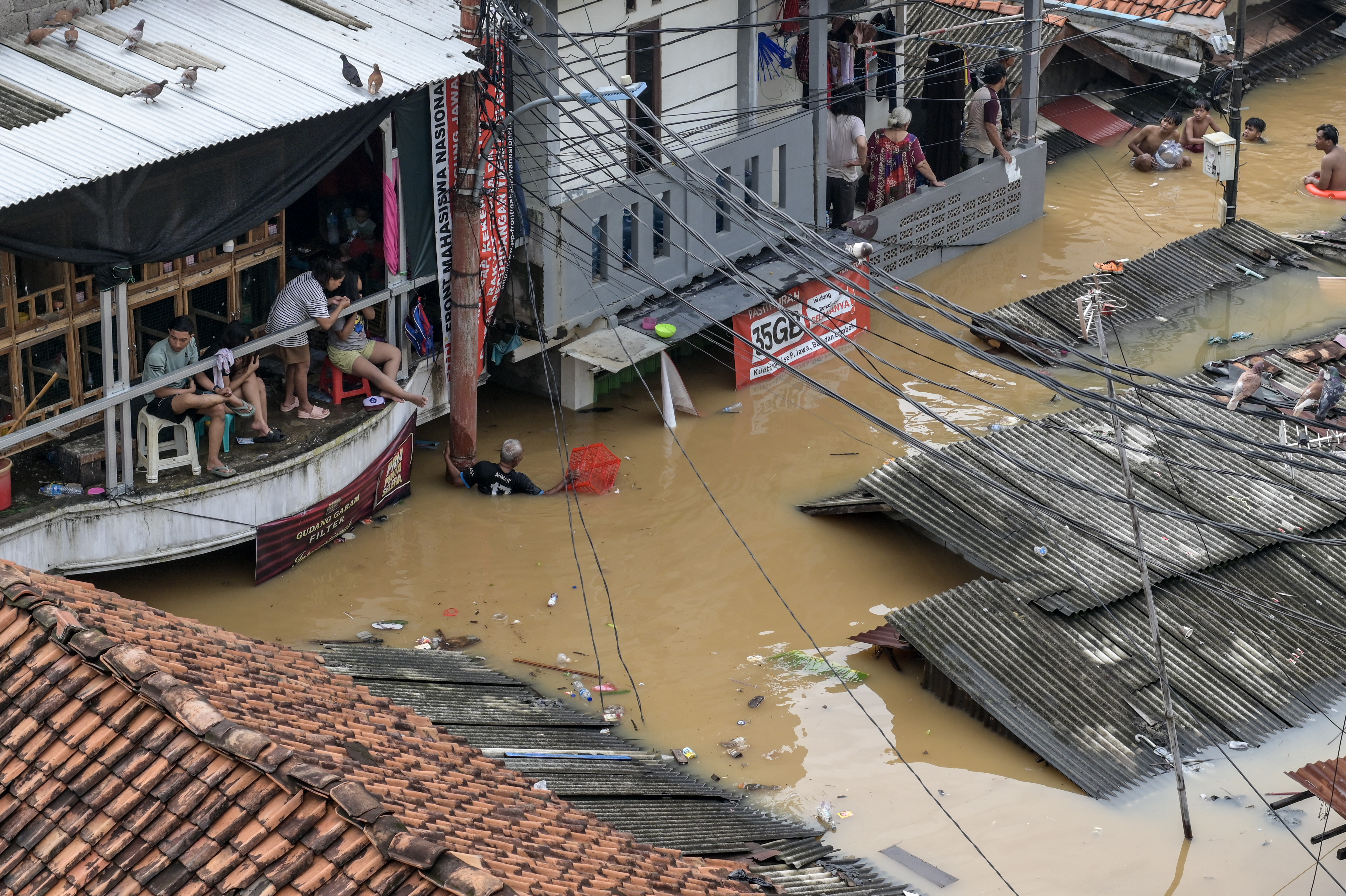
Jakarta faces an escalating threat from land subsidence, which experts warn could leave parts of the city underwater and cause massive economic losses if aggressive mitigation measures are not implemented.
A recent assessment by the National Research and Innovation Agency of Indonesia, or BRIN, estimates that Jakarta's land is sinking at an average rate of 3.5 centimeters per year.
Northern Jakarta is experiencing some of the most severe impacts. Over the past four decades, the area has subsided by up to 4 meters, leaving roughly 40 percent of it below sea level.
READ MORE: Waters recede in Bali after floods kill 16 people, two missing
"Jakarta's land is sinking," said Yus Budiyono, a senior researcher at BRIN. "The northern part is turning into a 'bowl' and a flood hot spot, vulnerable to overflowing rivers, torrential rains and encroaching seawater."
The city's location on a low-lying delta, where rivers from the southern highlands converge before emptying into Jakarta Bay, already makes it prone to flooding. Unchecked development and excessive groundwater extraction have only worsened the problem.
Yus estimated that Jakarta loses at least $186 million annually due to flood risks, a figure projected to rise to $421 million by 2030 if subsidence continues unabated.
Since 2014, the Jakarta administration and the central government have constructed around 20 kilometers of concrete barriers as part of the 46-km National Capital Integrated Coastal Development project, intended to protect the city from coastal flooding.
President Prabowo Subianto has also announced a multibillion-dollar plan to build the so-called Giant Sea Wall, a 500-km megastructure along Java's northern coast designed to shield flood-prone communities from Banten to East Java.
While the existing seawall in Jakarta has helped limit seawater intrusion compared with unprotected coastal areas such as Demak in Central Java, Yus said such structural measures fail to address the primary driver of land subsidence, which is excessive groundwater extraction.
Many Jakartans still rely heavily on pumped groundwater for domestic use because the city-owned piped water operator, PAM Jaya, has not yet achieved full coverage. Groundwater was also widely extracted for industrial purposes before the government banned the practice.
"Access to clean water must be fully provided so there is no reason for groundwater extraction,"Yus said, warning that without adequate measures to curb land subsidence, even the proposed giant sea wall would offer limited protection.
Bosman Batubara, a research fellow at the Asia Research Institute of the National University of Singapore, agreed, adding that Jakarta's land subsidence is also driven by rapid but uneven urban development.
Communities that have benefited from decades of urban expansion tend to be less exposed to subsidence, while coastal residents face disproportionately higher risks of flooding, land loss, and threats to their livelihoods.
"Since the heavy pressures of urban development and deep groundwater extraction are the two main drivers of land subsidence, both must be addressed first," Bosman said.
ALSO READ: Extreme weather casts shadow on ASEAN
However, he argued that the government has yet to address these root causes, instead prioritizing surface-level solutions such as the construction of concrete seawalls.
In 2021, then-governor Anies Baswedan issued a gubernatorial regulation banning groundwater extraction in nine industrial areas and along 12 roads across the city to curb worsening subsidence.
The current administration under Governor Pramono Anung is reportedly planning to tighten regulations further.
