

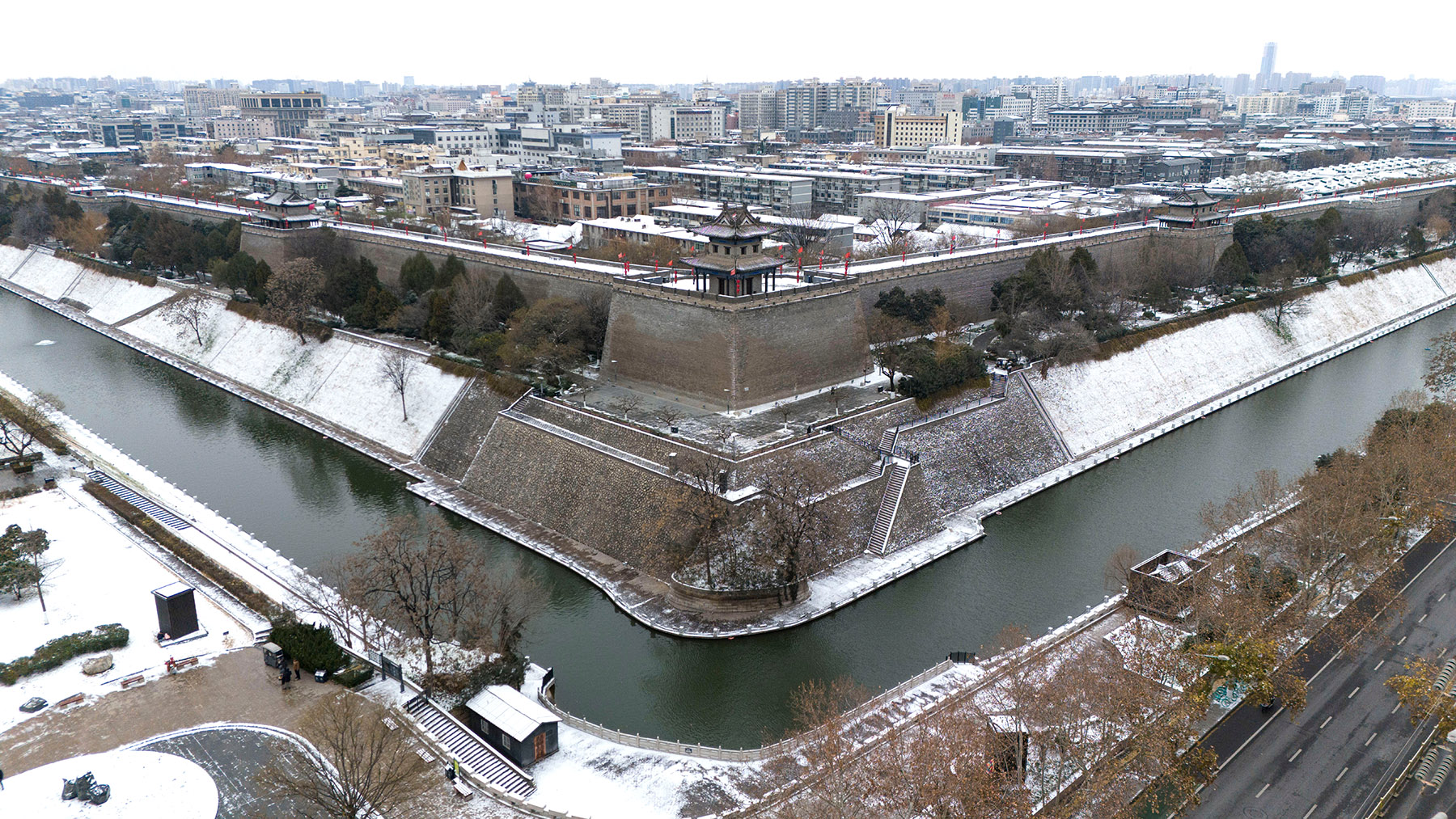
With a 40-year restoration project concluding recently, a moat of clear water once again embraces the ancient city wall in Xi'an, the capital of Shaanxi province.
What was once an eyesore for visitors and a potential threat to the safety of residents during flood season now makes a powerful first impression, as bright sunlight and the majestic gray stones reflect on the crystal water surface.
Li Jing, a tourist from Jiangsu province, said she was captivated by the beauty of the moat and the ancient wall as soon as she stepped out of Xi'an Railway Station.
READ MORE: Xi'an City Wall gets health checkup after heavy rains
"This is my third visit to the city. On the previous two occasions, I headed straight for other scenic spots and never paid much attention to the city wall," Li said. "But this time, the scene outside the station was straight out of a painting. I'd like to walk the full length of the moat surrounding the wall when spring arrives."
Xi'an, a city that boasts a history of more than 3,000 years, served as the Chinese capital through 13 dynasties, and its city wall is one of China's oldest, longest and best preserved.
The moat, which spans 14.6 kilometers, served as an additional tier of military defense during the Tang Dynasty (618-907), according to Jia Haitao, who leads the culture and tourism development department of the Xi'an city wall management committee.
"For hundreds of years, several dynasties carried on the defense legacy, relying on both man-made and natural barriers to stop approaching enemies," he said.
In modern times, the moat functioned as a catch basin, also known as a storm drain, to control flooding, manage water runoff and collect debris, sediment and other waste. "With time, the moat started choking on silt, and the water began to emit an unpleasant odor," Jia said.
In 1983, Xi'an called on its people to restore the structure to its original glory. Given the deep cultural importance of the site, hundreds of thousands of residents volunteered to work. The clanging of pickaxes breaking up clods of earth, the sound of shovels scooping up silt and the steady tread of people carrying baskets of silt became a common shared memory.
In 1998, around 5,000 soldiers from the People's Liberation Army arrived to lend a hand in the project.
Conservation efforts continued. On Jan 20 this year, the final 859 meters of the moat in front of the railway station were restored.
Wang Jie, project manager from Sinohydro Corporation Engineering Bureau 15 Co, said the underground culvert had accumulated silt with an average depth of 1.2 meters.
"It not only hindered the drainage system, but also concealed dangers. Every flood season, rainwater mixed with sewage would overflow and the rising water level sometimes submerged underground parking lots," Wang said. In addition to desilting efforts, purifying aquatic plants, such as irises and water lilies, were planted to build a small-scale circulation system, he said.
ALSO READ: China spends big on urban renewal in 2025
Jia, from the city wall management committee, said the moat is now set to improve Xi'an's flood control capacity and also offer residents a green space. The revitalized moat, which looks stunning when the ancient wall is illuminated after sundown, will further drive tourism, he added.
Wang Jianguo, a local resident, said he remembers the moat being filthy and emitting a foul smell when he was a child.
"The change today is almost dramatic. Waterbirds flock to the area, the banks have rows of trees and there are walking paths along the moat. It is visual poetry and adds to the charm of our city," he said.
A travel YouTuber, who asked to be identified as Nick, said riding a bike along the ancient city wall is great fun. "Don't just think about the Terracotta Warriors when you visit Xi'an; the wall is by far the most enjoyable sight."
Contact the writers at chenmeiling@chinadaily.com.cn
