


One and half months after the Wang Fuk Court fire tragedy in Tai Po, Secretary for Home and Youth Affairs Alice Mak Mei-kuen and Secretary for Labour and Welfare Chris Sun Yuk-han are on Straight Talk this week to talk about what has the Hong Kong Special Administrative Region government has done so far, including efforts to provide relief funds, accommodation, and support services to affected residents.
Check out the full transcript of TVB’s Straight Talk host Dr Eugene Chan Kin-keung’s interview with Alice Mak and Chris Sun:
Chan: Welcome to Straight Talk. I am Eugene Chan. The Tai Po fire was a tragedy that shook our city. Since then, the Hong Kong SAR government has acted swiftly to provide relief funds, accommodation, and support services to the affected residents. Today on Straight Talk, we speak with Secretary Alice Mak and Secretary Chris Sun about what has been achieved, the lessons learned, and how the community can continue moving forward. Our title today asks, “How much more can we do?” Welcome, Alice, and welcome, Chris!
Sun: Thank you for having us.
Immediate Response & Coordination
Chan: This is one of the deadliest fires that Hong Kong has ever experienced in our history, with many deaths and quite a number of people injured, and we lost a firefighter, and our deepest condolences to the families affected. Maybe we can start by giving a brief summary, how the SAR government has responded immediately, Alice.
Mak: Well, on the first day when the fire broke out, the Home Affairs Department, we opened nine shelters in Tai Po to serve more than ... At that time, at the peak, there were a thousand residents staying in night shelters. This is for the emergency accommodation. We mobilized more than 300 care team members, District Council members, and also deployed nearly a hundred staff from the Home Affairs Department to provide assistance in these shelters. And apart from emergency accommodation, we also provided an emergency relief subsidy for those affected residents for an amount of HK$10,000 that day. So, apart from this emergency assistance, we also set up our relief fund, which is on Nov 27. That is the second day of the after the fire broke out. We setup a fund, “Tai Po Wang Fuk Court Support Fund”. On the first day after the fund was set up, we received almost HK$1.2 billion from the donations from the residents. Until now, we have received HK$4 billion donations from enterprises and individuals from Hong Kong, the Chinese mainland and also overseas. So, we are making use of these funds to provide various support programs for our affected residents and flat owners.
Chan: I think, Secretary, the whole of Hong Kong is very saddened about this incident, but they're very impressed with the love and care from within the community and also from the mainland. So, Secretary Chris, you know, the fire, actually, I've read in the news that it started at 2:51 pm and the chief Executive convened an inter-departmental urgent meeting that very afternoon, with the government emergency monitoring and support center activated immediately. I'm just interested to know what was it that triggered CE’s such prompt and decisive response?
Sun: I think it's a testimony to very strong leadership and our attention to what is happening in our society. So, for the Tai Po fire, given the scale, it's an all-out effort by the government. So, you can imagine, while firefighting rescue work is ongoing, at the same time, as Alice has just said, we had to pull out all our efforts to help all the affected residents: accommodation, what they need to eat, and necessary clothing. So, it's not just the government, as you said, there is a huge outpouring of charity and generosity from all over the community.
Support for residents & welfare
Chan: So, Alice, you just mentioned, there are a lot of people who come up with resources, money, even NGOs, banks, et cetera. I mean, how do you ensure that everything is being coordinated so efficiently, so everybody will get the right amount at the right time? How do you do that?
Mak: We see various needs of those residents at different stages. At the very beginning, we provide them with very tiny financial support, by offering a living allowance of HK$100,000 for every affected household. And after that, we also provide various subsidies for those foreign domestic helpers, and workers working at Wang Fuk Court, and also students living at Wang Fuk Court. And apart from that, we also care about the needs of the flat owners. So, on Dec 18, we launched another program, that is the rental allowance program. We offered one HK$150,000 per year for those flat owners, so they can make use of these rental allowance to … We hope they can make use of these rental allowance to find a suitable place for their medium term accommodation. So, until now we have already launched 11 programs and schemes and have committed HK$1.2 billion on these various programs. You will see the needs of the residents at different stage and provide them with timely and suitable assistance.
Chan: Chris, I mean, Alice has just mentioned how much resources has been poured to the residents. But I'm sure we're going to ask, even with such a coordinated, well-coordinated response. Every emergency will present challenges. What were some of the most difficult moments that you have experienced?
Sun: The greatest challenge is with the people.
Chan: Right.
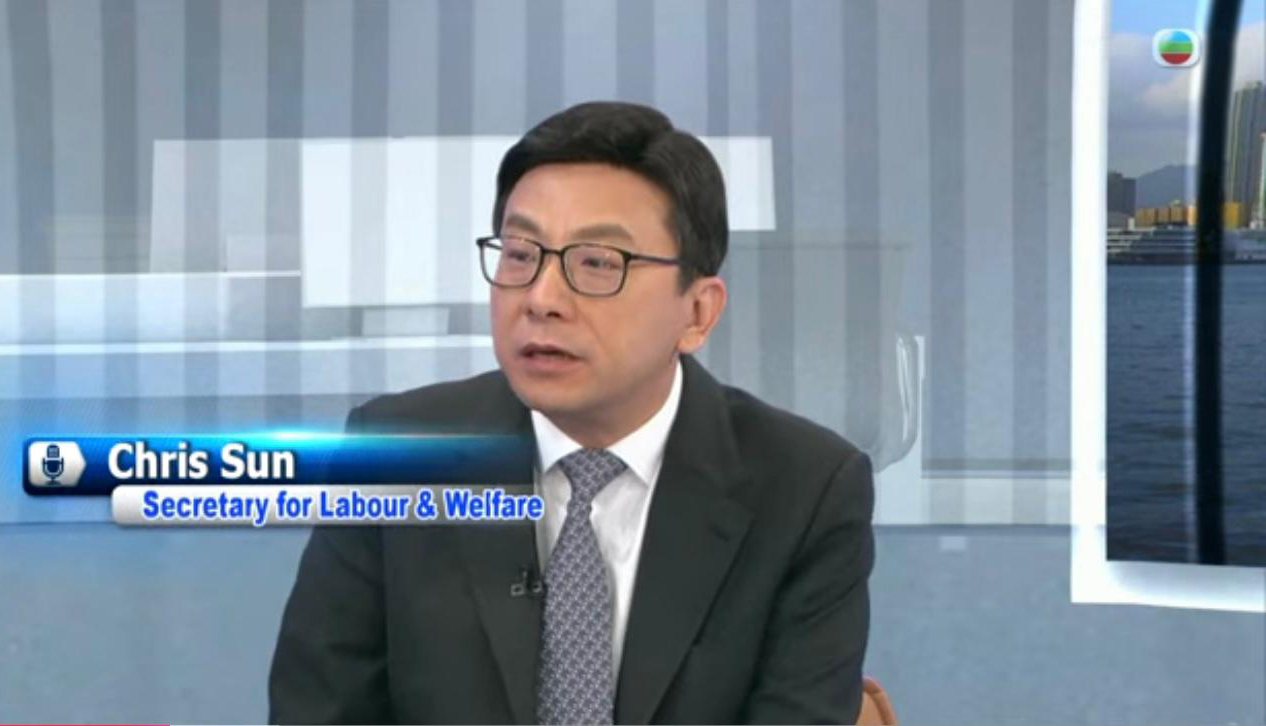
Sun: This is what we learned from our social workers on site, as they recount what happened in the initial days. So, there's a lot of counseling going on. Some who are shocked by the fire might not be able to express themselves. There's a very strong sense of grief. So, with our social workers, and as well as a lot of volunteers, they're trying to not just provide for the resources, but there's a lot of care and love going on.
Chan: Right.
Sun: I think this is very important for us. To make sure that they feel attached, they feel that they are part of us, and we are there to help them, to provide to them, to give them a hug and cry together, to help them go through the whole very, very painful process, but this is necessary.
Chan: Alice, I think, Chris has just enlightened us what has happened. I know our Chief Executive John Lee Ka-chiu has said, “never the best, but only better”. I mean, you've done a great job in supporting the residents with accommodation. But what has been responses from the residents? Are they happy? I'm sure they can always want more. How do you deal with that?
Mak: We try to cater to their needs, and, you know, for every affected residents, they will have different needs. Some have some family members who are deceased, so they will face great sorrow. So, we need to help them to go through this very difficult period through providing counselling and also care. And for those with children, how to ensure that their kids are … you know, can continue their studies as usual, to make sure that children's studies won't be affected. We tried to think of various services or assistance schemes to provide assistance to those affected residents. And so, I think the close communication with residents is very important. We have mobilized our Care Team members, and District Council members, to visit the affected residents, and to understand and to know more about their needs, and how they think. So, we tried to provide what they want, and to help them to solve their doubts, and to face the challenges ahead.
Chan: Chris, I think this time, the government had to look after all sectors, even including the domestic helpers. Do you find it difficult to communicate with the … do you have to communicate with the Filipino or the Indonesian consulates as well?
Sun: I think the whole process was very, very smooth.
Chan: As you said, I think they are either from the Philippines or from Indonesia.
Sun: Majority, yes. So, almost on day one, the Labour Department just contacted and worked with the two consul generals here in Hong Kong. So, actually, they went to Tai Po and helped all those working there. I think I met with the secretary, my counterpart from the Philippines, and we had a great meeting. He was truly, truly grateful, and he appreciated so much about what we did for the foreign domestic helpers. So, this, I think, once again, speaks volume about the generosity and care about Hong Kong.
Chan: Right. Time for a short break now, we will be back with more Straight Talk.
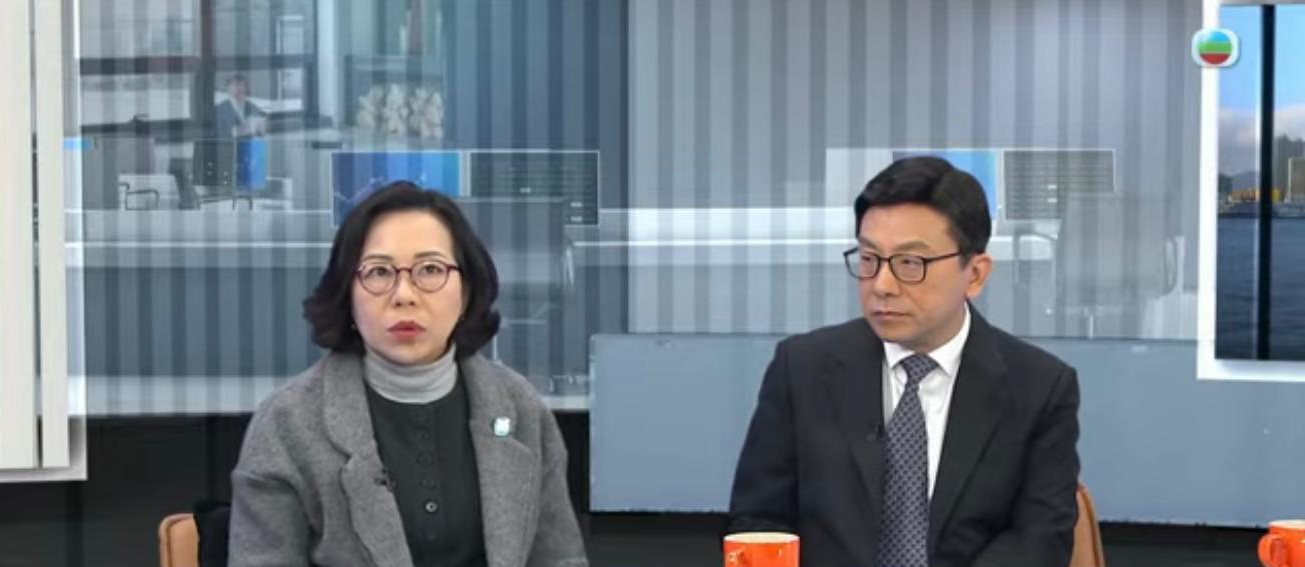
‘One social worker per household’
Chan: We are back on Straight Talk with Secretary for Home and Youth Affairs Alice Mak and Secretary for Labour and Welfare Chris Sun in the aftermath of the Tai Po fire, talking about what has been achieved so far and what more we can do. So, both Secretaries, it is only one and a half months since the tragedy, and I think you guys have done a lot, and I am sure all the Hong Kong people will be very grateful.
Maybe we will start with Secretary Chris. One initiative that you have started off with is “one social worker per household.” What exactly is that and what are you trying to achieve in that initiative?
Sun: This has been decided almost on the first day. So, given the scale and what happened at Tai Po, we believe it is important for us to assign for each household one dedicated social worker to help them through the whole process. We don't have a time limit to it because for each household, they will have different needs. So, instead of having them to contact different parties and different authorities, the best way to help them is to have a central contact point. And for that person, I think the best one would be a social worker. There are altogether 1,984 units at the Wang Fuk Court. So far, we have contacted all except two.
Chan: Right.
Sun: Right now we have registered and come into contact, spoke to them, there is altogether 1,982. So, there are two units that we will never be able to contact them because we know for one unit, the whole household had passed away several years ago, and there is one more unit they left Hong Kong for many, many years. For us, we think we have completed all. We have started the process, each social worker, by now, I think, they have been friends of the household involved, including helping them to apply for and get all the assistance, not just from the government, but also from other private charities. So, this is what we have been doing for them. Right now we are helping them to fill in the questionnaire about the long-term accommodation options. If they have any needs, our social worker is there to help them, including for the elderly one to go together with them for outpatient clinics. If there is something they need, we try to find for them. And also we have civil service volunteers. So, what we need is to help them to deliver things to them. Because if you look at the mix and the pattern of the Wang Fuk Court residents, about 40 percent are elderly people. So, they need a lot a lot of help.
Chan: Right. Is it a full-time dedication to those in need?
Sun: For us each household we get an assigned social worker, but the social worker is not the full-time work. They have got a daytime full-time work. So, on top of their existing daytime full-time work, they are going to attend to all the needs of each household.
Chan: Including livelihood, even emotional, anything?
Sun: Anything. This is the contact point. Through the social worker, they can get access to other services they need. But the key point is have somebody they can trust, they can speak to on regular contact. Our aim is to provide the best hope that is possible to all the affected residents.
Chan: Right. I am sure, on behalf of the viewers, please extend our deepest appreciation to the 1,900 plus social workers.
Sun: It nearly covers every social worker in the Social Welfare Department. We have around 2,000 social workers in the department.
Chan: So, full team?
Sun: It is almost more than 90 percent of all social workers from all ranks. They are all involved and they are all doing the best they can to help the residents.
Chan: What kind of services do you find the residents need the most?
Sun: In the initial weeks, it is mainly for those with relatives deceased at the fire. So, we have to help them to … went through … first of all, they have to recognize their relatives. There is a huge process leading to the funeral, so the social worker, including clinical psychologists, are with them. There is a lot of emotions going on.
Chan: I am sure.
Sun: You need somebody to help them. So, it would need eventually … most of our social workers will attend their funerals to counsel them. And then for the rest, for those that they need more about accommodations, about getting the assistance, financial or non-financial, the social worker is acting as their middleman to help them to navigate all the application process and to get the assistance for them. So, that means save them a lot of efforts, hassle to make sure that they can spend more time with their families and hope that they can recover as soon as possible.
Accommodation support
Chan: Right. I can see teamwork is very important. That is the reason why we have two secretaries here today, telling us the full story. So, Alice, another area that I am sure many viewers will be concerned are where the residents are being housed at the moment, where they are staying. I know there are hotels, youth hostels, transitional housing – a lot of different types. So, how has it been going on? Has everybody been settled nicely now?
Mak: Well, talking about accommodation issue, you will see that our residents will have different needs at different stages. So, at the beginning after the fire broke out, we had to provide them with emergency accommodation. The Home Affairs Department coordinated with hotel and youth hostels operators, and we offered more than 1,300 rooms to cater for the emergency accommodation. After the temporary accommodation, the residents will look for medium-term accommodation. So, we have transitional housing and other housing offered by the Housing Bureau and also the Housing Society. And apart from that, that is why just now I mentioned about the rental allowance scheme. We launched this scheme with the hope that residents can make use of these rental allowances to find a suitable place for their medium-term accommodation. And now we are talking about the long-term accommodation. As you know, the deputy financial secretary is working on this. He has led a task force on exploring various proposals and the best solutions for the long-term accommodation for the residents.
Chan: And I have also read in the news that you have actually asked, lobbied the community not to take advantage of the subsidies and making sure the rent level being offered to the residents is being at a fair market-level, right?
Mak: Yeah, because we heard from the residents that after the introducing of the rental allowance, when they try to rent a place in Tai Po, they find the rent level is increasing. That is why we urged the community to work together to help and support those affected residents of the Wang Fuk Court by providing reasonable rental places at reasonable prices. I hope when the community works together, we can help the residents of Wang Fuk Court and we can also work together to build a better society for us.
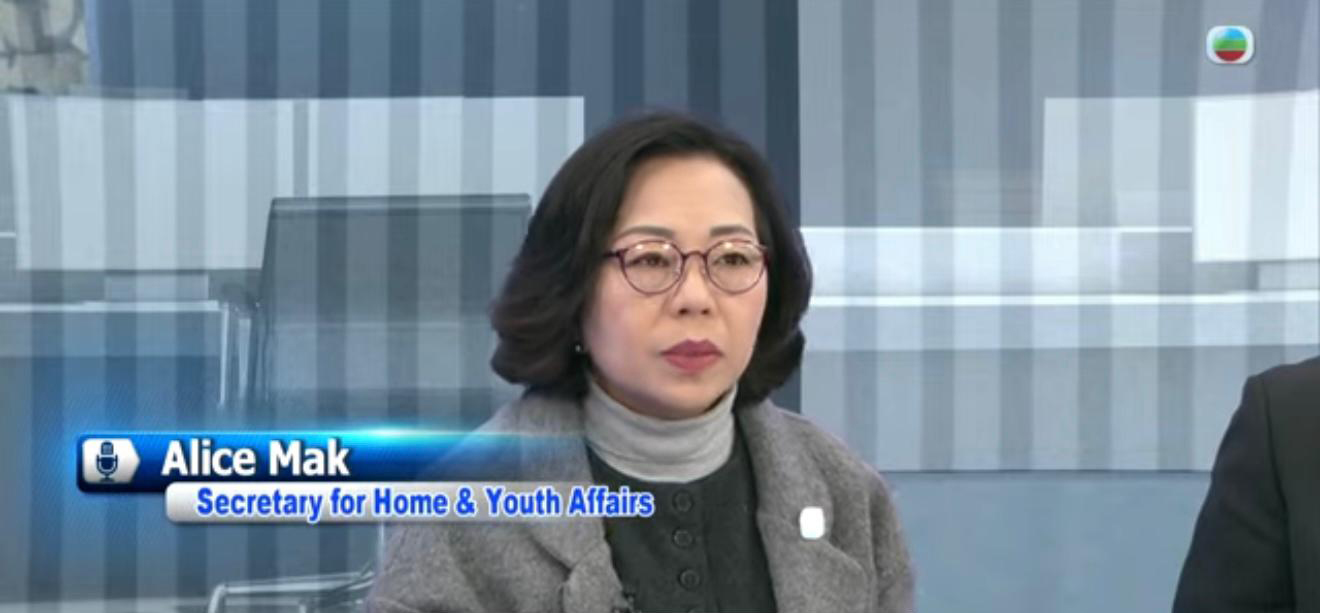
Way forward
Chan: So, Secretary Alice, the chief executive has established an independent committee to examine the causes of the fire and the systemic issues in the renovation works. Have you got plans to revisit our management ordinance? Do you have any plans to sort of revamp that in the future?
Mak: In fact, this term of government attaches great importance on building management. As you know, we have already proposed amendments to the Building Management Ordinance. I think the last time we had this amendment was talking about nearly 20 years ago.
Chan: Wow!
Mak: So, in 2023, we proposed amendments to this Building Management Ordinance. And with the support from the Legislative Council, the amendment was passed in 2024 and came into effect last year, in July. As I have already told the Legislative Council last year that, after the first round of amendments, we are going to propose a second round of amendments to the Building Management Ordinance. We will ask for a better or more transparency of the operation, of the OC (owners' corporations) meetings, and also their procurement process. We will look into various issues, sensitive issues that the society is concerned about, like the handling of proxy, the procurement process, and also the declaration of interest.
Chan: Right.
Mak: So, we are going to propose these directions to amend this ordinance to the LegCo. And I hope with the support of the Legislative Council, we can have this second round of amendments passed as soon as possible, so that the OCs will have a better guidance as to how to operate the OCs and to better manage their own buildings.
Chan: Right. Alice, I mean the Land Tribunal formally have actually approved that the dissolution of the incumbent management of Wang Fuk Court, and the government has appointed Hop On Management, which is under the Chinachem Group, to administer this estate for the time being. This is something not usual, why is this needed? And how can the rights and the interests of the owners be represented?
Mak: Well, you are right that this is the first time the government applied to the Land Tribunal under the Buildings Management Ordinance, to apply to the Tribunal to dissolve the management committee of a particular OC, and to appoint an administrator. As we all can see, the consequences of the fire that will be very unprecedented. So, we cannot expect our volunteer or part-time management committee members to handle all the very complicated situations because they have to deal with all the contracts that the OCs have already come into with various parties. So, how to manage the buildings at this stage? That is why we see the consequences and we simply cannot expect the management committees can carry out their duties under the DMC and the BMO. That is why we applied to the Land Tribunal to dissolve the incumbent MC and appoint an administrator. Hop On, as we all know, has a long history working in the industry and is a professional and licensed property management company. They will work on pro bono basis for the Wang Fuk Court residents, so that the Wang Fuk Court residents do not have to worry about further financial burden.
Chan: So, Secretary, I am going to ask you the last question, we have to be very brief: looking back at this multi-departmental response, which is all effort by the government, what have been the most important takeaways that will strengthen the coordination of future emergency situations?
Sun: I would say number one, strong leadership. I think this is very clear in this incident. Speed, so we have to act really, really fast. And also communication, you have to listen and then act and then respond.
Chan: Okay, I am afraid I will leave it there for now. And thank you for both secretaries for sharing your insights. The Tai Po fire was a tragedy, but it also showed how the government, community partners, and the public can come together in a crisis. There has been a clear commitment to supporting affected residents. So, as recovery continues, the important question remains: how much more can we do?
Have a good evening and see you next week.
