

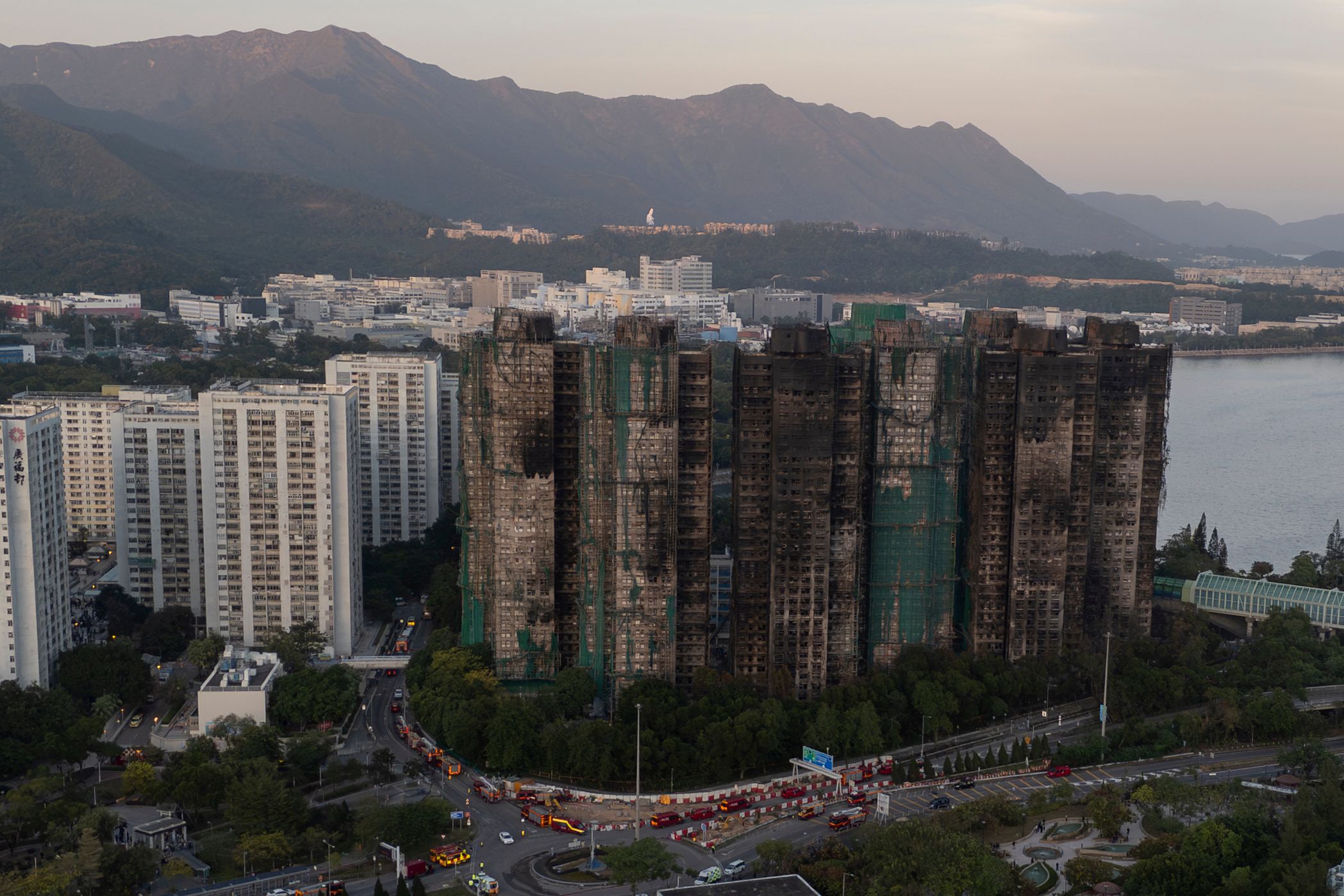
A dedicated body, as well as tough new regulations, to keep Hong Kong’s buildings in top shape and deal with bid rigging in building renovation works are indispensable following the fire at Wang Fuk Court in Tai Po.
That’s the view of building industry pundits in response to the city’s deadliest blaze in almost eight decades that took the lives of at least 161 people at the residential complex in November last year. They want coordinated action to protect homeowners and to ensure safety in buildings.
Investigators found non-compliant materials at the site of the inferno that also left thousands of residents displaced. The complex was being renovated at the time, with flammable foam and non-flame-retardant safety netting being used. The findings drew strong public criticisms over corner-cutting by contractors, and fueled suspicions of bid rigging and collusion involving the building’s owners’ corporation, consultants and contractors.
The Independent Commission Against Corruption – the city’s anti-graft watchdog – has set up a special task force to probe possible corruption, and has detained 14 individuals so far, including engineering consultants, contractors, scaffolding team supervisors, and former and current chairs of the owners’corporation.
ALSO READ: Independent committee members inspect Tai Po fire site
More than a month after the fire, public concern about bid rigging and the hazards it creates, including substandard work, materials not matching contracts, and mid-project price hikes, remains high. In response, the Hong Kong Special Administrative Region government has tasked the Construction Industry Council with bulk procuring safety netting for the sector, with about 50,000 certified nets due to be delivered before the Lunar New Year next month.
Some homeowners have also shared “self-help” anti-bid-rigging measures that have gained media coverage, such as phasing renovation and tendering separately, or independently hiring monthly paid site supervisors and quantity surveyors to monitor the works, creating independent oversight and checks and balances.
Vincent Ho Kui-yip – a seasoned surveyor who’s also president of the Hong Kong Institute of Building Safety -- said such self-help initiatives and awareness among owners are useful, noting they bear primary responsibility for their private properties.
He urged owners to join owners’ corporations, and even those outside the corporation, to keep themselves informed of project details and major decisions, such as those involving finances. Those who’re able to do so should help supervise the quality of the work being done, and join others in raising questions, and pressing consultants or contractors for clear answers.
Emphasizing the need for solidarity among owners, Ho stressed the importance of them attending meetings to help them unite and amplify their voice.
READ MORE: How can LegCo help HK to recover after the Tai Po fire?
However, he acknowledged that urging owners to help themselves is kind of a last-ditch effort because the real problem behind bid-rigging concerns irregularities in Hong Kong’s building renovation market – something that individual owners can hardly change on their own even with professional knowledge.
“You can’t expect every resident to help the police catch a thief,” he remarked, and called for institutional reform instead.
The veteran surveyor recalled that about two decades ago, large numbers of building had begun to age and intensified by 2007. At the time, only a handful of owners had organized voluntary inspections and repairs.
But, incidents involving old buildings -- from concrete pieces falling off external walls to the fatal collapse of a more-than-50-year-old building in To Kwa Wan – have drawn public concern.
Such accidents pushed the authorities to implement the Mandatory Building Inspection Scheme in 2012, requiring owners of buildings aged 30 or above to inspect the common areas, external walls, projections and signboards every 10 years. To encourage compliance, the government also introduced subsidies that helped to expand the building-repair market rapidly, Ho said. “Yet, the regulatory framework has failed to keep pace with the market growth.”
He explained that larger contractors tend to focus on new buildings or major renovation projects, and are reluctant to carry out inspection and repair work that demands high technical expertise and experienced judgment. This creates an opening for less formal and ineligible companies to dominate the market, thus squeezing out legitimate firms and fueling bid-rigging and collusion among owners’ corporations and contractors.
Ho noted that while Hong Kong already has various laws to tackle bid-rigging, which have been enforced by bodies like the ICAC and the Hong Kong Competition Commission, the real challenge is that many ordinary owners are either deliberately excluded from their corporations’ decision making, or choose to isolate themselves from the process due to potential conflict and liability, making them unaware of collusion of interests or unable to collect evidence.
Ho hopes the community, the government and the Legislative Council can jointly set up a building maintenance authority that could help owners, especially those unable to reach a consensus, lacking management confidence, or distrusting their corporation, to find reliable consultants, contractors and technical support. Equally important, such a body could also oversee projects on owners’ behalf.
Ho expects the authority to have other functions as well, such as independent quality inspections and vetting consultants’ past records.
READ MORE: Stamp out opportunities for corruption, fraud
Creating a new agency would take considerable effort, but Ho stressed its importance as the dilemma faced by owners who want to keep their buildings safe, but lack the professional capacity, has been discussed for more than a decade, and problems haven’t been solved.
“Standing still or making minor tweaks won’t work. It’s time for Hong Kong to move forward decisively,” he said.
Nicholas Chan Hiu-fung, who represents the legal sector in the Legislative Council, warned that bid-rigging in building repair projects could involve triad elements, leaving owners in need of dedicated support.
He noted that tens of thousands of Hong Kong buildings are over 30 years old, with annual maintenance costs running into tens of billions of Hong Kong dollars. As a member of the Hong Kong Competition Commission, he said although the authorities actively follow up on reports and act against bid rigging, the huge sums involved still tempt some to break the law.
To effectively deal with the problem, the newly-elect lawmaker, who started his term on Jan 1, said he would work to further criminalize bid rigging.
Chan believes that while such conduct can be prosecuted as conspiracy under the Crimes Ordinance, as had occurred in the past, specific criminal legislation against bid rigging would meet public expectations and have an immediate deterrent effect on all parties in the tender process.
Moreover, he noted that the existing conspiracy threshold is relatively high, and clearer and more targeted laws could help tackle bid rigging more effectively.
Chan urged stakeholders to think innovatively and bring together expertise from various sectors, including those from the legal, policy, industry and academic fields, to address this social issue. For example, since maintenance costs remain a major burden for homeowners, collective efforts can be made to adopt technology that will lower labor costs.
He also called for stronger public education to inform residents there’s a legal basis to account for such practices, and to highlight channels for raising concerns with the government and the legislature.
Contact the writer at amberwu@chinadailyhk.com
