

Sustained dialogue critical in stabilizing relations: Experts

China-US relations swung between highs and lows in 2025, but high-level trade talks and head-of-state diplomacy offered hope that the relationship will stabilize and become more predictable in the next 12 months, experts said.
Gary Hufbauer, a senior fellow at the Peterson Institute for International Economics in Washington, DC, said that while 2024 saw a gradual decline in bilateral relations, 2025 witnessed more of a "rollercoaster" situation.
The year was marked by bouts of intense turbulence followed by periods of slow cooling down, as ties between the world's two largest economies deteriorated not by chance but due to the US' calculated political moves, he said.
As bilateral trade and economic relations remained on tenterhooks despite several rounds of talks, China's consistent stand of — "Talk, our door is open; fight, we'll respond till the end" — became a widely shared catchphrase online.
According to Hufbauer, the tensions primarily escalated because the administration of US President Donald Trump assumed that aligning with China hawks would pay political dividends. As a result, the US imposed staggering, triple-digit tariffs on Chinese imports in April, which were met with swift retaliation from China.
The tit-for-tat moves pushed the countries perilously close to a full-scale trade war, making trade in most products "economically unviable", triggering market volatility, and amplifying uncertainties for businesses in the two countries and beyond, he said.
However, steep consumer prices in the US, the loss of agricultural sales to China, especially that of soybeans, and China's rare-earth export controls forced a White House reassessment of the situation, he added.

Diplomatic runway
"The notion that China would be economically and technologically crippled by US sanctions never made much sense, but it took a while for Trump to come to grips with reality," Hufbauer said. "Trump evidently decided that terrible relations with China were not to his political advantage and shifted to a reconciliation mode."
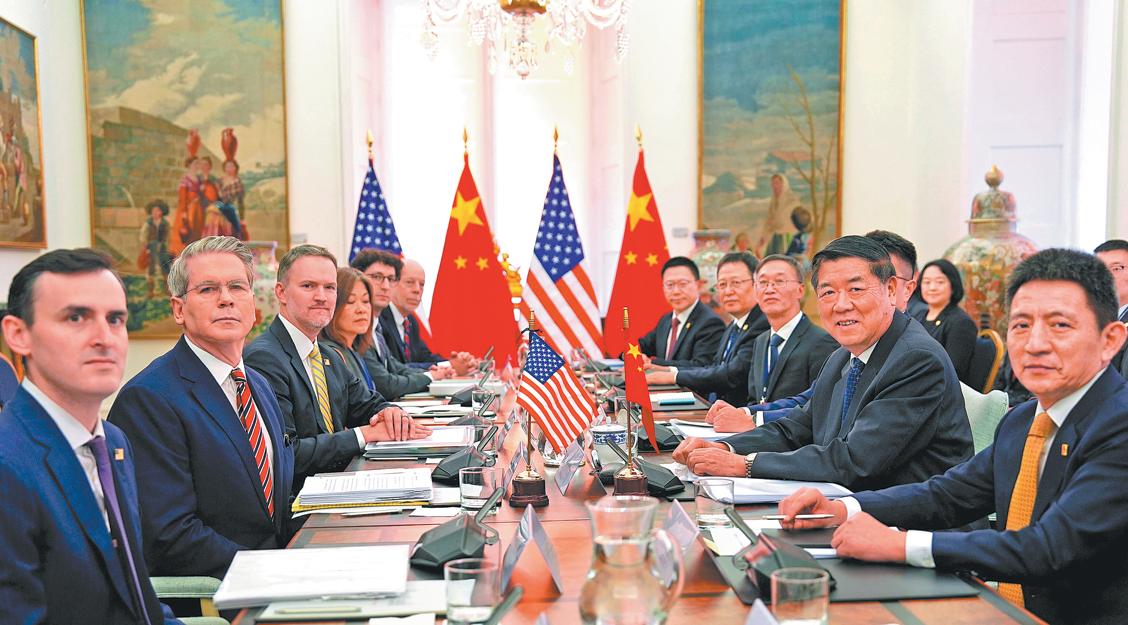
Throughout the year, Beijing and Washington launched multiple rounds of senior-level economic and trade talks, starting in mid-May in Geneva, Switzerland, reviving a regular consultation mechanism to keep disputes from spiraling.
Four more rounds of negotiations were held in Europe and Asia through early October, capped by a video conference between Chinese Vice-Premier He Lifeng and US Treasury Secretary Scott Bessent and US Trade Representative Jamieson Greer on Dec 5.
While these trade talk sessions yielded few breakthrough headlines, they maintained "candid, constructive" contact, managed friction in the implementation of points of consensus reached in each round of talks, and helped build a diplomatic runway for a leaders' meeting in late October.
When summarizing the year at a trade forum in December, Xie Feng, China's ambassador to the US, said that since the start of 2025, China-US economic and trade relations have gone through many ups and downs. "We have seen both looming clouds and clear skies," he said.
Xie pointed out that the strategic guidance for China-US relations is provided by the direct engagement between the two heads of state, which is a critical stabilizing force amid volatility.
President Xi Jinping and US President Trump were in frequent contact in the past 10 months, including an in-person meeting and four phone calls, the envoy said, adding that their successful meeting in Busan, South Korea, "recalibrated" the course of bilateral relations.
Xie noted that a follow-up phone call within a month of the Busan meeting helped sustain the stabilizing momentum, adding that leader-level diplomacy serves as the "anchor" for bilateral ties.

Measure of recovery
For Hufbauer, the reduction of tariffs, despite remaining high at 30 to 40 percent, resumption of agricultural trade, and meetings of Xi and Trump were all clear signs of progress.
"I don't think that anti-China rhetoric will pay off for either party in the US November elections. The biggest risk is some sort of military flare-up, but I think that is unlikely. Trade relations should modestly improve," he said.
Chas Freeman, former assistant secretary of defense for international security affairs, said that 2025 began with "a severe collapse in our relationship", as the Trump administration escalated protectionist trade measures — both tariffs and sanctions.
Many China hard-liners in Washington lack real knowledge of China, and they cling to preconceived notions, projecting motives and vulnerabilities onto Beijing that are not borne out by facts, Freeman said.
The year 2025 was closing with a measure of recovery from that low point, and for now, the US-China relationship appears to be relatively stable, heading into the new year, he pointed out.
Freeman said this is a period of calm, when both sides should think seriously about how to use any future meeting to perpetuate the relative stabilization of the relationship that was achieved in Busan.

The core question is whether that relative stability, which is temporary, can be converted into a durable foundation for a more normal long-term relationship, he said.
"I don't think anything the US can do is going to halt Chinese progress. I don't think it is in our interest to do that, but to the extent we try, we will fail," he added.
Despite the improved diplomatic atmosphere, analysts said US approach on core matters remains confrontational.
In December, for example, the Trump administration released its National Security Strategy, which cast China as the main driver of the US economic security policy. It also unveiled what could possibly be the largest-ever US arms sales package for Taiwan.
The strategy's language on China appears less hostile "rhetorically", but the underlying approach remains unchanged, said Wang Jisi, founding president of Peking University's Institute of International and Strategic Studies.
"In essence, I think the US policy toward China is still one of containment," he said at a forum hosted on Dec 12 by the University of Hong Kong's Center on Contemporary China and the World.
Interwoven interests
Zheng Yongnian, director of the School of Public Policy at the Chinese University of Hong Kong (Shenzhen), also cautioned against declaring a "turning point" or "bottoming out" in China-US ties following the trade negotiations and top-level engagements.
In an interview in November with Greater Bay Area Review, a new media outlet, Zheng said that China and the US are co-drivers of the post-1980s wave of globalization, and their interests remain interwoven across various fields — from economy and security to ocean and space.
As friction intensified, both sides actually became more rational, he noted. "In the past, we said that China-US ties were a 'struggle without rupture'. This time, we not only avoided rupture, but also made progress in a positive direction through struggle," Zheng added.
David Firestein, inaugural president and CEO of the George H.W. Bush Foundation for US-China Relations, noted that merely pulling back from threats is "not real progress", but rather a return to the previous status.
Firestein said that 2025 was a "difficult" and "tumultuous" year, because volatility and unpredictability dominated, during which the US policies on tariffs, trade and technology continuously oscillated, with stated positions shifting from week to week — and sometimes from day to day.
"But the one improvement that I do think we see is a tonal improvement. I think some of the language is more moderate," he said.

Firestein noted that US foreign policy is failing because it is built on flawed psychological projections and fundamental misunderstandings of China's true ambitions.
He identified four primary errors: the false belief that China wants to supplant the US as the world's only superpower; the incorrect assumption that China intends to overthrow the existing international order; the shift toward a zero-sum mindset; and the new perception of economic interdependence as a vulnerability rather than a stabilizing force.
A policy "predicated on these incorrect and flawed assumptions" is destined to" veer off course and to fail to achieve our own stated objectives", Firestein warned.
"So we've got to get back to a more rational and pragmatic way of looking at the relationship, and a way of looking at the relationship that is less emotional, less ideological and less political, because those tendencies are taking us in the wrong direction," he said.
There are still "a host of issues" on which Washington and Beijing "can and should try to work together to generate better outcomes for both countries and for the world",Firestein said, citing trade, global public health including pandemics, and key scientific and security challenges such as trying to find a cure for cancer and cooperating on artificial intelligence.

Academic exchanges vital
Looking ahead, Scott Rozelle, co-director of the Stanford Center on China's Economy and Institutions, said that another strong pillar for advancing ties is cross-border education and research.
Academic exchanges and research ties have been among the cornerstones of China-US relations and shared economic development over the past three decades, Rozelle said, calling for sustained two-way flows. The US should keep attracting Chinese students and "welcoming visiting scholars", while China should do more to support US graduate students and young scholars in conducting research, he said.
Rozelle, a professor of development economics at Stanford, noted that some US states remain "fully welcoming", but others have tightened restrictions. "Hopefully, the benefits will be seen to outweigh the costs in the coming years and all parts of the US will open up again."
No prediction is certain for China-US relations in 2026. However, as the clouds dispersed at times in 2025, the two countries' envoys hope to see some brighter days ahead.

At the trade forum in Washington in December, Chinese Ambassador Xie told business communities that 2026 will offer "unprecedented" cooperation opportunities for Chinese and US companies, with China hosting the 33rd APEC Economic Leaders' Meeting in Shenzhen, Guangdong province, and the US hosting the G20 Summit.
He urged both sides to deepen dialogue, narrow politically driven disputes, and pursue new opportunities made possible by the stabilizing role of head-of-state diplomacy alongside China's development blueprint for the five years starting from 2026.
In Beijing, US Ambassador to China David Perdue amplified US Trade Representative Greer's voice by reposting the latter's remarks on X on Dec 15.
"President Trump is very focused on having a constructive relationship with China… and so we're quite focused on trying to find a path forward to have an exchange of goods and services between China and the US that makes sense for both of us and that is fairly balanced," the post read.
Read together, the messages from both sides make a similar forecast for 2026 — not guaranteed blue skies, but an effort to improve visibility and, if the momentum holds, achieve greater certainty.
