

China's foreign trade sector is poised for steady growth in 2026, driven by rising global competitiveness of its exports and enhanced diversification of trading partners, as well as an increasingly open domestic market that translates into expanding imports, said experts and executives.
China will continue to serve as a key anchor for global trade stability, leveraging its upgraded manufacturing base and its vast, open market to navigate a complex international economic landscape marked by intensifying protectionism and unilateralism, they added.
"As China pivots toward a growth model increasingly driven by consumption and innovation, the sustained, high-quality development of foreign trade still remains a key component of its economic strategy," said Wang Xuekun, head of the Chinese Academy of International Trade and Economic Cooperation.
At the annual Central Economic Work Conference held in mid-December, policymakers laid out economic priorities for 2026, emphasizing the need to "support service export" and "actively develop digital and green trade".
According to data from the General Administration of Customs, China's total foreign trade in goods reached 41.21 trillion yuan ($6 trillion) in the first 11 months of 2025, up 3.6 percent year-on-year. Exports played a vital role in driving the overall expansion during the January-November period, growing 6.2 percent year-on-year to 24.46 trillion yuan, the data showed.
"China's robust export growth has fully demonstrated its resilience — one that tariffs alone cannot blunt. The advantages Chinese exporters have gained during such a trying time will help them secure more orders in 2026," Wang said.
Innovation holds key
Amid a complex global landscape, China's export growth is being powered not by chance, but by consistent innovation of many businesses across sectors.
On a production line in Ningbo, Zhejiang province, rows of newly designed hair clippers await shipment. This is Beiya Electrical Appliance Co's latest model upgraded with a brushless motor, offering higher power, lower noise and extended durability.
"We now ship 350,000 units of this clipper on average each month," said Song Jianli, general manager of Beiya, which has marked its presence in the United States, Europe, the Middle East and other regions.
"In this fiercely competitive market, innovation is our only way to break through homogenized competition and stay ahead," Song said, noting that the company has invested over 15 million yuan in research and development, amassing more than 70 patents in recent years.
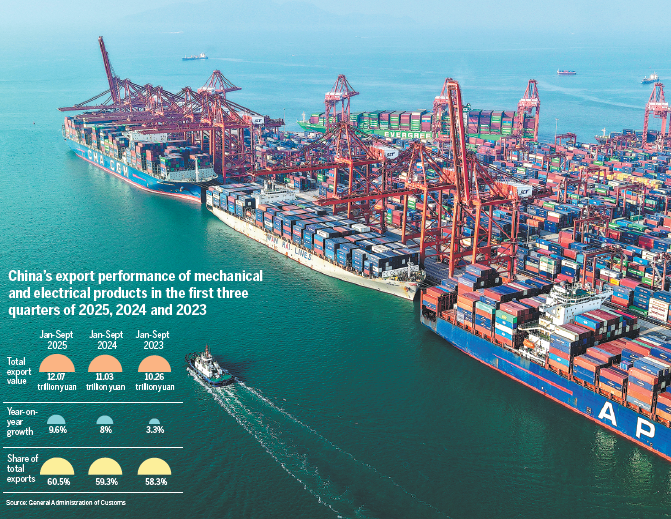
Beiya's growth trajectory is a microcosm of a broader trend. According to the GAC, exports of mechanical and electrical products reached 14.89 trillion yuan during the January-November period, up 8.8 percent year-on-year, accounting for 60.9 percent of China's total exports.
Chen Wenling, former chief economist at the China Center for International Economic Exchanges, said that amid external headwinds, Chinese manufacturers are increasingly "turning inward", not to retreat, but to "hone their core competencies".
The focus has sharpened on product development, technological upgrades and deliberate brand building. This internal strengthening allows companies to anchor themselves in market demand, moving up the value chain rather than competing solely on cost, Chen added.
A report from investment banking firm China International Capital Corp notes that China's trade specialization coefficient for high value-added manufacturing increased from zero in 2010 to 0.31 in 2024, reflecting a continuous enhancement of comparative advantages.
Beyond product innovations and upgrades on the factory floor, analysts said a broadening "circle of trade partners" is providing resilient pathways for growth, diversifying export markets and mitigating risks tied to any single economy.
The tariff policies of Washington and Brussels have clearly affected trade with the US and the European Union, but China has been able to fill the void globally.
"China has become one of the top three trade partners for 157 countries and regions worldwide," Sun Meijun, head of the GAC, said at a news conference in late August.
In 2024, China's export and import with countries participating in the Belt and Road Initiative reached 22 trillion yuan, accounting for over half of China's total trade volume, according to the administration.
Meanwhile, trade with emerging markets, including the Association of Southeast Asian Nations, Latin America, Africa and Central Asia, recorded an average annual growth rate of over 10 percent.
Pivotal destination
Shan Hui, chief China economist at Goldman Sachs, said the diversification of China's exports started after 2018, with shipments to developing countries growing particularly fast.
"The change each year may seem incremental, but the cumulative effect is significant," she said, adding that this deliberate broadening is precisely why "China's export resilience today is substantially higher than what it was in 2018".
Shan said in 2018, the EU was China's largest trading partner, followed by the US and ASEAN. Fast forward to the first 11 months of 2025, and that lineup has changed. ASEAN now occupies the top position, followed by the EU and the US.
The Central Economic Work Conference highlighted the need to promote high-quality Belt and Road cooperation in 2026, as well as negotiate and sign more regional trade and investment agreements.
In November, Goldman Sachs forecast that China's export volume will grow 5 to 6 percent annually in the coming years, which is expected to outpace global trade expansion and help drive China's overall economic expansion.
While its export resilience continues to power its overall trade growth, China's growing appetite for imports is transforming the nation from a powerhouse of outbound shipments into a pivotal destination for global goods, allowing the world to share in its scale and opportunity, experts and executives said.
Earlier this month, Han Wenxiu, executive deputy director of the Office of the Central Commission for Financial and Economic Affairs, said at a news conference that China "should expand exports while increasing imports, in order to promote the sustainable development of foreign trade".
The Ministry of Commerce has launched the "Big Market for All: Export to China" initiative to motivate foreign businesses to increase their exports to China to seize the new opportunities offered by the vast Chinese market.
Official data shows that China has remained the world's second-largest import market for 16 consecutive years, with combined imports of goods and services projected to exceed $15 trillion during the 14th Five-Year Plan (2021-25) period.
In the first three quarters of 2025,China's agricultural product imports reached $57.1 billion, up 2.6 percent year-on-year. Purchases of electromechanical and high-tech products increased 5 percent and 8.6 percent, respectively.
Openness index
"China's sustained economic development and the expansion of its middle-income group, coupled with Chinese people's growing demand for healthy food products, have underpinned the growth of our business," said Michael Jiang, president of Zespri Greater China.
Liao Fan, director of the Chinese Academy of Social Sciences' Institute of World Economics and Politics, said that as certain economies turn inward, embracing protectionist policies and erecting trade barriers, a market that seamlessly combines immense scale with genuine openness is transitioning from a common feature to a rare and critical resource.
The World Openness Index registered a marginal decline of 0.05 percent in 2024 compared with the previous year, recording a drop of 0.34 percent from 2019 and a decline of 5.39 percent from 2008, indicating that global openness remains in the contraction phase.
The index is included in the World Openness Report 2025, compiled by the CASS institute and the Research Center for the Hongqiao International Economic Forum.
China's openness index surged from 0.59 to 0.76 between 1990 and 2024, marking a rise of nearly 30 percent, according to the report released in November.
"The high-level opening-up has been crucial in unlocking new growth avenues. The market's sheer scale and diversity — from top-tier cities to lower-tier cities that are also growing in wealth — present vast, untapped potential," said Hubert de Haan, senior vice-president of BSH Home Appliances Group Region Greater China.
"Chinese consumers are eager to try new things and have high demand for innovation, and the capabilities we gain in China ensure that we can be successful in the rest of the world," he said, adding that this model, in which innovations born within China's robust ecosystem serve global demand, shows how China's opening-up contributes to global supply chain stability.
In the latest step to further open up the world's second-largest consumer market, China launched island-wide special customs operations in the Hainan Free Trade Port in mid-December.
This makes Hainan a key bridge for China to connect with the global market. The island has expanded the coverage of its zero-tariff policy to 74 percent of imported goods, with further expansion planned in the future.
Zhou Mi, a senior researcher at the Chinese Academy of International Trade and Economic Cooperation, said that by actively expanding imports, China is advocating a global trading system where multiple growth poles thrive and benefits are more widely distributed, especially among the Global South nations.
On Dec 1, 2024, China implemented zero-tariff treatment on 100 percent of tariff lines for all 53 least developed African countries that have diplomatic ties with China. In 2024, imports from these countries increased by a cumulative total of over 55 billion yuan, according to the GAC.
Zhou said: "China's deliberate expansion of imports and commitment to trade balance serve as a strategic buffer against global economic frictions. It strengthens the argument for nations to remain engaged with, rather than retreat from, the global economic framework."
