

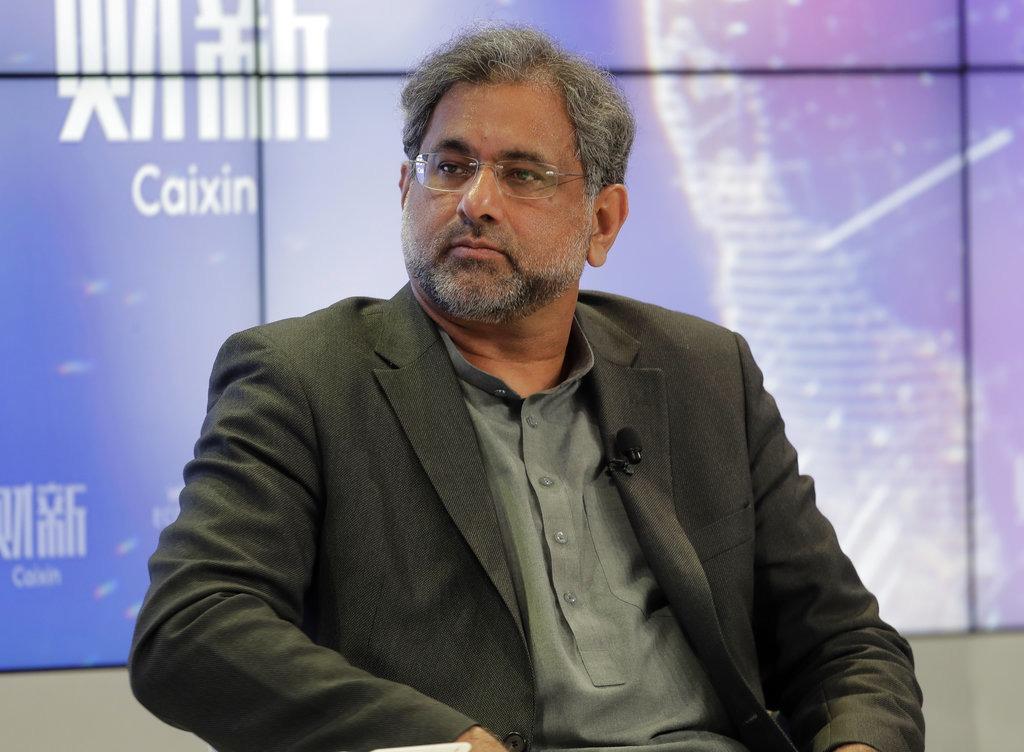
 In this file photo dated Jan 24, 2018, Shahid Khaqan Abbasi, then prime minister of Pakistan, attends a panel during the annual meeting of the World Economic Forum in Davos, Switzerland. (PHOTO / AP)
Former Pakistan prime minister Shahid Khaqan Abbasi stressed the importance of building a closer China-Pakistan community with a shared future, as he condemned a terror attack that killed some Chinese workers in his country last week.
Describing the March 26 attack that claimed the lives of five Chinese workers in Pakistan’s Khyber Pakhtunkhwa province as a very sad and unfortunate incident, Abbasi denounced the terrorists and said that his country is committed to protecting Chinese nationals working in Pakistan.
Pakistani Prime Minister Shehbaz Sharif on Monday visited the Dasu Hydropower project's camp in northwestern Khyber Pakhtunkhwa province to console Chinese personnel of the project. Addressing the workers, Sharif expressed deep condolences for the victims of the Dasu terrorist attack and sincere consolation to the relatives of the victims and the Chinese personnel of the project. It is the responsibility of the Pakistani government to protect the safety of the Chinese brothers and sisters who came to Pakistan to help its development and progress, the prime minister said.
“China firmly supports Pakistan in looking into what happened with utmost resolve and effort, bringing the perpetrators and whoever’s behind the attack to justice and doing everything possible to protect the safety and security of Chinese personnel, projects, and institutions in Pakistan,” said Wang Wenbin, Chinese Foreign Ministry’s spokesperson.
In an interview with China Daily in Boao, Hainan province, Abbasi praised China’s help to Pakistan through the Belt and Road Initiative (BRI) and the flagship China-Pakistan Economic Corridor (CPEC) project, saying he finds China’s engagement and the way the Chinese system works fascinating.
The BRI projects are “basically left to the host country to decide what to do”, said Abbasi, who recently took on a new role as member of the board of directors of the Boao Forum for Asia.
For example, with the CPEC, the Chinese and Pakistani governments worked together on the plan, but the project was basically left to the Pakistani government in regard to “what they wanted to do” and “how they wanted to do it”.
He said the Chinese side’s framework for CPEC had only two requirements: one was that the projects should be economically viable, which was discussed between the two countries, and the second was that the projects should be environmentally sustainable.
According to him, the CPEC projects have been developed at an amazing speed in the past ten years. Now the focus is shifting to high-quality BRI, which is basically moving away from the signature projects to smaller and sharper initiatives, which will give better returns and are more technology focused. BRI now is basically helping with the deficiencies of the other countries, he said.
“As part of the community of shared future, I think it is a very, very beneficial relationship in that sense, because if you really look back at the Silk Road, it was basically a trading route and it was about inclusion and integration. The same thing is happening now with the BRI,” Abbasi noted. “I think the focus now shifts to technology and also things like AI (artificial intelligence) and blockchain.”
CPEC has been a real success story according to the Pakistani politician. He refuted the “debt trap” accusations of some Western nations, saying the claims have been intentionally made up to harm the reputation of China.
He mentioned that Jin Liqun, president of the Asian Infrastructure Investment Bank, was asked during a panel event at the Boao forum that if a country has economic issues, should it stop borrowing. “His answer was no, absolutely not, they need to borrow more smartly and use it effectively to be able to develop a potential to repay the loans,” said Abbasi. “That's also what I think we need to work on in Pakistan.”
Talking about the recent terrorist attack against Chinese workers in Pakistan, Abbasi said protecting the lives of Chinese nationals involved in various projects in Pakistan is very important.
“In Pakistan there are over 15,000 armed personnel on duty to protect the CPEC workers,” he said.
However, he noted that Pakistan’s landmass spans a huge distance from north to the south, with very difficult terrain. “We have a long border with Afghanistan which is very porous. People come in and out. And we have a long border with Iran, too.
In a complex security environment, “Pakistan has to deal with a major threat from suicide bombers, something which is very difficult to guard against. Even the prominent office holders in the Pakistan government have to be guarded against this threat. I think we need to develop new methods for providing security in light of the recent incident,” Abbasi said.
But he said that the terror attack will not hinder the progress and success of the CPEC second phase, although some work has been suspended temporarily due to the incident.
“We are very hopeful of moving forward with CPEC and I am especially looking forward to progressing with the potential growth of exports, which CPEC can greatly help with. That's very critical for Pakistan,” Abbasi said.
Chinese companies and workers have resumed work on different sites in Pakistan a few days after the attack on Chinese engineers. Contrary to some malicious propaganda peddled by vested interests, work on the Tarbela Dam extension project continued unabated, a testament to the unwavering resolve of both nations in the face of adversity, and a classic example of Pakistan-China friendship.
Kaswar Klasra, a freelance journalist based in Islamabad, contributed to this story.
Contact the writer at vivienxu@chinadailyapac.com
