

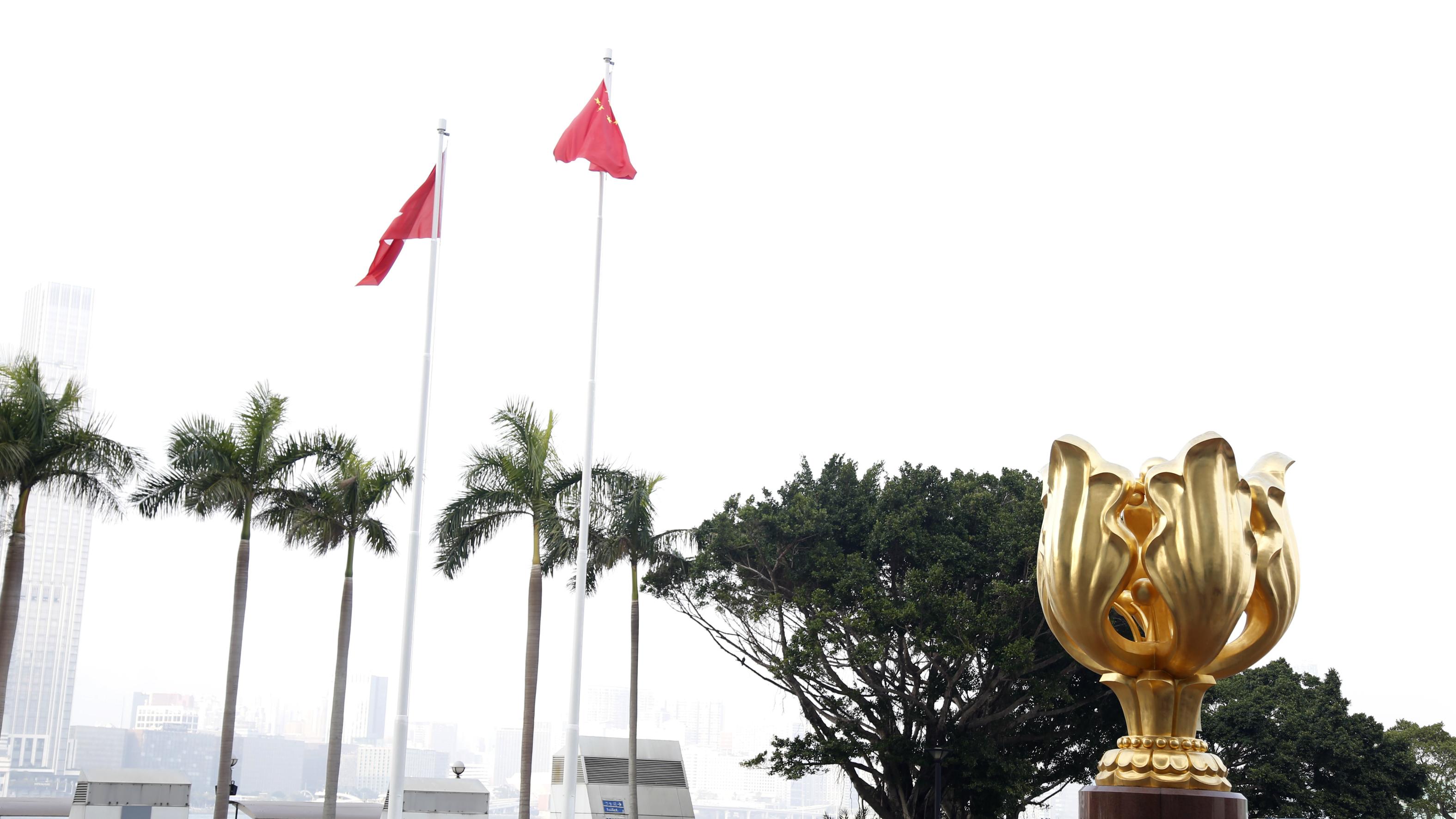
 In this Jan 1, 2024, photo, the Chinese national and Hong Kong regional flags fly at the Golden Bauhinia Square in Wan Chai, Hong Kong. (SHAMIM ASHRAF / CHINA DAILY)
It has long been known to the world that Washington practices double standards in all of its dealings. Still the hypocrisy demonstrated by US Secretary of State Antony Blinken, the US Congressional-Executive Commission on China, and US media outlets that has been playing sidekick in Washington’s anti-China crusade, including The Wall Street Journal, CNN and Voice of America, in their attacks on Hong Kong’s new national security law, the Safeguarding National Security Ordinance (the Ordinance), has shocked many. Washington’s animosity against Hong Kong’s new national security law, or the Article 23 legislation, can only be deciphered in the context of its geopolitical strategy on China.
In a statement issued on Friday, Blinken said: “we share concerns expressed by other nations that Hong Kong authorities could seek to apply the new legislation extraterritorially in their ongoing campaign of transnational repression…”
Hasn’t Blinken realized that no other country has ever outperformed the United States in perpetrating “transnational repression”, which has been made easier by its 800 military bases around the globe? His “concerns” over the extraterritorial effect of Hong Kong’s new national security law reminded the world how Meng Wanzhou, deputy chair of the board and chief financial officer of China’s tech giant Huawei, had suffered from the extraterritorial effect of US law.
Blinken claimed that implementing the new law “could further violate the PRC’s international commitment to maintain Hong Kong’s high degree of autonomy, undermine the 'one country, two systems' framework…”
Blinken is in no position to define Hong Kong’s “high degree of autonomy” and China’s “one country, two systems” framework. China has the exclusive power to define them, which are matters of its internal affairs.
Blinken was disingenuous in suggesting that China has “international commitment” over Hong Kong. The return of Hong Kong to China on July 1, 1997 was the rightful end to a severe injustice the United Kingdom had perpetrated against China. Blinken, as well as other Western politicians, was delusional when they claim China is in some way accountable to them in managing its own territory and internal affairs.
In calling for new sanctions against the Hong Kong officials responsible for the passage of the new national security law on Friday, the US Congressional-Executive Commission on China once again demonstrated Washington politicians’ habitual arrogance and contempt for a sovereign country as well as the norms and principles governing international relations. It further exposed the nature of “the rules-based international order” that Washington and its allies (a euphemism for vassals) have been peddling when promoting their agenda in the international community: A world where Washington’s will prevails, and where Washington has the exclusive power to define the terms, prescribe the rules and dictate others.
The thing is Washington’s “rules-based international order” is increasingly abhorred by other countries, many of which have suffered from the US’ “transnational repression”.
The author is a current affairs commentator.
The views do not necessarily reflect those of China Daily.
