

Digital initiatives, green focus, reduced dollar dependence vital for well-being of region
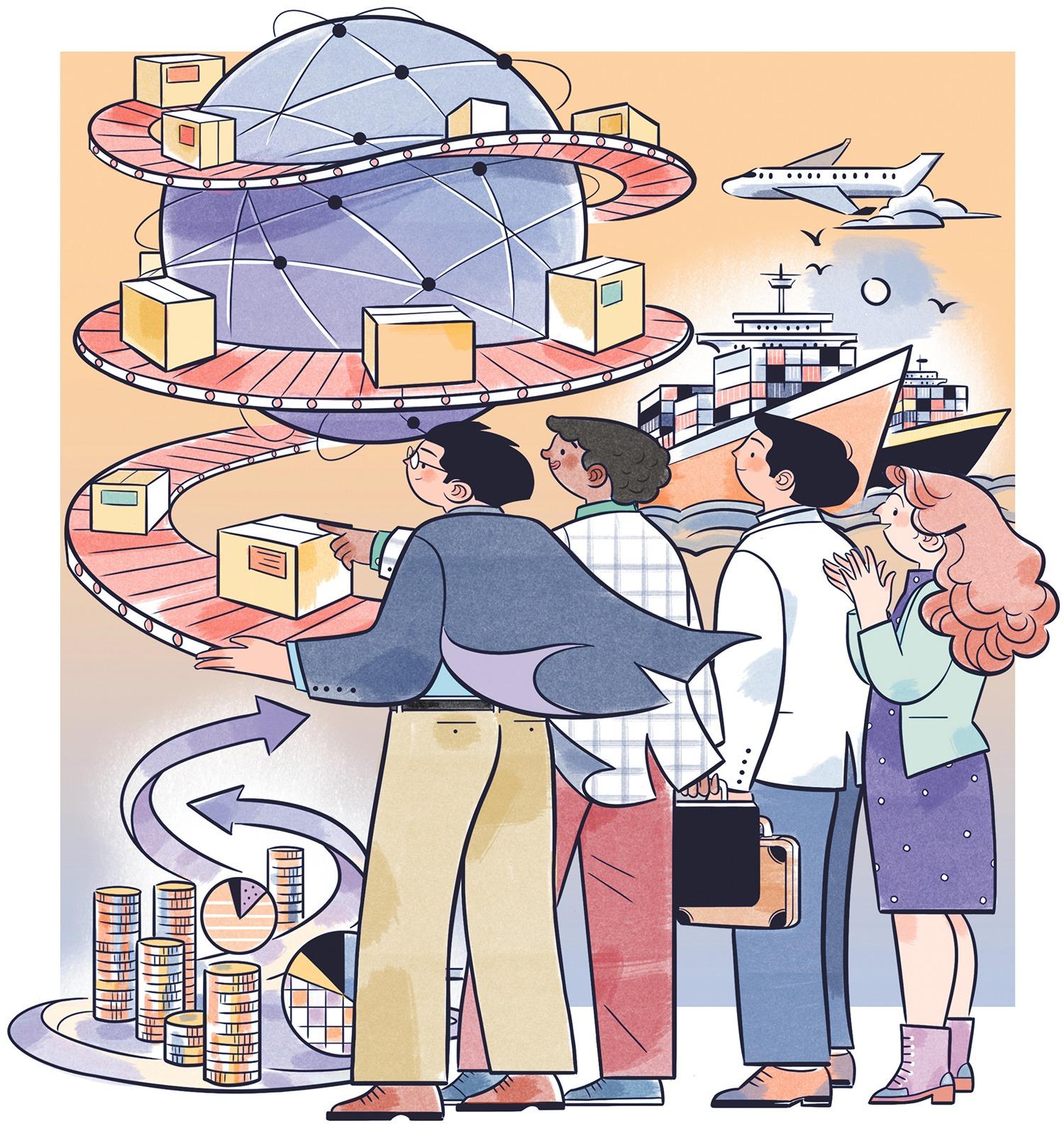 (LI MIN / CHINA DAILY)
Editor’s note: The world has undergone many changes and shocks in recent years. Enhanced dialogue between scholars from China and overseas is needed to build mutual understanding on many problems the world faces. For this purpose, the China Watch Institute of China Daily and the National Institute for Global Strategy, Chinese Academy of Social Sciences, jointly present this special column: The Global Strategy Dialogue, in which experts from China and abroad will offer insightful views, analysis and fresh perspectives on long-term strategic issues of global importance.
The profound restructuring of the world economy has given rise to many new trends.
Diverse emerging markets have generally outpaced developed economies, despite the severe impact of the 2008 international financial crisis and the COVID-19 pandemic since 2020. There have been widespread efforts in countries worldwide to go digital and green. New industries, business segments and business models have arisen and are driving rapid growth of the digital economy and trade.
However, protectionism and unilateralism has brought unprecedented challenges to economic globalization, leading to sluggish growth in global trade and investment. Some developed economies tend to view international economic and trade relations through the lens of geopolitics.
The Eurasian region is experiencing a deteriorating external environment. Economic growth faces strong pressures overall and shows a trend toward divergence.
According to the International Monetary Fund, growth of emerging markets and developing economies in Europe is projected to rise to 2.4 percent in 2023, 0.6 percentage points lower than global growth for the same period. Growth in the Middle East and Central Asia is projected at 2 percent, 3.6 percentage points below that in the previous year. Asian emerging markets and developing economies perform relatively better, with an expected growth of 5.2 percent in 2023, up by 0.7 percentage points from the previous year.
Driven by China’s Belt and Road Initiative and various regional cooperation mechanisms, and despite multiple sanctions imposed on Russia, integration among members of the Eurasian Economic Union has continued to advance.
However, the Eurasian economy still faces significant external challenges, including unresolved geopolitical hotspots, as well as economic sanctions and pressure from major developed countries. To overcome the challenges, Eurasian nations should promote cooperation through the following approaches.
First, advance South-South economic cooperation through Eurasian economic collaboration.
Countries in the Eurasian region should harness their economic potential, accelerate the implementation of the 2030 Sustainable Development Agenda, and promote cooperation in areas such as poverty alleviation, food security, green development, digital economy and connectivity.
At the same time, the nations should strengthen cooperation with emerging markets and developing countries in other regions to share opportunities and contribute to economic globalization.
Second, actively engage in international rule-making and enhancing institutional influence. In recent years, Eurasian countries have strengthened alignment with international standards and rules. However, in emerging areas such as digital and low-carbon sectors, governance rules are still in the making.
Eurasian countries should participate in the establishment of relevant rules, collectively uphold the multilateral trading system, and promote the creation of a high-standard free trade zone.
Third, create an efficient e-commerce platform to promote development of the digital economy. To boost the data economy and create a more efficient model of economic and trade ties, countries in Eurasia should align goals and demands for e-commerce growth.
Fourth, drive green development and deepen low-carbon cooperation. After the pandemic, countries in Eurasia have enhanced efforts on environmental protection, creating new opportunities for industries such as clean energy. The nations should further step up low-carbon trade and green investment to tap into the potential of economic and trade cooperation.
Fifth, strengthen local currency settlement cooperation to promote currency diversification in the international monetary system. The United States, driven by its own interests, has adopted a radical interest rate policy and poses huge financial risks to Eurasian countries. At the same time, it is leveraging the dollar’s dominant position to abuse financial sanctions, causing instability in the Eurasian financial markets.
To mitigate the negative spillover effects of monetary policies from developed economies and reduce reliance on the US dollar, Eurasian countries should promote the use of local currency settlement in cross-border trade and investment. Monetary cooperation should be further deepened to provide more options in the international financial system.
The author is a senior research fellow of the Institute of World Economics and Politics at the Chinese Academy of Social Sciences and the National Institute for Global Strategy at the CASS. The author contributed this article to China Watch, a think tank powered by China Daily.
The views do not necessarily reflect those of China Daily.
