

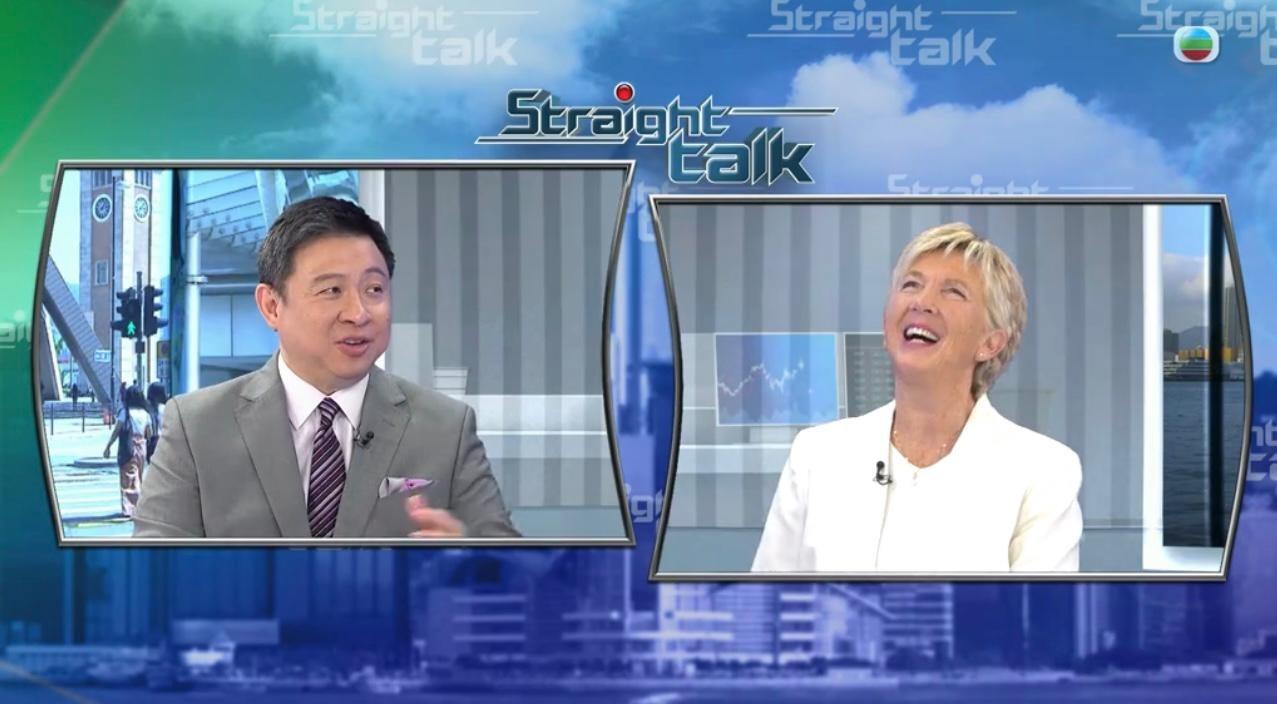
 Straight Talk presenter Eugene Chan (left) interviews Chief Executive of the Hong Kong Sports Institute Trisha Leahy on TVB, Oct 17, 2023. (PROVIDED TO CHINA DAILY)
Trisha Leahy, the chief executive of the Hong Kong Sports Institute, is on our show this week.
Hong Kong athletes are consistently performing very well at major international events. Trisha Leahy says one major critical success factor is government investment.
She says the government and the Hong Kong Sports Institute are not just looking for marginal gains in the international events, what they are looking for now is microscopic. Trisha says the city’s sport sector is now entering the territory of science, research and micro technologies that helps to sustain the high performance.
Trisha adds that a successful high performance sports sector is an important role modelling effect for young people and it also helps develop social cohesion and tolerance in the community.
Check out the full transcript of TVB’s Straight Talk host Dr Eugene Chan’s interview with Dr Trisha Leahy:
Chan: Good evening I'm Eugene Chan and a warm welcome to Straight Talk. Our guest today is Dr Trisha Leahy, the chief executive of the Hong Kong Sports Institute. Under Dr Leahy's leadership, Hong Kong athletes have consistently succeeded at major international events, including the recent Asian Games and the Tokyo Olympics, as well as the Paralympics. She previously worked at the Australian Institute of Sport as senior psychologist and was awarded the Australia Sport Medal for services to Olympic sports in 2000 following the successful Sydney Olympic Games. Here in Hong Kong, she has also been awarded the Bronze Bauhinia Star in 2014 and the Silver Bauhinia Star in 2020 for her contributions to the community and to sports. This evening, we have invited Dr Leahy to talk to us about whether our medal expectations are too high for our athletes. Welcome, Trisha!
Leahy: Thank you, Eugene. Thank you so much.
Chan: Trisha, maybe we start by telling the viewers what the Hong Kong Institute of Sport is and where its stay in the sports landscape in Hong Kong is?
Leahy: Excellent question, Eugene. So, the Hong Kong Sports Institute is the government's delivery agent of the high performance sports systems in Hong Kong. What this means is that we are funded to assist the sports’ governing bodies to identify, nurture and develop their talented athletes so that they can become world champions, Olympic champions, and Paralympic champions. So, this is the core of our being is to develop and produce medals.
Chan: Right. So, can we highlight some of the major achievements of the local athletes internationally over the last few decades? As a recap to our viewers?
Leahy: Well, I think we can see that and perhaps it's not so visible to some of the viewers, as we're moving forward all the time. Whether it's Asian championships, whether it's World Championships, whether it's Olympic Games, Paralympic Games, Asian Games, all of the trends are moving in the right direction in a very positive direction and athletes from Hong Kong are consistently on the podium at all of these events. So, we have a very nice, sustainable, reproducible system happening, thanks to many collaborating partners, including ourselves, the government, the National Sports Association, and of course the Hong Kong Sports Federation Olympic Committee of Hong Kong China.
Chan: Trisha, you're making a very strong statement saying that is consistently on the stage I mean, for most Hong Kong people, we never treat Hong Kong as a sporting city because we never had the facilities or venues. The attitude of the whole community to sports is just for leisure games, only until I still remember 1996 when Lee Lai Shan won the gold medal. So, has Hong Kong been doing well even before that, all these are planned or they're just coincidental?
Leahy: There is no such thing as coincidence in high performance sport, everything is planned. Everything is based on a system. Now I think you'll have heard recently the government saying how in the past 10 years, they've given us around 7 billion Hong Kong dollars to ensure that we're able to do the job that we need to do. Now the question that some people ask, is that a lot of money, but for us, the more pertinent question is, how are we using that money? Are we identifying the critical success factors? Are we investing the money into those factors so that we can have sustainable results? Now starting from the Lee Lai Shan in 1996, it was my privilege to be part of the support team working with her. We already had a system then that wasn't Lee Lai Shan's first public competition. She had previously been world champion, world top three. She'd been to the Olympics four years previously. So, we had a system of coaching, science, medicine, training, access to overseas competition, and that's what produced that result.
Chan: So, what you are saying is, all the money has been well spent on results.
Leahy: Exactly.
Chan: So, do we still need more money?
Leahy: Yes, it's interesting. If you look at the Asian Games results this time. We are overall on the medal table 10th. Even though we got 53 medals. At the last Asian Games cycle, we were overall on the medal table 11th and the time before that, 10th, with much fewer medals. So, the reality is just to maintain your place on the medal table, you have to get more and more medals, more and more medals which means more and more investment. So, everywhere around the world, not just Hong Kong, but our counterparts around the world, everyone is recognizing that you have to keep investing for tinier and tinier marginal gains in order to sustain the same place on the medal table.
Chan: Right, Trisha, you just mentioned you were with Lee Lai Shan in 1996 and then, we have also heard that you will be retiring this December.
Leahy: Correct.
Chan: I'm sure you had this legacy. Do you have hope a build for Hong Kong? Would you say that you will finish on a high note?
Leahy: I think I am very happy to be finishing at this time, on a very positive note. And I'm also confident that what we, with our collaborative approach have built is not dependent on any one person being in any position. It really is dependent on teamwork. And of course, this is the beauty of sport. This is why we promote sports in our community because we believe that it drives collaboration, it drives values of teamwork and cooperation. And no matter whether you're working in corporate finance, or you're working in high performance sport, that's what's going to lead to success. I'm confident going forward, things are going to be in really good hands.
Chan: Right. You just mentioned that we have 53 medals, maintaining number 10 on the medal table for this time it is a very good result. We had the chief executive welcoming our athletes over last weekend, saying that we have eight gold, six silver and 29 bronze medals, I mean it is very encouraging.
Leahy: Yes.
Chan: And out of those who got the gold medals, there are two new sports that are actually not under the Tier A system, which I'm sure we're gonna talk about in a minute: both golf and bridge. So, what exactly is Tier A because the viewers, they are not familiar with the tier system. Maybe you can tell them surely the Tier A star, Tier A – what is this all about?
Leahy: Yes, so, the government has a multi-pronged approach to the development of elite sport, starting from sports who have proven capacity in repeatable proven capacity in international events, in at least the Asian level. Then they get full access to the Hong Kong Sports Institute. So, the athletes can live there, they train there, we give them all of the science and medical support that they need, and supply them with all of the funding for competitions and training. That's Tier A. At the top of Tier A, we have six sports who are Olympic podium ready, and those get a little bit more in terms of really fine tuning the kinds of things that they need to do to be successful at the Olympics. Now for those sports who are knocking on the door who almost at that Tier A level but not quite there, there's another level called Tier B. So, they get funding from us. They get access to some of the science and medical services if their athletes are at a particular level. So, this matrix of support that the government has provisioned for athletes is definitely producing results. So, the purpose of Tier B is we want them to get into Tier A. So, for example, golf, they're going to be eligible for Tier A status in the next round of review because of their gold medal and we're very happy to be part of that and we are happy to see that sports are coming up through the system and that the system has been successful. It doesn't mean we don't need to review the system. We should always review to see how we can calibrate better, how can we do it more in a more sophisticated way? How can we guarantee sustainability? That's also critical analysis that we undergo all the time.
Chan: Right, given what you said? I mean, if you're going to have support, say golf and bridge, that means they will do better and better. And you mentioned a very good point that it is predictable. I mean, it's planned.
Leahy: Yes.
Chan: So, it looks like maybe in a few more years, we're gonna have more golf champions, more bridge champions in Hong Kong.
Leahy: Well, I think our goal is always to have more and better. So, we really do need to critically evaluate, what we are doing, what went well this time, what didn't go so well this time, how can we do it better next time. We have a concept in high performance sport that we're always looking for marginal gains across a number of parameters, because each little marginal gain can add up to an aggregate of a major change and that's what gets you the medal. But now, one more point on that Eugene, marginal gains are no longer sufficient. Marginal, you can see, what we're looking for now is microscopic. Now we're really entering into the territory of science, technology, research, micro technologies. So, this is the new frontier now for all of the elite sports around the world. And Hong Kong is also moving in this direction.
Chan: I'm just thinking if you look at the eight gold medals we have, with golf and bridge being the newcomers. And if we could have more facilities and more funding into that, we're going to have even more on the international map. Just a wild thought, does that mean that we're going to need more golf courses or even more venues for playing bridge.
Leahy: One of the critical success factors in terms of high performance sports results is world standard venues. If you can't train your athlete in a world standard venue, you're missing a major critical success factor. Now we're fortunate at the Hong Kong Sports Institute that the government has funded us to have all of the world's standard venues that we need. As more new sports come in. I'm confident that the government will make the right decision in terms of investment in those sports also to ensure that that critical success factor is not becoming the major weakness and the link in the chain that will break the succession and the sustainability of results.
Chan: Trisha, I'm going to ask you one question before the break and there's something that we have mentioned last year during the interview saying that since we talked about medals, but let's talk about Olympics.
Leahy: Yeah.
Chan: Hong Kong had been very fortunate that we got Olympic medals in 1996, 2004, 2012, 2020 – every eight years. We seem to miss out something in between. So, it is an eight year rule. You've been in the sport for a long time. So, are we saying that we won't be getting any metal in 2024 but only in 2028? What is your prediction?
Leahy: That's a very good question. Not necessarily. It's also a complicated question. And in relation to that, I do have to say we almost had a medal in 2016 with Sarah Lee, but unfortunately, she was knocked off her bike by another competitor. So, there goes on medals so it's not necessarily eight years. That could be just a coincidence. But it's interesting that it does take an eight year time period to develop a young athlete to be ready to compete on that international stage. So, when you think about that, and then you think about when it comes to big events like the Olympics anything can happen at any point and athlete can get injured falling off the bike, something else happens and there goes your medal. Now when we're in Hong Kong and we don't have a huge population, we have a seven point something million population. The athletes are not very huge compared to their counterparts. So, we're already punching far above our weight classes, if I might use a sports analogy in terms of the results that we are having. Now. After the Olympics in Tokyo. You can see we have some outstanding athletes, Cheung Ka-long, Siobhan Haughey. So, they're still at prime time. And they are ... They're looking good for 2024 in Paris. So, we are doing everything we can to make sure that the athletes that we do have, have the best opportunity of making the podium when it comes to 2024.
Chan: Great, Trisha. Let's take a break now but viewers do stay with us. We will be right back.
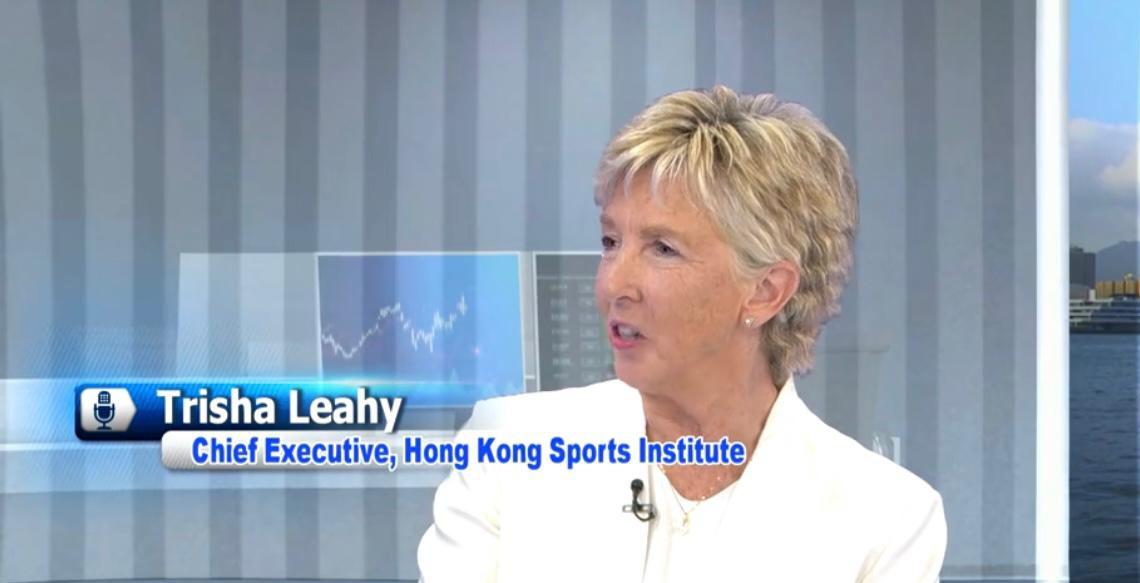 Trisha Leahy, chief executive of the Hong Kong Sports Institute, attends the Straight Talk show on TVB, Oct 17, 2023. (PROVIDED TO CHINA DAILY)
Chan: Thank you for staying with us. And we have been talking with Dr Trisha Leahy about whether our medal expectations are too high for our athletes. So, Trisha, in the first part of the show, I mean a very good point that you have told us is it is all predictable, Hong Kong is doing well, we are doing … actually given our size of our population and size of our athletes, we are doing very well. Just on that point, can you tell the viewers what you meant by that? People often think Hong Kong is never a sporting city, as I said right at the beginning of our show. But now seems like we are getting results, and you said it is because the government money has been put in the right use. And the title of the show today is ‘Whether We Are Expecting Too Much?’. I mean people say “are we going to get medals tonight?” So, are we expecting too much of our athletes?
Leahy: It's a very good question, Eugene. And I think no matter our expectations of athletes, we will never exceed their own expectations. These are highly professional young people, and they themselves never go to a competition without having a clear expectation of what they want to do. So, the question then for us is how do we support them? In the very complicated bio-psychosocial environment that really is the fundamental pathway to success at the Olympics, how do we support them properly with the right investment into the right critical success factors to make sure that they can achieve their own expectations? And when they do, it is quite right that we celebrate their success. And yesterday we were delighted that the chief executive of Hong Kong, gave so much kudos to the athletes and presented them with a certificate, and really acknowledged their results. And he said a really nice thing that the athletes are telling positive Hong Kong stories. And I think that's the crux of the matter for us. When the athletes are out there representing Hong Kong, they are not just telling Hong Kong stories, they are performing Hong Kong stories, and that positive message going out and being reflected back to the athletes about themselves, I think is setting us up for great future leaders in Hong Kong.
Chan: Right. Trisha, of course it is happy that we have medals, and it is understandable that, I think, the athletes have even higher expectations than the public. So, I understand we have over like 560 athletes who went to the Asian Games this time, but we only got 53 medals. So, I mean, definitely, it is 1 out of 10. Are you happy with that? Is that the only measurement that we have, using medals? Do you have any other measurements to say we have done well?
Leahy: Yes. When it comes to success at major games, we look at a number of parameters. We look at improvements based on last time, we look at different colors of medals, we look at positions in the Top 8, depending on the size of the events. But let me contextualize the current Asian Games results for you. If we look at, we came 10th overall in the medal table Hong Kong athletes. Over 600 athletes went, yes. About 46 percent of those athletes were from the Hong Kong Sports Institute system, and they were responsible for 96 percent of the medals. So, 51 or 52 of those medals were won by the Hong Kong scholarship athletes. And that is something that, I am not saying that to show how clever is HKSI, I am saying that to show how well the government support system is working, in terms of the provisioning of Hong Kong Sports Institute, to be able to support the athletes. So, we are very happy about that. Is it enough? Of course, it is never enough. But if we look across the sports where we are competing, and instead of looking at the overall medal table, we do a like-to-like comparison, the sports we were competing in versus our counterparts, then we would be 5th on the medal table. So, that is pretty extraordinary, given the 7.4 million population. Now back to the original medal table where we came 10th, look at all the countries that are ahead of us on that table, they have huge populations. So, I would challenge anyone to say that this was not an amazing result for the Hong Kong athletes.
Chan: Right. So, can you say that Hong Kong actually has developed a winning formula for sports?
Leahy: It certainly has. And related to that, we get a lot of questions from our counterparts in other jurisdictions because they do want to know “how do you do it? You have such a tiny population, you have so few elite athletes, how are you systemically supporting them such that they are able to consistently win medals?” We are very proud of it, and we are very proud of the fact that we have such a deep collaboration between our coaching teams, our science and medicine teams, our research teams, and the government is so supportive in terms of allowing us to move forward in terms of the sports technology research, and giving us the venues that we need. So, everything is in a very stable position. Now stable, we got to be careful because when we get to stable position, we all start to relax. In high-performance sports, you cannot relax, you are always looking for that microscopic next edge. And if you don't do that, you are going backwards, relative to your counterparts.
Chan: Right. Trisha, being having high expectations is very motivating.
Leahy: Uh huh.
Chan: However, that can also lead to a lot of stress for the athletes.
Leahy: Yeah.
Chan: So you are being a sports psychologist yourself, how do you see setting high standards and then balance against ensuring the well-being of athletes? How would you do that?
Leahy: Yes, in the support that we provide to the athletes, we have a whole, what we call an entourage, of supports staff that help them. Not just psychologists, but also nutritionists, biochemists, and biomechanics, and everybody who is taking of their body and their mind. And really the mind, when it comes to high performance sport, what is happening in your head is often the difference between a medal or no medal because everybody trains well around the world, so how do we make that edge?
We really need to look at helping athletes to understand their own selves, helping them to have a stable sense of identity, a very strong self-confidence, and a way of coping with failure because let’s face it, you are going to fail most of the time. It's that one time when you get to the Olympics or the Asian games that you won that real medal. And that's the time you want to succeed. So, how do you deal with all those failures leading up to that? You really have to have a mindset that says there is no such thing as failure, there's only learning, every time I don't succeed the way I wanted to, I learn something, I move forward. And I think that is a very positive message for all of us to have.
Chan: So, what you are saying is sport psychology plays such a big part in success, especially between a medal and a non-medal, which could be a fraction of a second.
Leahy: Exactly, exactly.
Chan: So, it is all a mental thing.
Leahy: Yes.
Chan: Since you mentioned Hong Kong is doing so well with the HKSI, you being there for all this time, how would you say what are the key elements of our elite sports system, which have contributed to the Hong Kong athletes’ support? I know that we got some unique aspects, such as sectorial collaboration, or even centralized elite training environment.
Leahy: Yep.
Chan: Can you tell the viewers a bit more of … I mean all the details of your program?
Leahy: Sure. The way we are trying to develop athletes to be on the world stage, we have a very fundamental principle behind that, which is you have to take care of the biological, the psychological, and social elements. So, the biological is about physical training, having world-standard venues, having appropriate coaching, so that they can optimize their talent, moving in the right direction. The psychology, we just mentioned, making sure we are taking care of their mental health and their wellbeing. And then we have the social aspect. This is around the lifestyle environment that we provide for them at the institute. They can live in the institute, we have our own catering staff to provide them with high-performance food to make sure that they are recovering in between training. And we have deep collaborations with the school sector, with the university sector, that allows the athletes to have access to flexible education. So, that is the social aspect, the social environment of their school, of their university, will significantly impact on how fast they can move up that ladder to high-performance sports. So, collaborations with high schools like the Lam Tai Fai College, like the ESF schools systems, collaborations with the UGC, who now has a new program since 2022, which allows athletes, with results, direct access into university. This is such a positive message that we can say to parents, now you don't have to worry if your child is gifted in sport, send them to the institute because we will take care of their education, their adult pathway, everything.
Chan: So, parents don’t have to be sorry about their academic achievements for their athletes anymore?
Leahy: Yes.
Chan: So, now we are at the last part of the show, I want to ask you very quickly. So, far we have been very encouraged to hear how the Hong Kong Sports Institute, how the Hong Kong government, has helped develop all our athletes so that we have got some stars for Hong Kong. So, how do you see that will benefit to the community at large?
Leahy: I think having a successful high-performance sports sector is a really important role-modeling effect for young people in Hong Kong. There are masses of research around the world showing the importance of sport participation for the development of young people, not just as individuals in terms of their physical and mental health, but also the effect it has on the community, developing social cohesion, and developing tolerance. And even between communities, the United Nations, for example, well recognizes the power of sports, as a positive and celebratory space, to bring communities together, to send positive messages about communities. So, having a government which values sports and has a priority on sports policy, is more and more common around the world because everybody sees the benefits for developing young people.
Chan: Right. Thank you, Trisha, for that inspiring discussion. We will continue to support and celebrate the incredible achievements and contributions of all our athletes and look forward to an exciting future for sports in Hong Kong.
Allow me to share with you a quote from athlete Wilma Rudolph, who overcame polio to win 3 gold medals and broke 3 world records at the 1960 Olympics – “Winning is great, sure, but if you are really going to do something in life, the secret is learning how to lose.”
Have a good evening and see you next week!
