

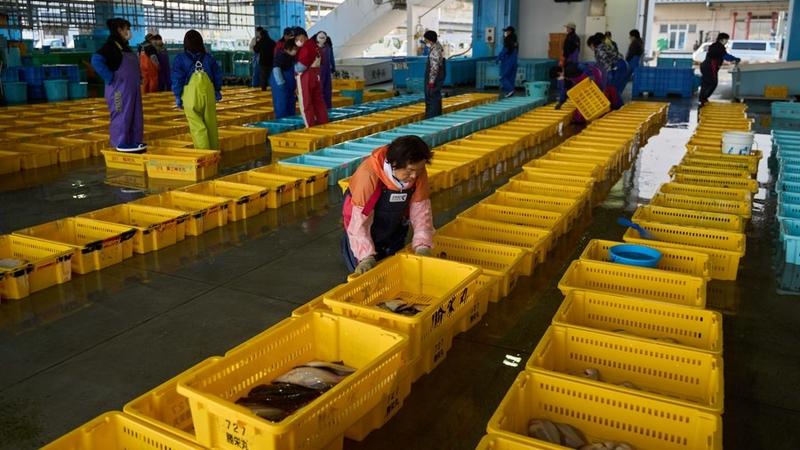
 This photo taken on March 8, 2023 shows a fish market in Soma City, Fukushima Prefecture, Japan. (PHOTO / XINHUA)
Malaysian environmentalist and business groups have opposed Japan’s release of nuclear-contaminated water into the Pacific Ocean, warning that such a move will harm the marine environment and human health over the long term.
The Japanese government has “claimed that the water is safe, but how safe it is? That is the question”, Winston Liaw, chairman of Sabah Travel and Tourism Agencies Association (SATTA), told China Daily.
The discharged water had been used to cool the reactors at the Fukushima nuclear plant, which was decommissioned after a strong earthquake and tsunami devastated northeastern Japan in March 2011
Alluding to Japan’s plan to discharge contaminated water from the crippled Fukushima Daiichi nuclear power plant amounting to over one million tons in the next 30 years, he noted that this is a “long-term project” which will affect not only Japan but its neighbors as well.
READ MORE: Fukushima plan a nuclear threat to Asia-Pacific
The Tokyo Electric Power Company (TEPCO), the plant’s operator, had said that it would release the second batch of radioactive water into the ocean on Oct 5.
Sophine Tann, vice-president of the Association for the Protection of Natural Heritage of Malaysia, said that over time, entire oceans and seas of the world would be affected as ocean currents can spread the wastewater’s contaminants and toxins.
“I am against (the dumping) unless the Japanese government and authorities can give us a more concrete answer than what they have provided. For example, let the Japanese people use and drink the treated water for a year and then see what the effects could be,” Tann told China Daily.
On June 12, TEPCO started testing the equipment to discharge the nuclear-contaminated water from the plant into the Pacific. Japanese Prime Minister Fumio Kishida announced on Aug 22 that TEPCO would start discharging wastewater on Aug 24. Between that day and Sept 11, TEPCO released about 7,800 tons of water stored in tanks into the ocean.
The discharged water had been used to cool the reactors at the Fukushima nuclear plant, which was decommissioned after a strong earthquake and tsunami devastated northeastern Japan in March 2011.
The government’s decision sparked widespread protests not only in Japan but also in other Asia-Pacific countries. Environmentalists, fisherfolks, consumer rights advocates and business leaders warned against the long-term environmental and public health impact of the release of nuclear-contaminated water.
Following the release of the wastewater, Malaysia’s health ministry announced that it would closely inspect all high-risk food products imported from Japan.
Protest actions and a signature campaign “Raise Your Voice, Stop the Discharge of Nuclear Wastewater into the Ocean” were also held in the western Malaysian state of Selangor
Malaysia’s Director-General of Health Muhammad Radzi Abu Hassan said on Aug 23 that the ministry “is sensitive to consumers’ concerns on the matter”. “It always conducts monitoring at the entrance to the country and local markets to ensure food safety is guaranteed,” he added.
Protest actions and a signature campaign “Raise Your Voice, Stop the Discharge of Nuclear Wastewater into the Ocean” were also held in the western Malaysian state of Selangor.
One participant, David Kong Hon Kong, founder and CEO of funeral services provider Nirvana Asia Group, said that “everyone should unequivocally protest the release of nuclear-contaminated water into the ocean to prevent the world from another crisis”, Malaysian daily The Star reported.
Kong also urged more Malaysian companies and individuals to speak out, noting that businesses need to fulfill their social responsibility. He said his company would organize more petition signing events in Shah Alam and the capital city of Kuala Lumpur.
READ MORE: 'Pacific island heads urge Japan not to dump nuclear waste into ocean'
Liaw, the SATTA chairman, said he visited the Japanese consulate in Sabah, an eastern Malaysian state, in July to express the group’s concerns over the release of TEPCO’s wastewater. While the consulate had said that the treated water was safe, Liaw said Japan needed to conduct more testing and provide more data that could attest to the water’s safety.
“The most important thing is the testing of the seafood,” he said, adding that Japan, Malaysia and other countries need to check if the seafood that were sourced after the release of the wastewater is safe for consumption.
If the data shows that the seafood is safe to eat, then the discharged wastewater is indeed safe, he said. “We must act (based) on scientific data.”
Contact the writer at prime@chinadailyapac.com
