

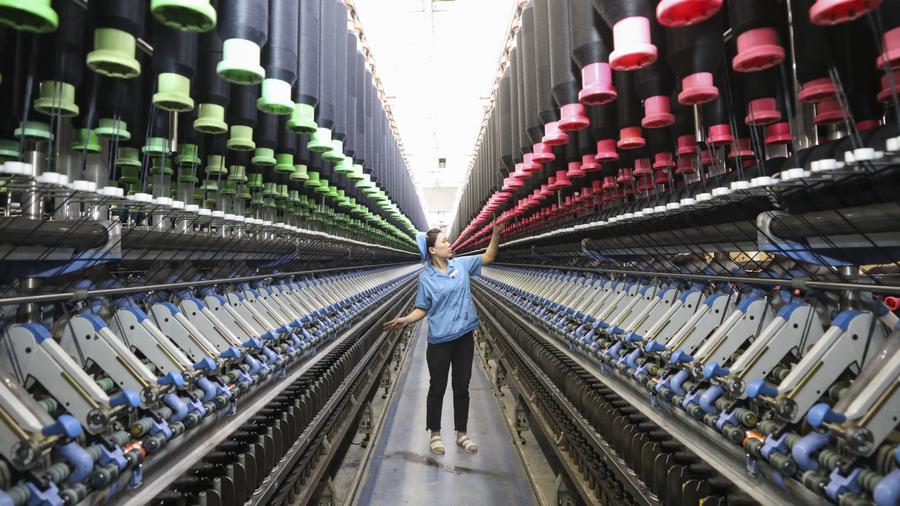
 A textile company employee works at a factory in Huai'an, Jiangsu province, on Jan 30, 2023. (ZHAO QIRUI / FOR CHINA DAILY)
BEIJING - China's value-added industrial output, an important economic indicator, went up 2.4 percent year-on-year in the first two months of 2023, data from the National Bureau of Statistics showed Wednesday.
The growth rose by 1.1 percentage points from the level in December 2022, and the two-year average growth stood at 4.9 percent, NBS data showed.
"In the first two months, Chinese economy steadily recovered with rising production demand, stable employment and consumer prices and improved market expectations," NBS spokesperson Fu Linghui told a press conference.
By ownership, state-controlled enterprises saw an increase of 2.7 percent in output from January to February, while the private sector's output grew by 2 percent, according to the National Bureau of Statistics
A breakdown of the figure by industries showed the mining industry's output increased by 4.7 percent year-on-year during the period, while that of the manufacturing sector rose by 2.1 percent.
By ownership, state-controlled enterprises saw an increase of 2.7 percent in output from January to February, while the private sector's output grew by 2 percent, according to the NBS.
In terms of products, the production of solar cells and new-energy automobiles rose by 40.8 percent and 16.3 percent year-on-year, respectively.
The industrial output is used to measure the activity of large enterprises each with an annual main business turnover of at least 20 million yuan ($2.91 million).
Steady growth in fixed-asset investment
Wednesday's data also showed China's fixed-asset investment went up 5.5 percent year-on-year to 5.3577 trillion yuan in January and February combined, 0.4 percentage points higher than the full-year growth rate of 2022.
In breakdown, investment in infrastructure construction reported a robust 9-percent increase in the period, and manufacturing investment also maintained growth momentum, up 8.1 percent. However, capital inflows in property development slipped 5.7 percent.
ALSO READ: China's private sector economy prioritized at two sessions
In breakdown, investment in infrastructure construction reported a robust 9-percent increase in the period, and manufacturing investment also maintained growth momentum, up 8.1 percent. However, capital inflows in property development slipped 5.7 percent
NBS spokesperson Fu said investment will continue to drive China's economic growth and the country will step up investment to address the problem of unbalanced and inadequate development.
According to the data, high-tech industries came as a bright spot, with investment up 15.1 percent. Specifically, investment in high-tech manufacturing and services expanded by 16.2 percent and 12.3 percent, respectively.
More capital support was also given to improving people's livelihoods as investment in public health and education went up 18.8 percent and 4.8 percent, respectively.
Speaking at the press conference, Fu pointed out that the real estate market has seen some positive changes despite the continued drop in property investment. The investment decline narrowed from last year's 10 percent to 5.7 percent in January and February, and home sales also logged smaller declines in both floor area and value.
The property market is still under adjustment and will gradually stabilize with the improvement of the overall economy and market expectations, Fu said.
 People shop at a shopping mall in Changchun, northeast China's Jilin province, Jan 23, 2023. (PHOTO / XINHUA)
Retail sales bounce back
On China's consumption market, the retail sales of consumer goods rebounded in the first two months as COVID-triggered restrictions on consumption gradually waned and market demand and vitality improved.
The country's retail sales of consumer goods rose 3.5 percent year-on-year to 7.7 trillion yuan, reversing declines seen in the previous three months, according to NBS data.
The rebound of consumption is a major bright spot of China's economic operations in the first two months of this year," NBS' Fu said.
The consumption of travel, culture absorption, and entertainment regained momentum between January and February due to the combined effects of the boost of China's Spring Festival holiday and the removal of the pandemic's impact on consumption, said spokesperson for the National Bureau of Statistics Fu Linghui
Fu attributed the recovery in retail sales partly to the revival of contact-based and service-related consumption.
The consumption of travel, culture absorption, and entertainment regained momentum between January and February due to the combined effects of the boost of China's Spring Festival holiday and the removal of the pandemic's impact on consumption, Fu said.
Domestic trips during the Spring Festival holiday rose 23.1 percent year-on-year, official data showed.
China's catering sector saw its revenue increase by 9.2 percent from a year ago in the first two months, much better than the drop registered in December last year.
Commodity sales improved in the first two months. For instance, retail sales of grain, oil, and food went up by 9 percent, while that of gold, silver, and jewelry saw an increase of 5.9 percent, NBS data showed.
ALSO READ: China's consumption recovers at accelerated pace
Also, retail sales at brick-and-mortar stores improved significantly, and online retail sales maintained steady growth, Fu said.
In the first two months, retail sales at department stores climbed by 5.5 percent, while online sales of physical goods increased by 5.3 percent over the previous year, indicating a strengthening consumption recovery.
"Overall, consumption's contribution to economic growth will significantly improve in 2023 compared with last year," Fu said.
China will expand domestic demand in 2023, prioritizing the recovery and expansion of consumption, according to this year's government work report.
Supportive measures have been rolled out nationwide. These measures include launching consumption promotion festivals and issuing vouchers for automobile purchases.
 Passengers wait to board a train at Luoyang Longmen Railway Station in Luoyang, Central China's Henan province, Feb 15, 2023. (PHOTO / XINHUA)
Fast recovery in service sector
The bureau's data also revealed that China's service sector witnessed an accelerated recovery momentum in the first two months of 2023.
The index gauging the country's service industry output rose 5.5 percent year-on-year in the Jan-Feb period, rebounding from the 0.8-percent decrease in December 2022, according to data released by the bureau.
The sub-index tracking the output of the information transmission, software, and IT services climbed 9.3 percent year-on-year, while that for accommodation and catering expanded 11.6 percent.
ALSO READ: Service consumption recovery in China gathers speed
NBS data showed that the country's railway and air transportation, postal services, accommodation, and leasing industry have rebounded to a rather active level.
The recovery of the service sector will contribute to stabilizing and expanding employment, according to the NBS.
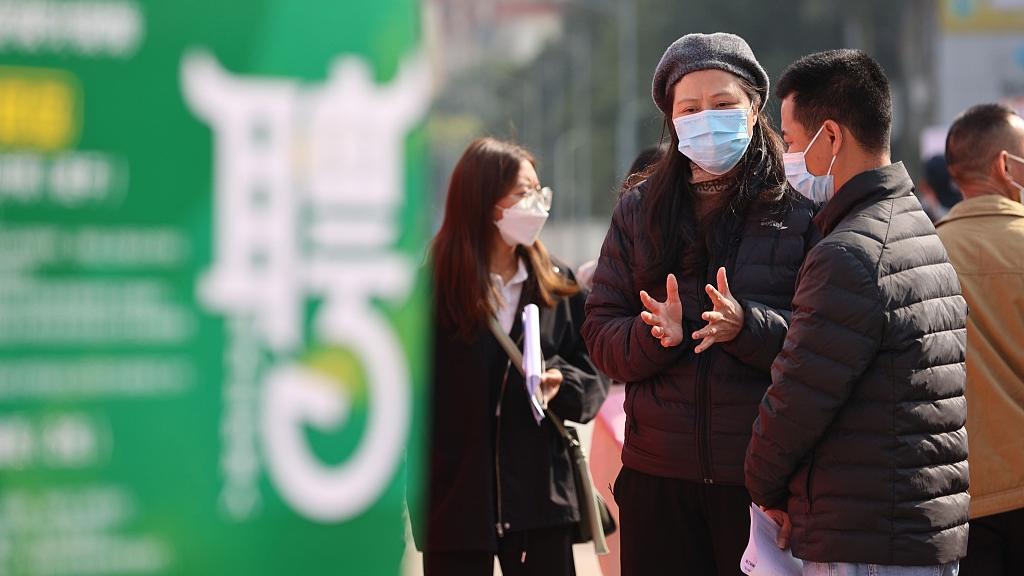 A job seeker learns about employment information at a large spring job fair in Xiamen, Fujian province on Feb 26, 2023. (PHOTO / VCG)
Urban unemployment stable
Regarding the job market, the bureau's data indicated that China's employment level remained stable, with the average surveyed urban unemployment rate standing at 5.6 percent in the first two months.
In February alone, the surveyed urban unemployment rate was also 5.6 percent, up 0.1 percentage points from the previous month, according to the NBS.
The surveyed unemployment rate among those aged between 25 and 59, which constitute the majority of the labor market, came in at 4.8 percent in February
Attributing the marginal increase of the February figure to seasonal factors, NBS' Fu said China's employment environment has favorable conditions and solid foundations conducive to maintaining stability.
He cited factors, including the overall economic upturn and the accelerated recovery of contact-based services, which will expand the employment market.
China will also upgrade policy support, as the country proposed to create around 12 million new urban jobs in 2023 in its government work report, larger than the target number set for last year, according to Fu.
ALSO READ: China's industrial economy expands, boosting macroeconomy
The surveyed unemployment rate among those aged between 25 and 59, which constitute the majority of the labor market, came in at 4.8 percent in February.
The surveyed unemployment rate in 31 major cities was 5.7 percent last month, NBS data revealed.
The surveyed urban unemployment rate is calculated based on the number of unemployed people who have participated in the employment survey in urban areas, including migrant workers in cities.
Expansion in energy output
In terms of energy resources, NBS data showed China's output of natural gas and raw coal posted a stable expansion in the first two months.
The country produced 39.8 billion cubic meters of natural gas in the period, up 6.7 percent from a year earlier, according to the bureau.
The growth rate was 0.2 percentage points higher than that of December 2022, the bureau said.
China's crude oil output rose 1.8 percent year-on-year to 34.17 million tonnes during the same period, the data showed.
READ MORE: China tops investment in energy transition
For raw coal, the country produced 730 million tonnes in the period, up 5.8 percent year-on-year, according to the NBS.
The pace of growth was 3.4 percentage points faster than that of December last year, the bureau said.
China's coal imports stood at 60.64 million tonnes during the same period. In 2022, the country imported 290 million tonnes of coal.
