

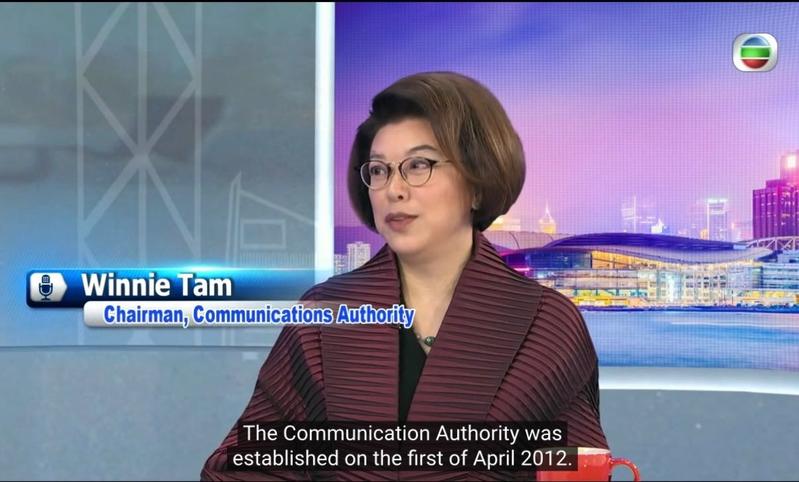
 Chairman of Hong Kong's Communications Authority Winnie Tam attends the Straight Talk show on TVB on Dec 27, 2022. (PROVIDED TO CHINA DAILY)
Chairman of the Communications Authority Winnie Tam is on the show this week.
Winnie Tam talks about how media regulation can ensure quality content for the public. She says she's seen no deterioration of media freedom since 1997. Tam also talks about the need to register user of paid SIM cards and the progress of Hong Kong's 5G development.
Check out the full transcript of TVB’s Straight Talk host Dr Eugene Chan’s interview with Winnie Tam:
Chan: Good evening! You're watching Straight Talk with Eugene Chan. Our guest this evening is the Chairman of the Communications Authority, Winnie Tam. Tam is a senior counsel and an international arbitrator. She is a former chairman of the Hong Kong Bar Association and specializes in intellectual property law. In public service, Tam is the chairman of Hong Kong Palace Museum as well as a member of the West Kowloon Cultural District board. This evening, we're going to talk about how media regulation in Hong Kong ensures quality content for the public. Welcome, Winnie!
Tam: Thank you for having me, Eugene.
Chan: Yes, Winnie. We know that the Communication Authority has just celebrated its 10th anniversary and congratulations! And do tell us, the viewers, what are some of the milestones in the last 10 years in the two areas of governance – broadcasting and telecommunication.
Tam: The communications authority was established on the first of April, 2012. That was at a time when regulatory matters were conducted by the Telecommunications Authority separately from the Broadcasting Authority. With the advancement of technology, optic fiber networks were employed for both telecommunication purposes and broadcasting purposes. So, it was seen as more conducive to efficient regulation, to amalgamate the two authorities into the Communications Authority. And this was also seen to have an effect in promoting a landscape for the industry, which is more conducive to development and to a fair trading. So, the Communications Authority has been regulating both broadcasting and telecommunication. And at the same time, we also have the responsibility to enforce fair trade matters under the Competitions Ordinance and the Trade Descriptions Ordinance.
Chan: Right, chairman. I read on your website that the authority’s vision is that Hong Kong has the world class communications services needed to meet the challenges of the information age. So, as chair, do you think the Communication Authority is achieving this?
Tam: Yes, by amalgamating two functions into one, we have been able to make more rational use of our resources. For example, since the advent of full digital broadcasting services, we have been able to redeploy some of the radio frequency backup spectrum in order to leave more resources for the development of 5G. So, previously when broadcasting was not fully digital, the employment of the spectrum would start over the 500 megahertz to 700 megahertz. But since we have been able to consolidate all the broadcasting spectrum to be done within the 500 megahertz, leaving 600 and 700 megahertz spectrum for the use of 5G services makes much more room for the development of the 5G communications industry.
Chan: Right. We'll come back to 5G in the later part of the show, but for most viewers when we talk about Communication Authority, we think of the broadcasting which is really the media. And we know for the media sector to flourish, it needs environment to foster creativity. So, they can think outside the box, they have a lot of flexibility. But one of the roles of the Communications Authority is the regulation of the Hong Kong media. Some have said this: too many regulations that you have, like the free TV licenses, can hamper the development. Do you agree with that statement?
Tam: I do not agree entirely. But I understand the demand for more freedom in order to compete fairly with other means of communication, which are not currently under the regulatory regime. This is a policy consideration of the government and not within the purview of the Communications Authority to change or to do something more about it. So, insofar as pay TV licenses and broadcasting licenses are concerned, we have to balance the interest of the viewers, public interest and the interest of the operators, i.e. the broadcasters. So, in enforcing the regulations, we have a balancing exercise to conduct. For example, the Communications Authority has been promoting freeing up of advertising regulations for product placements in TV programs. And we have also enabled, for example, sales of property programs or advertisements to be placed in sports programs. And this kind of relaxation of the regulations is all with a view to promoting wider possibilities for advertising.
Chan: Yes, Chairman, I can hear what you're saying. But how are our rules or regulations compared to the rest of the world? Or even in the in the Asia Pacific region? Are we very stringent? Or are we very lenient?
Tam: In fact, we are not stringent at all, because, in fact, in most countries around the world, the OTT services – over the top services – are not under regulation. And, well, Hong Kong is no different from these countries. So, the free TV, the free TV licensees, and the broadcasters are still competing alongside OTT services. But we do not see a situation where nobody wants to take free TV licenses, or broadcasting industry becomes unattractive for industry players. So, there is still a significant value in the license. As one can see, the free TV is very much still the preferred means of entertainment by many.
Chan: Yes, Chairman, I think you've rightly pointed out that there are still people who want it to be free. I think there are three free TV licenses at the moment. But I got the opportunity to read some of the regulations such as they require to provide certain number of positive programs such as news, current affairs, documentaries and one even for advertising time within an hour, the maximum 10 minutes. I mean, there are just more examples of it. Do you think all these are within the expectations of the public? Or how does this ensure quality contents to the public? The show's supporters have asked.
Tam: Well, you're spot on, because in order to ensure quality content to the public, we have to limit advertising time. But at the same time, there are important public messages. We need to use free TV operators as a channel to reach the public. So, understandably, free TV licenses are a very significant form of public resource. So, the quid pro quo for putting this resource in the hands of licensees is for them to also fulfill some public duty. This is an intricate balancing exercise that we have to conduct all the time. And at all times, we have viewers’ interests in mind, and we believe that by constant review, and appropriate adjustments from time to time, with an awareness of the market competition environment, we're able to achieve a balanced, a well-balanced overall regime.
Chan: Right, Chairman, I often get messages from the viewers and they kind of tell us that in all media services right now, I mean, television and the radio and all that, they’re facing very keen competition. And they actually their business development is quite in jeopardy because a lot of the… from the pandemic, also from the riots that we had, and the downturn economy, that’s a reason why I think they're looking for relaxation. So would the board consider further relaxation, such as the sort of relaxed, I mean, sort of fewer time for the advertisement, or even open up the investments programs such as politics or even medical services or drugs. I mean, would that be along your agenda?
Tam: We are constantly conducting reviews and we are constantly open to suggestions of relaxation or to change, gradual change in regulatory regime in order to satisfy the demands and the needs of both the operators and the viewers; from the viewers, we hear their voices, and also from the operators, we understand the difficulties in the operation environment. For me, I particularly have been conscious of this fact and have been pushing for more timely review, and more progressive relaxation from time to time. Please be assured that we’re constantly on top of it. And we are prepared to walk step by step ahead of the market.
Chan: Right, Chairman, let's go to a break now. Viewers, do stay with us and we will be right back.
Chan: Welcome back! The chairman of the Communications Authority. Winnie Tam is with us this evening. And we have been talking about how regulation of the media ensures quality content for the public. So, chairman in the first half you talked about, you're fully, the board is fully aware, the difficulty the operators are having, and also the interest from the viewers, and also from a public interest standpoint. And I'm very glad to… I'm sure… I mean, the viewers and I are very happy to hear that you are constantly looking for sort of changes with time. One area that we have touched on in the first half is the OTT services. And you said that, all in the neighboring region, they're not under sort of control as well. So would it be sort of going against the goodwill, intention of the Communication Authority to ensure quality content, and fair and impartial content to the public, while the OTT services are not under such regulations and also would it not make the operators now, so having what we call the level playing field.
Tam: This is a policy consideration, which is very important, which also generates a lot of debates. So, I mean, this is a study which will have to be conducted at the instigation of the government, because there are also all sorts of freedoms to be balanced against. And whether there is a means of regulation, which is proportionate to be applied to OTT services. This is a difficulty which is or a challenge which is faced by many governments around the world. And perhaps we could, in due course, look at how other governments have done it insofar as any is done. But this problem or this challenge is not unique to Hong Kong, itself. But it is, as I mentioned, beyond the purview of the Communications Authority, which is a statutory body with limited jurisdiction.
 Chairman of the Communications Authority Winnie Tam speaks to Straight Talk's Eugene Chan on Dec 27, 2022. (PROVIDED TO CHINA DAILY)
Chan: Yes. Chairman, I mean, you being the chairman of the Communications Authority, looking after Hong Kong's overall broadcasting issues, and telecommunication which we'll come to in a minute. We often hear from in our so far from the news that a lot of people are concerned about the freedom of information or freedom of communication in Hong Kong. Personally, do you agree?
Tam: I don't agree, I do not find that there is any freedom, which is overly restrictive at all, and I do not see there is much change since 1997, for example, in terms of the restriction of communication or the flow of information.
Chan: Right, Chairman, let's move on to another area under your work is to telecommunication we should mention about 5G. I remembered we were using 3G 4G, now 5G. What are the current status of Hong Kong's 5G development?
Tam: It is going really well. The use rate amongst the population of Hong Kong is (59 percent). As far as we are aware right now. So, in terms of coverage of 5G, through base stations built all over Hong Kong is 98 percent of all the core areas and we are working very hard to take care of even the remote areas to ensure optic fiber networks are laid without facilitation, and we are ensuring that there are more applications to made on 5G or innovations devised for the use of 5G technology. And to that end, we have provided a funding through the government to encourage innovative technologies to be devised. And it has been a very successful regime with over 100, nearly 200 successful applications
Chan: It is very happy to hear that we have 90 percent coverage and (59 percent) of people using 5G. So, what else is the authority sort of helping to facilitate the actual development apart from funding as well and what else will you be doing to make sure more people will be using 5G. Anything in plan?
Tam: Well, on a consistent basis, we always try to provide a supply of 5G spectrum for the use of the industry and it is either by allocation or by an auction process. So, we have a constant supply of spectrum to add to the portfolio of various operators. And secondly, as I said, we have been facilitating the rollout of 5G services. And to do that, the government has worked with us to make available a lot of spots in Hong Kong say, for example, in government buildings, or structures for the installation of 5G base stations. And that has helped to achieve a very, very high coverage and very efficient use of the network. And further we have been extending broadband services to remote places like the outlying islands, and constantly looking after really remote areas, in order to ensure that the coverage actually achieves a complete coverage in due course,
Chan: Right, Winnie, to viewers and to myself. 5G means faster download times, and better coverage for both Internet and mobile phones. But I'm sure the benefits are not just for individuals. I mean, how does 5G benefit our industry from your perspective? And how does it enhance Hong Kong’s position as a communication hub in the region, that's something that we want to strive to achieve.
Tam: 5G is a network by itself and therefore, it really depends on innovation and application in order for it to be put to good use. So, as I mentioned, we have been encouraging early application and wider application of the 5G technology. And to that end, we have launched the subsidy scheme, a subsidy scheme for 5G applications. And to date, we have seen very encouraging use, new uses being put to have the 5G network. I could mention for example, use of intelligent management of a construction site. There are applications for that using 5G technology and live consultation for surgeons remotely in medical procedures. And also very effective live streaming of cultural programs for example, by the Hong Kong Chinese Orchestra. So, they have set up a system whereby they can livestream their performances using 5G technology. So the application has been in all spectrum of Hong Kong life. And I'm very happy to report that these innovations, these innovative projects happen been subsidized by the subsidy scheme. And it seems that it also has brought to life to the innovative sector in coming up with more new applications for 5G usage.
Chan: Right, Chairman, thank you for your update. And I'm happy to know that the application of 5G is not only for individuals but also for the industry. Another area that I've looked up when I'm preparing for your interview is that you are going to do your telephone SIM card registration. And you know all of us have mobile telephones and a lot of them are registered. Some of us do use unregistered numbers as you buy from convenience stores. So, why do they have to be registered? And what is your plan at the moment?
Tam: Well, we have heard of many uses of unregistered SIM cards in dishonest manners. And there are a lot of scams, which have been perpetrated, surprisingly successfully. But it is all … it is very much to do with the fact that anybody can obtain a SIM card without registering any name to it. Now, as a matter of fact, in most countries around the world, this is no longer possible, you have to register a new name to a SIM card, you can't just buy 100 numbers and use them at will at different times with different people. So, this system will enable an appropriate degree of control over who is using which number to transmit data, to make calls and so on. And it is seen as necessary and conducive to the protection of the public. And there is a lot of demand from the public in protection from scams, and we can see that just advertisement or API broadcasted everywhere on TV, radio has not succeeded in stopping these scams.
Chan: Do you have any specific plans in stopping that in the future?
Tam: Well, the real name registration regulation has already been put in place. So, within less than two months' time, anybody who uses a data SIM card will have to register the real name. So, by (Feb 23) 2023, every SIM card issued will have to be registered in the individual’s name. Although for any person you are able to register up to 10 SIM cards and this system will be implemented shortly. So, the Communications Authority would like to remind citizens to register their SIM cards, otherwise they will not be able to use it.
Chan: Right. Thank you, Chairman Winnie, for highlighting these two areas of broadcasting and telecommunication, which is so relevant to our viewers on a daily basis. It is good to know that to the Communications Authority is ensuring quality content and future proof world class telecommunication services. Have a pleasant evening and good night!
