

Ushering in a winter solar term, Chinese prepare for long, cold nights with traditional fortifying food
 Chunks of ice float down the Yellow River in Hohhot, the Inner Mongolia autonomous region, on Friday. (SHANG JUN / CHINA NEWS SERVICE)
Avisit to the Houzaimen fresh market in Nanjing, East China’s Jiangsu province, reveals a dazzling array of choices for cured meat, especially during this time of the year. The locals follow the tradition of pickling vegetables during Minor Snow, and meat during Major Snow, or daxue, the 21st traditional solar term out of the entire 24, which began on Dec 7 this year.
Most of the shoppers are similarly intoxicated by the variety of cured meat and sausages on display. A vendor surnamed Chen told Jiangsu Broadcasting Corp that he sold 5,000 kilograms of cured meat last year. The peak season for this year is yet to come, as the current first batch is fresh on the market and needs to be marinated for half a month before reaching its premium tasting time.
His handmade sausages cater to the tastes of young and old alike. Three years ago, before the COVID-19 pandemic, Chen often commanded half-hour lines during the evening peak hours. Chen said he can only take individual orders at the moment, but not for large quantities. The suitable temperature for drying the meat should be around 0 C on sunny days.
The chill December wind blows in a delightful salty and smoked fragrance from lines of stalls here in this down-to-earth market. In the early years, people pickled food to lock in the freshness with salt, but today, with improved livelihoods, cured meat is still the sweetest hometown memory for many locals.
Zhang Yan, a Nanjing native, said pickling meat during daxue is a sense of ritual for her family. “People here love salty pickled goods, and the craftsmanship is passed down from generation to generation. You can easily learn it from your neighbors,” she said.
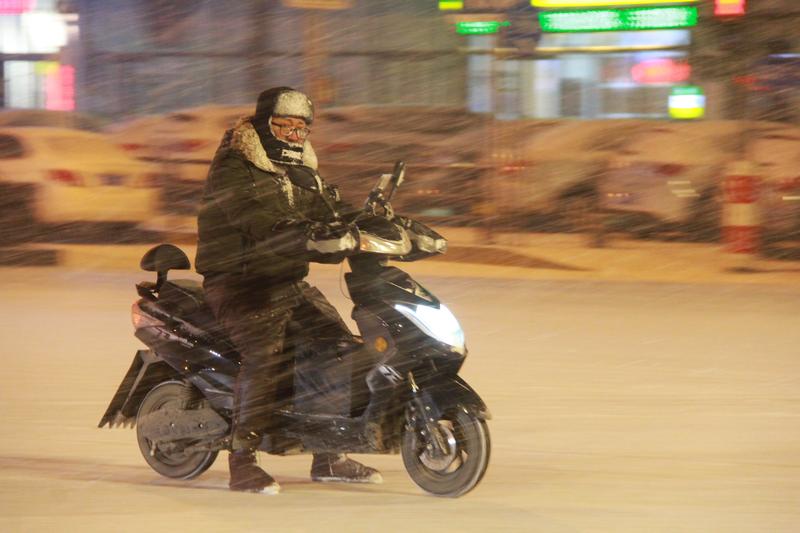 A Shenyang resident tackles the snow in Liaoning province on Friday. (WANG RUIZHONG / ZHAI HUIYONG / GENG YUHE / ZHOU CHANGGUO / FOR CHINA DAILY)
In the 1970s, when many commodities used to be rationed, people bought ration-free pig heads to marinate. Housewives rubbed the meat with salt, then added pepper, star anise and so on. After marinating, it was hung under the eaves. “After it is air-dried, we boiled it on a high heat before eating,” Zhang recalled.
“After the broth was boiled, it was then simmered on a small flame until the bones were crispy and the meat mushy, emitting its natural tangy fragrance. We cut the meat into pieces, garnished it with Chinese cabbage, and the dish was ready to serve with our local chili sauce.”
Nanjing folklore expert Xue Bing said: “These folk customs and common sense have been telling us for centuries that we depend on our inner clocks, but what and where they are and how they work has long remained a mystery, although we do know such tradition is borne by our cultural genes.”
The embedded cultural roots prompted the Beijing Folklore Museum to launch its Twenty-Four Solar Terms folk culture performance series in 2020.
On the day of daxue that year, the show ended in rapturous applause in the museum’s theater hall with the solar term song Major Snow sung, and dancers in white costumes descending from above in sling ropes, acting as if they were large “snowflakes” falling from the sky. Their themed performance ushered in another wave of traditional cultural appreciation.
The museum posted on its Sina Weibo account that the Twenty-Four Solar Terms are a unique temporal Chinese knowledge system that has been passed down from generation to generation, which has profoundly influenced people’s way of thinking and code of conduct. They are also an important carrier of the cultural identity of the Chinese nation.
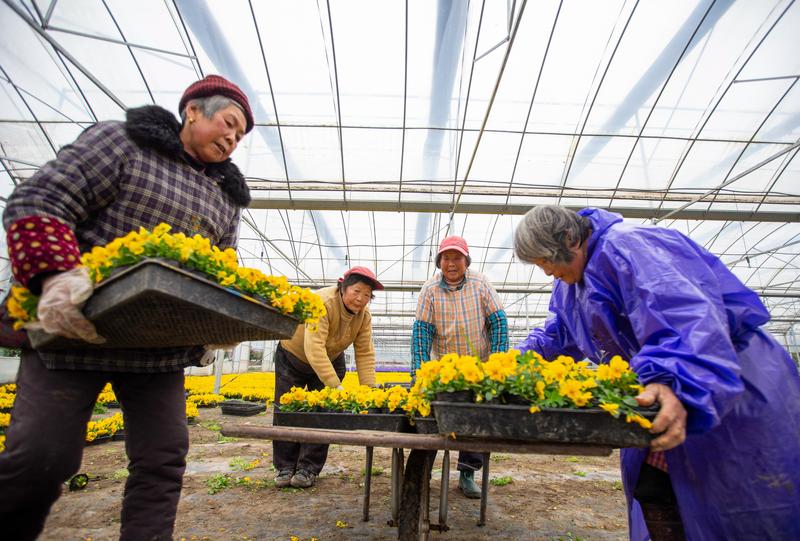 Workers move flower trays in a greenhouse in Hai'an, Jiangsu province. (WANG RUIZHONG / ZHAI HUIYONG / GENG YUHE / ZHOU CHANGGUO / FOR CHINA DAILY)
Repertoire performances on the day of each solar term have been staged in an effort to promote the deep integration of intangible cultural heritage, culture and art.
Major Snow is another solar term, like Minor Snow, that reflects the changing trend of temperature and precipitation. At this time of the year, the Yellow River Basin is gradually covered with snow, and northern China presents a charming snow-covered world with splendid scenery. The ancients believed that, at this time, yin energy is at its peak.
Folklore expert Liu Xiaochang shares an interesting anecdote of daxue during one of his public lectures on the solar terms.
“A child was very happy when he saw the characters jinri daxue (‘Major Snow today’) written on the calendar. He ran to the window, but did not see a single snowflake. He was very curious, pointed to the calendar and said to his parents, ‘It’s deceiving, there’s no snow at all!’ Of course, this is just a joke, but it shows that people actually don’t know the real meaning of many solar terms,” he said.
“Although it is called Major Snow, it is different in terms of meteorology, and it does not mean that on this day you will witness the heaviest snow in the whole year. The solar term is the product of thousands of years of farming culture and a response to changes in nature.”
Weather China has monitored the snowfall data of all the provincial capital cities from 1951 to 2019. During the daxue solar term, the average number of snowfall days in Urumqi, Xinjiang Uygur autonomous region, is 8, and the probability of snowfall exceeds 50 percent; in Northeast China’s Harbin, Heilongjiang province, and Changchun, Jilin province, it is about 30 percent; and the probability on average across all provincial capitals is 10.3 percent.
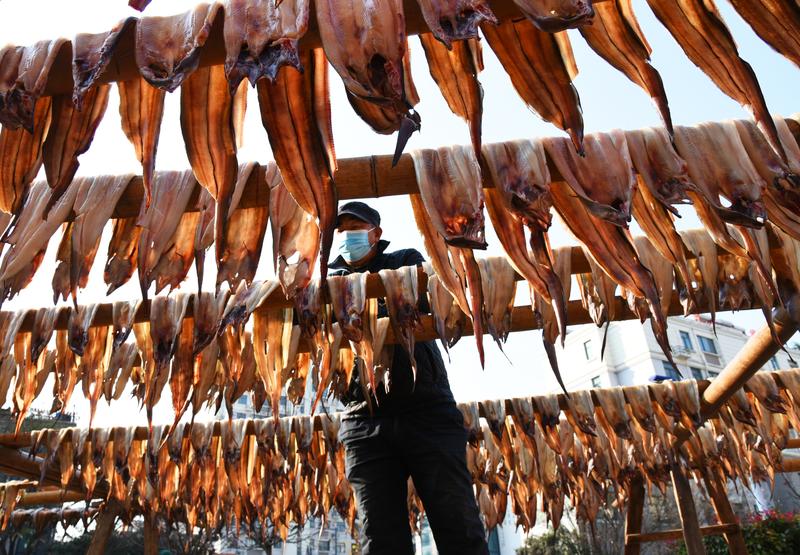 Salted fish is hung out to dry in Lianyungang, Jiangsu. (WANG RUIZHONG / ZHAI HUIYONG / GENG YUHE / ZHOU CHANGGUO / FOR CHINA DAILY)
The solar term, spanning 15 days, is divided into three subterms by the ancients. In the first subterm, even the trumpet bird no longer chirps as a result of extremely cold weather during the first five days. In the second subterm, the tigers begin to mate when the yin energy reaches its peak. In turn, it heralds the sprouting of yang energy, and in the third subterm, a specific kind of grass called Iris lactea also sprouts new shoots due to the germination of yang in the previous term.
Since it is a solar term that reflects farming culture, farmers will, naturally, not be idle on this day. Liu said the suburbs around Chengdu, Sichuan province, at this time normally turn into a busy landscape. Although the field has been plowed before Minor Snow, the farmers are still busy fertilizing and watering the newly sprouted soybeans and wheat in the field. Others are planting rapeseed, with their children lending a helping hand to weed out the grass.
“That’s why we have the farming proverb saying, ‘with proper weeding on daxue, we can have a pest-free fertile coming year’,” Liu said.
As the days are short and the nights are long during daxue, various handicraft workshops and household handcrafting began at night during the Song Dynasty (960-1279), in which the capitalist mode of production started to prevail.
Craftsmen at the handmade textile, sewing, paper binding, embroidery and dyeing workshops had to eat late at night. In order to meet this demand, various restaurants and food stalls also opened during night hours back then, the earliest record and the origin of the modern midnight restaurants.
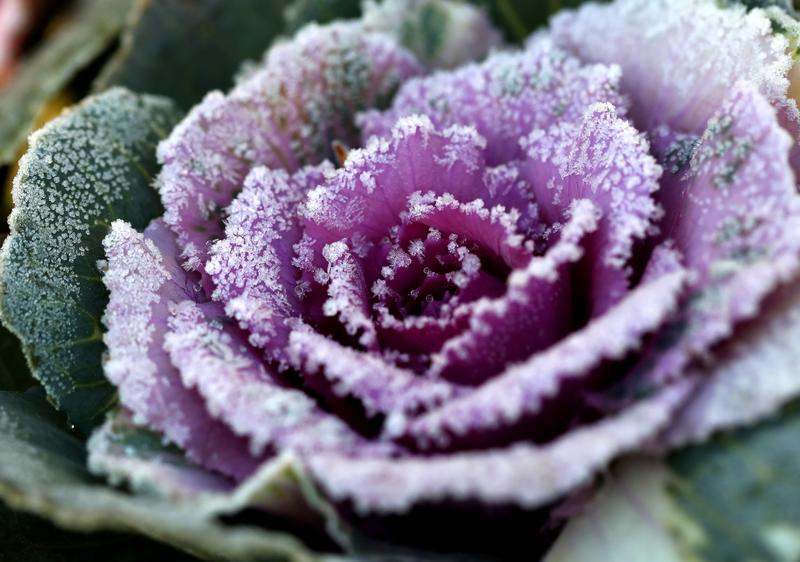 Frost decorates a flower in Huai'an, Jiangsu. (WANG RUIZHONG / ZHAI HUIYONG / GENG YUHE / ZHOU CHANGGUO / FOR CHINA DAILY)
In some rural regions in northern China, people have kept the custom of eating maltose on daxue. Vendors selling maltose will appear at school gates and parks, attracting crowds. In Shandong province, people eat sweet potato porridge on daxue to nourish the spleen and stomach.
It is also a good time for tonic food. Liu said that, in Chengdu, there is an old saying that on the day of Major Snow, people should eat black food.
According to the five elements theory, a Chinese philosophy that used to describe interactions and relationships between things, wood, fire, earth, metal and water are believed to be the fundamental elements of everything in the universe between which interactions occur.
“Winter belongs to water and its color is black,” Liu added. “Black food is the best food during Major Snow. It’s recommended to take in more black sesame, black beans, black rice and shiitake mushrooms.
“Chinese cabbage is also a good choice. In northern China, people eat radishes on Minor Snow and cabbage on Major Snow. Cabbage is a vegetable native to China with a long history of cultivation (for about seven millennia), and the ancients believed that cabbage is the best among vegetables.”
During Major Snow, tonic and keeping warm are essential. Another old saying goes: “Tonic in winter, you can fight tigers in the coming year”.
The modern Chinese continue to cherish the ancient folk customs and, as such, the long winter nights come alive.
