

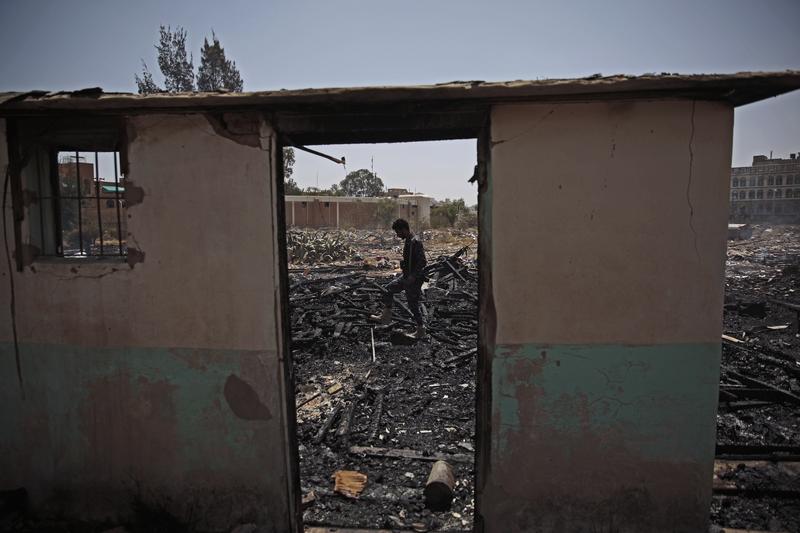
 A Yemeni soldier inspects a site of Saudi-led airstrikes targeting two houses in Sanaa, Yemen, in this March 26, 2022 file photo. (HANI MOHAMMED /AP)
HONG KONG – As Yemen’s humanitarian crisis remains critical, countries should turn existing truce into perpetual peace and refrain from supplying arms that have been fueling the years-long conflict in the Middle East nation, experts said.
Security concerns that have prolonged the fighting should be reassessed following reports of possible unauthorized use of bombs and weapons that have caused thousands of civilian harms and have displaced over 4 million people, they said.
A report by the United States’ Government Accountability Office, or GAO, on June 15 found that the US Department of Defense, or DOD, and the US Department of State, “have not fully determined the extent to which US military support has contributed to civilian harm in Yemen”.
“In my opinion, the most critical question is whether the security concerns are real or just an illusion created by those who take advantage of the war,” Dina Yulianti Sulaeman, director of the Indonesia Center for Middle East Studies, said.
READ MORE: Yemen warring parties agree to extend truce for two months, says UN
The situation “is very regrettable” because what is at stake are the lives of innocent women and children in Yemen, Sulaeman said.
Arhama Siddiqa, a Middle East expert and research fellow at the Institute of Strategic Studies Islamabad, Pakistan, noted that in light of the global geopolitical changes, the administration of US President Joe Biden “has been making certain decisions which contradict what has been their policy otherwise”.
The most critical question is whether the security concerns are real or just an illusion created by those who take advantage of the war.
Dina Yulianti Sulaeman, Director, Indonesia Center for Middle East Studies
She said the fact that the GAO has published the report “should come as no surprise”, given that the US mid-term elections are approaching.
According to the GAO findings, the DOD administered at least $54.6 billion in military support to Saudi Arabia and the UAE from 2015 through 2021.
The vast majority of this support comprised defense equipment and services, including training, purchased by the countries through the US Foreign Military Sales program, it said. The items included helicopters, missiles, and small diameter bombs.
Civil war in Yemen broke out in 2014, following the Houthi rebels’ seizure of the capital Sanaa, forcing out the internationally recognized government of President Abd-Rabbu Mansour Hadi. Saudi Arabia led a military coalition into Yemen the following year, but it has struggled to take out the rebels.
The country has since been divided into factions. Apart from the Houthis, a rebel group that resisted the rule of former Yemeni President Ali Abdullah Saleh in the 1990s, some areas are being controlled by the Southern Transitional Council, or STC, and the anti-Houthi forces opposed to the government.
“Logically, it would be more profitable for the Saudis to cooperate with the Yemenis and receive lucrative economic contracts rather than constantly seeing them as threats and carrying out attacks,” said Sulaeman, from Indonesia.
ALSO READ: Houthi top official: Group not against extending truce in Yeme
In April, Yemen established a Presidential Leadership Council. Rashad Mohammed Al-Alimi, an adviser to Hadi during his presidency and a former interior minister under the late president Ali Abdullah Saleh, is at the helm of the eight-member council after Hadi stepped down from the top office on April 7 and relinquished all his executive powers to the council.
Currently, Yemen is on an extended truce until Aug 2, following an agreement first reached on April 2.
According to Hans Grundberg, the United Nations’ special envoy for Yemen, the truce has been holding in Yemen for some two months now, and is markedly improving the humanitarian situation and significantly reducing civilian casualties.
But the official urged further consolidated efforts in order to bring about lasting peace.
Contact the writer at jan@chinadailyapac.com
