

 A child receives the Pfizer-BioNtech COVID-19 vaccine for children aged 5-11 as a performer dressed as superhero character Spider-Man looks on at a gym in San Juan City, suburban Manila on Feb 7, 2022. (TED ALJIBE / AFP)
JAKARTA / AMMAN / HANOI / SUVA / KUALA LUMPUR / TOKYO / SEOUL / WELLINGTON / NEW DELHI / ULAN BATOR / MANILA / SYDNEY - COVID-19 infections in the Philippines continue to slow, averaging less than 500 cases daily, as over 65 million people have been fully vaccinated, a health official said on Tuesday.
"The COVID-19 cases slowed down in all areas," Health Undersecretary Maria Rosario Vergeire said at a virtual press conference, adding that all regions remain "at minimal risk."
She said the country's positivity rate is at 2.7 percent and continues to decrease. Over 65.2 million people, or 72.49 percent of the targeted population, have been fully vaccinated in the country with around 110 million population.
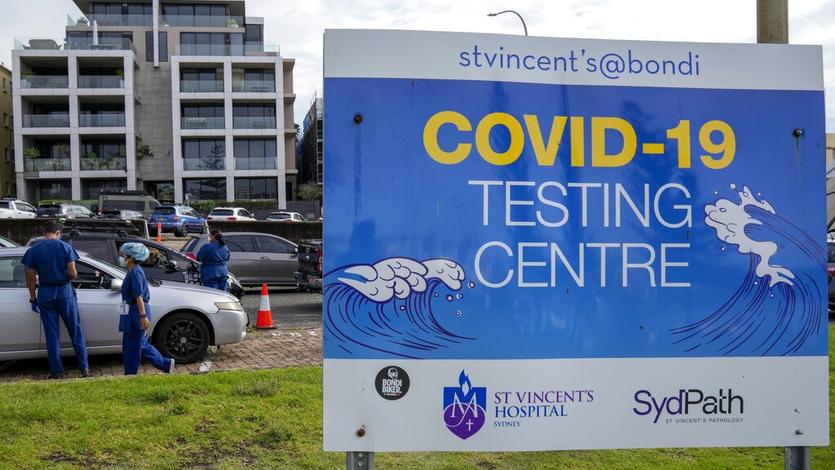 Staff check a client at a drive-through COVID-19 testing clinic at Bondi Beach in Sydney, Australia on Jan 8, 2022. (MARK BAKER / AP)
Australia
Researchers from Australia's QIMR Berghofer Medical Research Institute have discovered new evidence that blood from someone who has recovered from COVID-19 could be used to protect vulnerable people.
The research, published in the PLOS Pathogens journal and released on Tuesday, showed how T cell-based immunotherapy could be utilized in the immunocompromised.
"This study gives us hope that we can develop a T cell-based immunotherapy capable of treating multiple COVID-19 variants in the sickest patients," said lead researcher Corey Smith.
T cells are white blood cells central to human's adaptive immune response, and they are able to recognize a broad range of harmful cells to kill them, including tumor cells and other viruses.
The researchers' initial study showed that this same process could be leveraged against COVID-19.
A total of 60 volunteers in the Australian state of Queensland who had previously contracted COVID-19 donated blood to aid the investigation.
It was found that some participants' blood had the potential to generate COVID-fighting T cells.
If successful, they would be able to match T cells to patients and deliver them to patients with severe COVID-19 symptoms. The researchers compared the practice to patients with cancer receiving chemotherapy.
India
India's COVID-19 tally rose to 43,010,971 on Tuesday with 1,581 new cases registered in the past 24 hours across the country, showed the federal health ministry's latest data.
Another 33 deaths due to the pandemic were recorded since Monday morning, taking the death toll to 516,543.
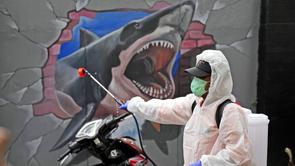 A worker walks past a mural as he sprays disinfectant amid fears of another wave of the coronavirus outbreak at a low income neighborhood in Jakarta, Indonesia, Feb 5, 2022. (DITA ALANGKARA / AP)
Indonesia
Indonesia has removed its quarantine requirement for all arrivals from overseas, its tourism minister said on Monday, responding to improvements in its containment of the coronavirus
The decision, effective immediately, follows the successful implementation of a quarantine waiver this month for visitors vaccinated against COVID-19 on the islands of Bali, Batam, and Bintan, minister Sandiaga Uno told a news conference.
"With the handling of the pandemic more controlled ...today we announce that the policy of no quarantine has been expanded across Indonesia," said Sandiaga, adding a negative COVID test would still be required.
The waiver follows similar moves by Thailand, the Philippines, Vietnam, Cambodia and lately, Malaysia, as countries seek to rebuild travel sectors that have collapsed under tight restrictions.
Sandiaga said detailed regulations could be published on Tuesday.
A visa-on-arrival policy is in effect in Bali covering 42 countries, with an exemption for visitors from Southeast Asian nations. It was not immediately clear if those rules would apply beyond Bali.
A senior minister last week said the visa-on-arrival would be expanded to include the capital Jakarta and Surabaya.
About 143,700 foreign tourists came to Indonesia in January, up 13.6 percent from a year earlier, although the number was far below pre-pandemic levels, which were typically above 1 million each month.
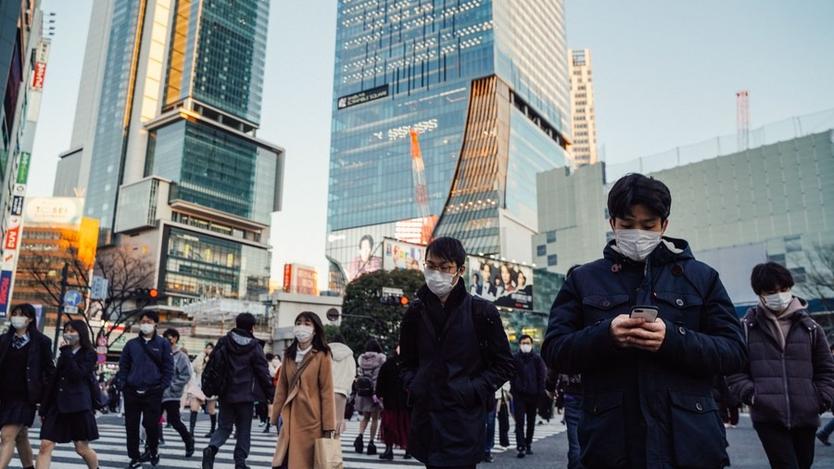 People wearing face masks walk through the Shibuya scramble crossing in Tokyo, Japan, Jan 21, 2021. (ZHANG XIAOYU / XINHUA)
Japan
Japan on Tuesday ended a COVID-19 quasi-state of emergency that was in place for 18 of the country's 47 prefectures, including Tokyo and Osaka, owing to a downtrend in the number of new daily infections.
Tuesday marks the first time since Jan 8 that no emergency COVID-19 measures have been in place in the Asian country.
But concerns are rife that as both the business and academic year draw to a close and owing to Japan's eased border controls, there could be yet another resurgence of the coronavirus due to the highly contagious Omicron subvariant BA.2 of the virus.
On Thursday, the government decided to officially lift the emergency measures in place taking into account the burden on the healthcare system.
But some regions that were under emergency virus measures had the occupancy rate of designated hospital beds for COVID-19 patients above the boom-or-bust threshold of 50 percent as recently as Friday.
Since the beginning of the year, the measures had been in place in as many as 36 of the nation's 47 prefectures, although some virologists informing the government believe the antiviral measures do not go far enough in tackling the virus.
 People buy dried fruits and nuts at a market ahead of the Muslim holy month of Ramadan, during the coronavirus pandemic in the Jordanian capital Amman, on April 23, 2020. (KHALIL MAZRAAWI / AFP)
Jordan
Jordan will ease COVID-19 restrictions during the upcoming holy Islamic month of Ramadan, Minister of State for Media Affairs Feisal Shboul said on Monday.
The new measures follow recommendations by the National Epidemiological Committee, Shboul was quoted by the state-run Petra news agency as saying.
The measures include canceling physical distancing at mosques and churches, and removing the obligatory measure to wear masks in open places, but wearing masks in gatherings in closed areas is still needed.
For restaurants and cafes, the limitation on seating capacity would also be canceled, the minister added.
The new measures permit the organization of Ramadan-related gatherings and iftar banquets during the holy month, he added.
The minister also revealed that a campaign would be launched to revive rituals and activities associated with the holy month after a two-year hiatus due to the pandemic.
Malaysia
Malaysia recorded 17,828 new COVID-19 infections as of midnight Monday, bringing the total tally to 4,010,952, according to the health ministry.
They included 407 new imported cases and 17,421 local transmissions, data released on the ministry's website showed.
A further 63 deaths have been reported from the pandemic, bringing the death toll to 34,463.
Mongolia
Mongolia's COVID-19 tally rose to 468,700 after 46 new local infections were recorded over the past 24 hours, the country's health ministry said on Tuesday.
Meanwhile, no new deaths were reported in the past day, and the country's COVID-19 death toll remains at 2,108, the ministry said.
New Zealand
New Zealand reported 20,907 new community cases of COVID-19 on Tuesday, said the Ministry of Health in a statement.
Among the new community infections, 4,291 were in the largest city Auckland. The rest of the cases were identified across the nation, including 3,488 in Canterbury, according to the ministry.
Samoa
Samoa extended the nationwide lockdown for another two weeks on Tuesday while the Ministry of Health (MOH) rolled out the vaccination for children and adults who have not been inoculated.
According to the Samoa Observer newspaper, Samoan Prime Minister Fiame Naomi Mata'afa announced the extension of the Level 3 lockdown, indicating that there will be two days in the two-week period allowing people to replenish supplies and access essential services.
Due to the notice, the prime minister said the window from 8 a.m. to 2 p.m. local time for people to access these essential services, including shops that will open for 6 hours, will start on March 23, March 26, March 29, April 2 and April 5.
The latest update from the MOH reported 66 new community cases by Monday, taking the number of active cases to 247 since the first community case was detected last Thursday.
"The surge in community cases was expected and will continue to increase due to the transmissibility of this virus," said Fiame.
South Korea
South Korea recorded 353,980 new COVID-19 cases as of midnight Monday compared to 24 hours ago, bringing the total number of infections to 9,936,540, the health authorities said Tuesday.
The daily caseload was sharply up from 209,165 in the previous day, marking the first rebound in five days, according to the Korea Disease Control and Prevention Agency (KDCA).
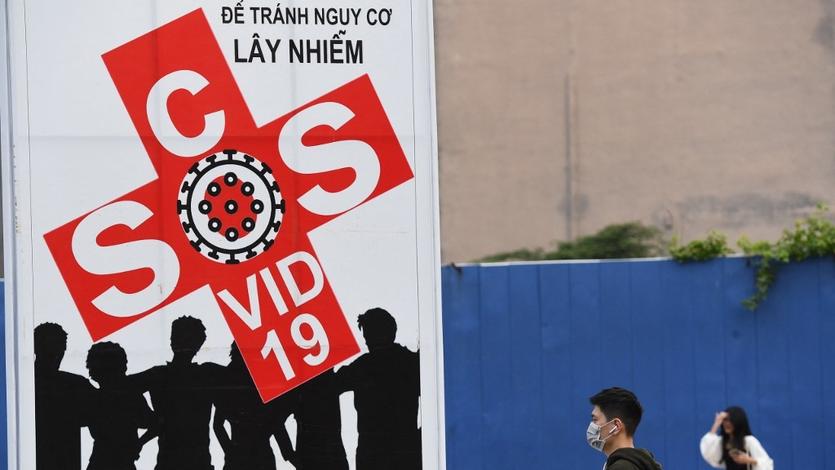 A man passes walks past a billboard on the coronavirus in Ho Chi Minh City on Dec 4, 2021. (NHAC NGUYEN / AFP)
Vietnam
Vietnam reported 131,713 new COVID-19 cases on Monday, down 9,438 cases from Sunday, according to its Ministry of Health. The new infections, logged in 63 localities nationwide, included 131,709 domestically transmitted and four imported.
Vietnamese capital Hanoi remained the epidemic hotspot with 17,916 cases on Monday, followed by central Nghe An province with 5,403 cases, and northern Phu Tho province with 5,348 cases.
The infections brought the total tally to 8,089,761, with 41,949 deaths.
